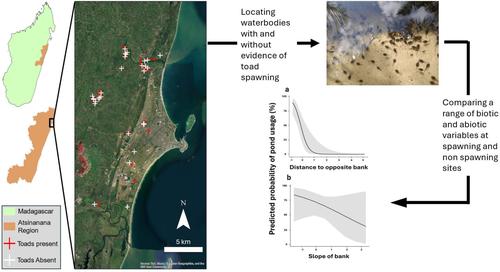
Invasive species are a major threat to biodiversity on a global scale. Control strategies for these species could be improved by understanding and exploiting life history vulnerabilities. For example, most invasive anurans require waterbodies with specific characteristics for spawning; therefore, modifying these characteristics could influence spawning success. Asian toads (Duttaphrynus melanostictus) were accidentally introduced to the east coast of Madagascar around 2010, and have since established and spread across an area exceeding 850 km2. To determine if Asian toads select spawning sites with specific characteristics within their invaded range, we surveyed habitat characteristics at 30 waterbodies used by toads for spawning, and compared these to characteristics at 30 adjacent, unused waterbodies, in urban and rural areas in eastern Madagascar.
Toads selectively oviposited in small waterbodies with gently sloping banks, while the structure of surrounding vegetation, water chemistry (salinity, water temperature), presence of other species, depth of the waterbody, and substrate of the waterbody bank did not appear to influence spawning site selection.
Our results provide a pathway to examine modification of potential Asian toad spawning sites as a management strategy for these invasive pests. © 2025 Society of Chemical Industry.




 京公网安备 11010802042870号
京ICP备2023020795号-1
京公网安备 11010802042870号
京ICP备2023020795号-1

 分享
分享
 求助内容:
求助内容: 应助结果提醒方式:
 扫码关注我们
