{"title":"Diatomite-Based Hybrid Electrolyte for Improving Reversibility of Cathode/Anode Interface Reaction in Zn-MnO2 Batteries","authors":"Xiaoyu Wu, Yida Hu, Hailong Li, Wenjie Xiao, Jiashu Fang, Juanjia Liang, Jinghua Chen, Shuquan Liang, Sainan Liu, Guozhao Fang","doi":"10.1002/smtd.202402042","DOIUrl":null,"url":null,"abstract":"<p>The cyclic stability of aqueous zinc-manganese batteries (ZMBs) is greatly restricted by the side reaction of the anode and the irreversibility of the cathode. In this work, a solid-liquid hybrid electrolyte mixing by traditional ZnSO<sub>4</sub>-based electrolyte and diatomite (denoted as Dtm) is proposed that exhibits good compatibility and reversibility in both the anode interface and the cathode interface. The abundant hydroxyl groups at the anode interface disturb the hydrogen bond network of water molecule, which weakens the corrosion of the active water to Zn anode. Moreover, the negatively charged surface of diatomite is able to regulate the electric field at the anode interface to promote the uniform deposition of Zn ion as well as inhibit the formation of Zn hydroxyl sulfate (ZHS) at the anode interface. As a result, Zn||Zn symmetric battery with Dtm achieves a stable cycling for 2500 h at 1 mA cm<sup>−2</sup>/1 mAh cm<sup>−2</sup>, while Zn||MnO<sub>2</sub> battery can achieve a stable cycle time of 500 cycles at current densities of 0.2 and 0.5 A g<sup>−1</sup> with capacities of 228 and 177.6 mAh g<sup>−1</sup>, respectively. The Dtm provides new ideas for electrolyte screening for high-performance aqueous ZMBs.</p>","PeriodicalId":229,"journal":{"name":"Small Methods","volume":"9 7","pages":""},"PeriodicalIF":9.1000,"publicationDate":"2025-01-23","publicationTypes":"Journal Article","fieldsOfStudy":null,"isOpenAccess":false,"openAccessPdf":"","citationCount":"0","resultStr":null,"platform":"Semanticscholar","paperid":null,"PeriodicalName":"Small Methods","FirstCategoryId":"88","ListUrlMain":"https://onlinelibrary.wiley.com/doi/10.1002/smtd.202402042","RegionNum":2,"RegionCategory":"材料科学","ArticlePicture":[],"TitleCN":null,"AbstractTextCN":null,"PMCID":null,"EPubDate":"","PubModel":"","JCR":"Q1","JCRName":"CHEMISTRY, PHYSICAL","Score":null,"Total":0}
引用次数: 0
Abstract
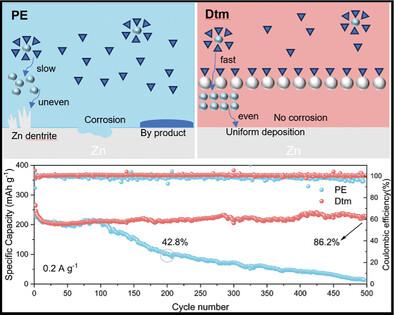
The cyclic stability of aqueous zinc-manganese batteries (ZMBs) is greatly restricted by the side reaction of the anode and the irreversibility of the cathode. In this work, a solid-liquid hybrid electrolyte mixing by traditional ZnSO4-based electrolyte and diatomite (denoted as Dtm) is proposed that exhibits good compatibility and reversibility in both the anode interface and the cathode interface. The abundant hydroxyl groups at the anode interface disturb the hydrogen bond network of water molecule, which weakens the corrosion of the active water to Zn anode. Moreover, the negatively charged surface of diatomite is able to regulate the electric field at the anode interface to promote the uniform deposition of Zn ion as well as inhibit the formation of Zn hydroxyl sulfate (ZHS) at the anode interface. As a result, Zn||Zn symmetric battery with Dtm achieves a stable cycling for 2500 h at 1 mA cm−2/1 mAh cm−2, while Zn||MnO2 battery can achieve a stable cycle time of 500 cycles at current densities of 0.2 and 0.5 A g−1 with capacities of 228 and 177.6 mAh g−1, respectively. The Dtm provides new ideas for electrolyte screening for high-performance aqueous ZMBs.
锌锰水电池的循环稳定性受到阳极副反应和阴极不可逆性的极大限制。本文提出了一种由传统的znso4基电解质与硅藻土(Dtm)混合而成的固液混合电解质,该电解质在阳极界面和阴极界面均具有良好的相容性和可逆性。阳极界面上丰富的羟基打乱了水分子的氢键网络,减弱了活性水对锌阳极的腐蚀。此外,硅藻土带负电的表面能够调节阳极界面处的电场,促进Zn离子的均匀沉积,抑制阳极界面处羟基硫酸锌(zs)的形成。结果表明,含Dtm的Zn||锌对称电池在1 mA cm-2/1 mAh cm-2下可实现2500 h的稳定循环,而Zn||MnO2电池在电流密度为0.2和0.5 a g-1、容量分别为228和177.6 mAh g-1时可实现500次的稳定循环。Dtm为高性能zmb水溶液的电解质筛选提供了新的思路。
Small MethodsMaterials Science-General Materials Science
CiteScore
17.40
自引率
1.60%
发文量
347
期刊介绍:
Small Methods is a multidisciplinary journal that publishes groundbreaking research on methods relevant to nano- and microscale research. It welcomes contributions from the fields of materials science, biomedical science, chemistry, and physics, showcasing the latest advancements in experimental techniques.
With a notable 2022 Impact Factor of 12.4 (Journal Citation Reports, Clarivate Analytics, 2023), Small Methods is recognized for its significant impact on the scientific community.
The online ISSN for Small Methods is 2366-9608.



 京公网安备 11010802042870号
京ICP备2023020795号-1
京公网安备 11010802042870号
京ICP备2023020795号-1

 分享
分享
 求助内容:
求助内容: 应助结果提醒方式:
 扫码关注我们
