{"title":"Inhibition of Renal Cell Carcinoma Growth by 1,3-thiazin-6-one Through Targeting the Inflammatory Reaction","authors":"Hongmei Zhou, Xin Li, Dongju Liu","doi":"10.1134/S1607672924601008","DOIUrl":null,"url":null,"abstract":"<p>The current study examined the underlying mechanism and the effect of 1,3-thiazin-6-one on the growth of renal cancer. The findings showed that 1,3-thiazin-6-one treatment inhibited the growth of xenograft tumors in a dose-dependent manner in mice model of renal cancer. Furthermore, when 1,3-thiazin-6-one was administered in a dose-dependent manner to mice with renal cancer, the expression of the proteins p-PI3K and p-Akt significantly decreased. In mice model of renal cancer, 1,3-thiazin-6-one treatment also inhibited p-mTOR expression. In a model of renal cancer in mice, the 1,3-thiazin-6-one therapy specifically targeted the expression of nuclear factor κB (NF κB) and signal transducer and activator of transcription 3 (STAT3). Renal cancer cells’ vitality was significantly (<i>p</i> < 0.05) reduced in a dose-dependent manner upon exposure to 1,3-thiazin-6-one. It also prevents invasiveness of the renal cancer cells in addition to suppression of colony forming potential. In summary, the 1,3-thiazin-6-one blocks the growth of kidney cancer by focusing on the pathways that trigger the inflammatory cascade. Therefore, 1,3-thiazin-6-one might be developed as a significant medicinal agent to cure renal cancer.</p>","PeriodicalId":529,"journal":{"name":"Doklady Biochemistry and Biophysics","volume":"520 1","pages":"101 - 108"},"PeriodicalIF":0.7000,"publicationDate":"2025-01-22","publicationTypes":"Journal Article","fieldsOfStudy":null,"isOpenAccess":false,"openAccessPdf":"","citationCount":"0","resultStr":null,"platform":"Semanticscholar","paperid":null,"PeriodicalName":"Doklady Biochemistry and Biophysics","FirstCategoryId":"99","ListUrlMain":"https://link.springer.com/article/10.1134/S1607672924601008","RegionNum":4,"RegionCategory":"生物学","ArticlePicture":[],"TitleCN":null,"AbstractTextCN":null,"PMCID":null,"EPubDate":"","PubModel":"","JCR":"Q4","JCRName":"BIOCHEMISTRY & MOLECULAR BIOLOGY","Score":null,"Total":0}
引用次数: 0
Abstract
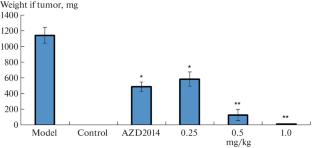
The current study examined the underlying mechanism and the effect of 1,3-thiazin-6-one on the growth of renal cancer. The findings showed that 1,3-thiazin-6-one treatment inhibited the growth of xenograft tumors in a dose-dependent manner in mice model of renal cancer. Furthermore, when 1,3-thiazin-6-one was administered in a dose-dependent manner to mice with renal cancer, the expression of the proteins p-PI3K and p-Akt significantly decreased. In mice model of renal cancer, 1,3-thiazin-6-one treatment also inhibited p-mTOR expression. In a model of renal cancer in mice, the 1,3-thiazin-6-one therapy specifically targeted the expression of nuclear factor κB (NF κB) and signal transducer and activator of transcription 3 (STAT3). Renal cancer cells’ vitality was significantly (p < 0.05) reduced in a dose-dependent manner upon exposure to 1,3-thiazin-6-one. It also prevents invasiveness of the renal cancer cells in addition to suppression of colony forming potential. In summary, the 1,3-thiazin-6-one blocks the growth of kidney cancer by focusing on the pathways that trigger the inflammatory cascade. Therefore, 1,3-thiazin-6-one might be developed as a significant medicinal agent to cure renal cancer.
期刊介绍:
Doklady Biochemistry and Biophysics is a journal consisting of English translations of articles published in Russian in biochemistry and biophysics sections of the Russian-language journal Doklady Akademii Nauk. The journal''s goal is to publish the most significant new research in biochemistry and biophysics carried out in Russia today or in collaboration with Russian authors. The journal accepts only articles in the Russian language that are submitted or recommended by acting Russian or foreign members of the Russian Academy of Sciences. The journal does not accept direct submissions in English.



 京公网安备 11010802042870号
京ICP备2023020795号-1
京公网安备 11010802042870号
京ICP备2023020795号-1

 分享
分享
 求助内容:
求助内容: 应助结果提醒方式:
 扫码关注我们
