Structural equation modeling of the impact of disease activity on inflammatory bowel disease control: the mediating roles of self-efficacy and self-management behaviors.
Yongli Zhu, Ke Liu, Jinfeng Jiang, Xin Cheng, Hao Wang, Feiyang Long, Kang Li, Changping Mu, Lijun Cui
{"title":"Structural equation modeling of the impact of disease activity on inflammatory bowel disease control: the mediating roles of self-efficacy and self-management behaviors.","authors":"Yongli Zhu, Ke Liu, Jinfeng Jiang, Xin Cheng, Hao Wang, Feiyang Long, Kang Li, Changping Mu, Lijun Cui","doi":"10.1186/s12876-025-03623-6","DOIUrl":null,"url":null,"abstract":"<p><strong>Background: </strong>Maintaining effective disease control in patients with inflammatory bowel disease (IBD) is both a significant goal and challenge. Drawing on the Common-Sense Model of Self-Regulation (CSM) and related research, this study investigates how IBD activity status influences disease control through both direct and indirect pathways.</p><p><strong>Methods: </strong>A cross-sectional survey was conducted among 310 IBD patients who attended a tertiary general hospital, the leader of the IBD Alliance Group in Chongqing City, between March and August 2024. Structural equation modeling (SEM) was utilized to assess the role and magnitude of various influencing factor pathways. Relying on AMOS26 software, the path effects and magnitude of various factors in the disease control process were analyzed using structural equation modeling (SEM) to test hypothetical models.</p><p><strong>Results: </strong>A total of 306 valid questionnaires were collected, with a mean IBD-control score of 12.14 ± 3.665. There was a negative link between disease activity and IBD-control (P < 0.01) and a positive correlation between chronic illness management self-efficacy, IBD self-management behavior, and IBD-control (P < 0.01). Path analysis showed that IBD activity negatively predicted IBD control (β = -0.715, P = 0.01). Chronic disease management self-efficacy partially mediated this relationship (β = -0.071, P = 0.012). A significant chain-mediated pathway was identified, where IBD activity affected IBD control via self-efficacy guided by self-management behavior (β = -0.025, P = 0.007). However, the pathway where IBD activity influenced control through self-efficacy and subsequently self-management behavior showed only marginal significance (P = 0.074).</p><p><strong>Conclusion: </strong>Effective self-management behaviors improve IBD control. High disease activity may reduce chronic disease management self-efficacy, impairing IBD control. Positive feedback loops involving self-management behaviors and enhanced self-efficacy are crucial for better disease control, as patients who perceive positive outcomes are more motivated to maintain these behaviors.</p>","PeriodicalId":9129,"journal":{"name":"BMC Gastroenterology","volume":"25 1","pages":"30"},"PeriodicalIF":3.2000,"publicationDate":"2025-01-22","publicationTypes":"Journal Article","fieldsOfStudy":null,"isOpenAccess":false,"openAccessPdf":"https://www.ncbi.nlm.nih.gov/pmc/articles/PMC11752657/pdf/","citationCount":"0","resultStr":null,"platform":"Semanticscholar","paperid":null,"PeriodicalName":"BMC Gastroenterology","FirstCategoryId":"3","ListUrlMain":"https://doi.org/10.1186/s12876-025-03623-6","RegionNum":3,"RegionCategory":"医学","ArticlePicture":[],"TitleCN":null,"AbstractTextCN":null,"PMCID":null,"EPubDate":"","PubModel":"","JCR":"Q2","JCRName":"GASTROENTEROLOGY & HEPATOLOGY","Score":null,"Total":0}
引用次数: 0
Abstract
Background: Maintaining effective disease control in patients with inflammatory bowel disease (IBD) is both a significant goal and challenge. Drawing on the Common-Sense Model of Self-Regulation (CSM) and related research, this study investigates how IBD activity status influences disease control through both direct and indirect pathways.
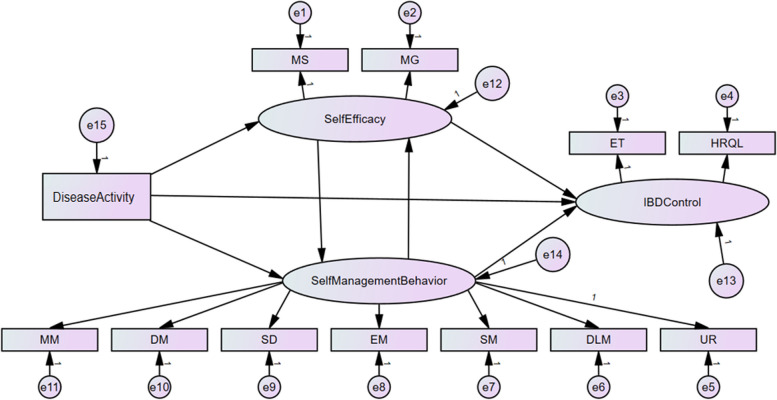
Methods: A cross-sectional survey was conducted among 310 IBD patients who attended a tertiary general hospital, the leader of the IBD Alliance Group in Chongqing City, between March and August 2024. Structural equation modeling (SEM) was utilized to assess the role and magnitude of various influencing factor pathways. Relying on AMOS26 software, the path effects and magnitude of various factors in the disease control process were analyzed using structural equation modeling (SEM) to test hypothetical models.
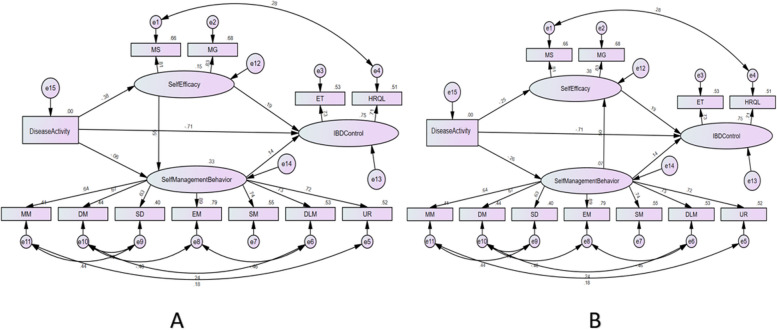
Results: A total of 306 valid questionnaires were collected, with a mean IBD-control score of 12.14 ± 3.665. There was a negative link between disease activity and IBD-control (P < 0.01) and a positive correlation between chronic illness management self-efficacy, IBD self-management behavior, and IBD-control (P < 0.01). Path analysis showed that IBD activity negatively predicted IBD control (β = -0.715, P = 0.01). Chronic disease management self-efficacy partially mediated this relationship (β = -0.071, P = 0.012). A significant chain-mediated pathway was identified, where IBD activity affected IBD control via self-efficacy guided by self-management behavior (β = -0.025, P = 0.007). However, the pathway where IBD activity influenced control through self-efficacy and subsequently self-management behavior showed only marginal significance (P = 0.074).
Conclusion: Effective self-management behaviors improve IBD control. High disease activity may reduce chronic disease management self-efficacy, impairing IBD control. Positive feedback loops involving self-management behaviors and enhanced self-efficacy are crucial for better disease control, as patients who perceive positive outcomes are more motivated to maintain these behaviors.
背景:维持炎症性肠病(IBD)患者的有效疾病控制是一个重要的目标和挑战。本研究利用自我调节常识模型(Common-Sense Model of Self-Regulation, CSM)及相关研究,探讨IBD活性状态如何通过直接和间接途径影响疾病控制。方法:对2024年3月至8月在重庆市IBD联盟集团龙头三级综合医院就诊的310例IBD患者进行横断面调查。利用结构方程模型(SEM)评估了各种影响因素通路的作用和大小。依托AMOS26软件,利用结构方程模型(SEM)分析疾病控制过程中各因素的路径效应和幅度,检验假设模型。结果:共回收有效问卷306份,平均ibd控制评分为12.14±3.665分。结论:有效的自我管理行为有助于IBD的控制。高疾病活动度可能降低慢性疾病管理的自我效能,损害IBD的控制。涉及自我管理行为和增强自我效能的积极反馈循环对于更好地控制疾病至关重要,因为感知到积极结果的患者更有动力保持这些行为。
期刊介绍:
BMC Gastroenterology is an open access, peer-reviewed journal that considers articles on all aspects of the prevention, diagnosis and management of gastrointestinal and hepatobiliary disorders, as well as related molecular genetics, pathophysiology, and epidemiology.





 京公网安备 11010802042870号
京ICP备2023020795号-1
京公网安备 11010802042870号
京ICP备2023020795号-1

 分享
分享
 求助内容:
求助内容: 应助结果提醒方式:
 扫码关注我们
