Majid Alfadhel, Bashayr S Alhubayshi, Muhammad Umair, Ahmed Alfaidi, Deemah Alwadaani, Essra Aloyouni, Safdar Abbas, Abdulkareem Al Abdulrahman, Mohammed Aldrees, Abeer Al Tuwaijri, Ruaa S Alharithy, Abdulaziz Alajlan, Abdulrahman Alswaid, Saad Almohrij, Sultan Al-Khenaizan
{"title":"Truncated SPAG9 as a novel candidate gene for a new syndrome: Coarse facial features, albinism, cataract and developmental delay (CACD syndrome).","authors":"Majid Alfadhel, Bashayr S Alhubayshi, Muhammad Umair, Ahmed Alfaidi, Deemah Alwadaani, Essra Aloyouni, Safdar Abbas, Abdulkareem Al Abdulrahman, Mohammed Aldrees, Abeer Al Tuwaijri, Ruaa S Alharithy, Abdulaziz Alajlan, Abdulrahman Alswaid, Saad Almohrij, Sultan Al-Khenaizan","doi":"10.1590/1678-4685-GMB-2024-0094","DOIUrl":null,"url":null,"abstract":"<p><p>Sperm-associated antigen 9 (SPAG9) is a member of cancer-testis antigen, having characteristics of a scaffold protein, which is involved in the c-Jun N-terminal kinase JNK signaling pathway, suggesting its key involvement in different physiological processes, such as survival, apoptosis, tumorigenesis, and cell proliferation. We identified two families (A and B) having multisystem features like coarse facial features, albinism, cataracts, skeletal abnormalities, and developmental delay. Whole genome sequencing (WGS) in families A and B revealed a homozygous frameshift variant (c.903del; p.Phe301Leufs*2) in the SPAG9 gene. Sanger sequencing of both families revealed perfect segregation of the identified variant in all family members. 3D protein modeling revealed substantial changes in the protein's secondary structure. Furthermore, RT-qPCR revealed a substantial reduction of SPAG9 gene expression at the mRNA level in the affected individuals of both families, thus supporting the pathogenic nature of the identified variant. For the first time in the literature, biallelic SPAG9 gene variation was linked to multisystem-exhibiting features like coarse facial features, albinism, cataracts, skeletal abnormalities, and developmental delay. Thus, this data supports the notion that SPAG9 plays an important role in a multisystemic disorder in humans.</p>","PeriodicalId":12557,"journal":{"name":"Genetics and Molecular Biology","volume":"48 1","pages":"e20240094"},"PeriodicalIF":1.3000,"publicationDate":"2025-01-20","publicationTypes":"Journal Article","fieldsOfStudy":null,"isOpenAccess":false,"openAccessPdf":"https://www.ncbi.nlm.nih.gov/pmc/articles/PMC11773325/pdf/","citationCount":"0","resultStr":null,"platform":"Semanticscholar","paperid":null,"PeriodicalName":"Genetics and Molecular Biology","FirstCategoryId":"99","ListUrlMain":"https://doi.org/10.1590/1678-4685-GMB-2024-0094","RegionNum":4,"RegionCategory":"生物学","ArticlePicture":[],"TitleCN":null,"AbstractTextCN":null,"PMCID":null,"EPubDate":"2025/1/1 0:00:00","PubModel":"eCollection","JCR":"Q4","JCRName":"BIOCHEMISTRY & MOLECULAR BIOLOGY","Score":null,"Total":0}
引用次数: 0
Abstract
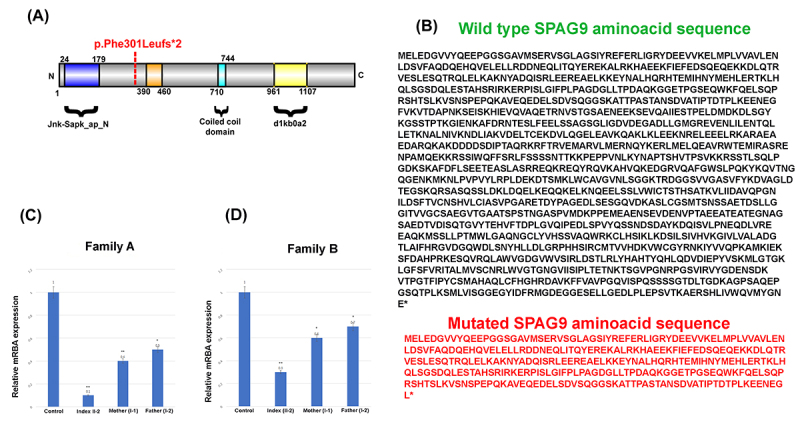
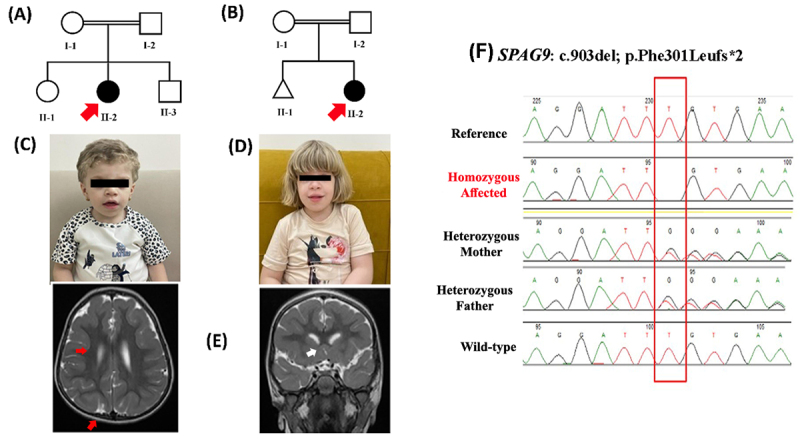
Sperm-associated antigen 9 (SPAG9) is a member of cancer-testis antigen, having characteristics of a scaffold protein, which is involved in the c-Jun N-terminal kinase JNK signaling pathway, suggesting its key involvement in different physiological processes, such as survival, apoptosis, tumorigenesis, and cell proliferation. We identified two families (A and B) having multisystem features like coarse facial features, albinism, cataracts, skeletal abnormalities, and developmental delay. Whole genome sequencing (WGS) in families A and B revealed a homozygous frameshift variant (c.903del; p.Phe301Leufs*2) in the SPAG9 gene. Sanger sequencing of both families revealed perfect segregation of the identified variant in all family members. 3D protein modeling revealed substantial changes in the protein's secondary structure. Furthermore, RT-qPCR revealed a substantial reduction of SPAG9 gene expression at the mRNA level in the affected individuals of both families, thus supporting the pathogenic nature of the identified variant. For the first time in the literature, biallelic SPAG9 gene variation was linked to multisystem-exhibiting features like coarse facial features, albinism, cataracts, skeletal abnormalities, and developmental delay. Thus, this data supports the notion that SPAG9 plays an important role in a multisystemic disorder in humans.
期刊介绍:
Genetics and Molecular Biology (formerly named Revista Brasileira de Genética/Brazilian Journal of Genetics - ISSN 0100-8455) is published by the Sociedade Brasileira de Genética (Brazilian Society of Genetics).
The Journal considers contributions that present the results of original research in genetics, evolution and related scientific disciplines. Manuscripts presenting methods and applications only, without an analysis of genetic data, will not be considered.



 京公网安备 11010802042870号
京ICP备2023020795号-1
京公网安备 11010802042870号
京ICP备2023020795号-1

 分享
分享
 求助内容:
求助内容: 应助结果提醒方式:
 扫码关注我们
