Predicting the need for step-up after EUS-guided drainage of peripancreatic fluid collections, including Quadrant-Necrosis-Infection score validation: a prospective cohort study
Giuseppe Vanella MD, PhD , Roberto Leone MD , Francesco Frigo MD , Gemma Rossi MD , Piera Zaccari MD, PhD , Diego Palumbo MD, PhD , Giorgia Guazzarotti MD , Francesca Aleotti MD , Nicolò Pecorelli MD , Paoletta Preatoni MD , Luca Aldrighetti MD, PhD , Massimo Falconi MD , Gabriele Capurso MD, PhD , Francesco De Cobelli MD , Paolo Giorgio Arcidiacono MD, FASGE
{"title":"Predicting the need for step-up after EUS-guided drainage of peripancreatic fluid collections, including Quadrant-Necrosis-Infection score validation: a prospective cohort study","authors":"Giuseppe Vanella MD, PhD , Roberto Leone MD , Francesco Frigo MD , Gemma Rossi MD , Piera Zaccari MD, PhD , Diego Palumbo MD, PhD , Giorgia Guazzarotti MD , Francesca Aleotti MD , Nicolò Pecorelli MD , Paoletta Preatoni MD , Luca Aldrighetti MD, PhD , Massimo Falconi MD , Gabriele Capurso MD, PhD , Francesco De Cobelli MD , Paolo Giorgio Arcidiacono MD, FASGE","doi":"10.1016/j.gie.2025.01.019","DOIUrl":null,"url":null,"abstract":"<div><h3>Background and Aims</h3><div>Factors predicting the need for step-up procedures after endoscopic ultrasound (EUS)–guided fluid collection drainage (EUS-FCD) of peripancreatic fluid collections (PFCs) were explored in retrospective studies restricted to walled-off necrosis (WON) and lumen-apposing metal stents (LAMSs).</div></div><div><h3>Methods</h3><div>All consecutive candidates for EUS-FCD from 2020 to 2024 were included in a Prospective Registry of Therapeutic EUS (PROTECT, <span><span>NCT04813055</span><svg><path></path></svg></span><span>), with prospective monthly follow-up evaluating clinical success, adverse events, and recurrences. Prospectively assessed baseline clinical and morphologic factors, including the Quadrant-Necrosis-Infection (QNI) classification, were included in a stepwise logistic regression<span> model to predict the need for step-up. The agreement between EUS and radiology in assessing the extent of necrosis was compared with the use of Cohen’s kappa.</span></span></div></div><div><h3>Results</h3><div><span>Seventy patients (29 postsurgical collections, 21 pseudocysts, and 20 WONs) were treated with double-pigtail plastic stents (DPPSs) in 59% of cases and LAMSs in 41%. Clinical success was 92.9%, with a need for step-up (mostly endoscopic necrosectomy) in 35.7% of cases. Necrosis ≥60% (odds ratio [OR], 7.7; 95% confidence interval [CI], 1.4-43) and being in the high-risk QNI group (OR, 4.6; 95% CI, 1.4-15) were the only independent predictors of any step-up. The same factors predicted the endoscopist’s decision to allocate PFCs to LAMSs vs DPPSs. The high-risk QNI group was associated with a significantly longer hospital stay (12 days vs 4 days; </span><em>P</em> = .004). EUS tended to upscale the necrotic content compared with preprocedural radiology (κ = 0.31).</div></div><div><h3>Conclusions</h3><div>The extent of necrosis and the QNI classification strongly correlated with the need for step-up and allocation to LAMS versus DPPS drainage, suggesting a central role in treatment personalization.</div></div>","PeriodicalId":12542,"journal":{"name":"Gastrointestinal endoscopy","volume":"102 3","pages":"Pages 362-372.e8"},"PeriodicalIF":7.5000,"publicationDate":"2025-09-01","publicationTypes":"Journal Article","fieldsOfStudy":null,"isOpenAccess":false,"openAccessPdf":"","citationCount":"0","resultStr":null,"platform":"Semanticscholar","paperid":null,"PeriodicalName":"Gastrointestinal endoscopy","FirstCategoryId":"3","ListUrlMain":"https://www.sciencedirect.com/science/article/pii/S0016510725000446","RegionNum":1,"RegionCategory":"医学","ArticlePicture":[],"TitleCN":null,"AbstractTextCN":null,"PMCID":null,"EPubDate":"2025/1/20 0:00:00","PubModel":"Epub","JCR":"Q1","JCRName":"GASTROENTEROLOGY & HEPATOLOGY","Score":null,"Total":0}
引用次数: 0
Abstract
Background and Aims
Factors predicting the need for step-up procedures after endoscopic ultrasound (EUS)–guided fluid collection drainage (EUS-FCD) of peripancreatic fluid collections (PFCs) were explored in retrospective studies restricted to walled-off necrosis (WON) and lumen-apposing metal stents (LAMSs).
Methods
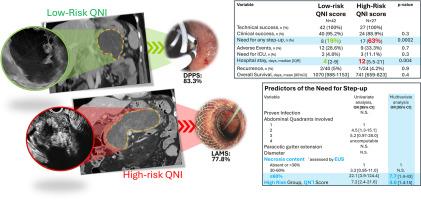
All consecutive candidates for EUS-FCD from 2020 to 2024 were included in a Prospective Registry of Therapeutic EUS (PROTECT, NCT04813055), with prospective monthly follow-up evaluating clinical success, adverse events, and recurrences. Prospectively assessed baseline clinical and morphologic factors, including the Quadrant-Necrosis-Infection (QNI) classification, were included in a stepwise logistic regression model to predict the need for step-up. The agreement between EUS and radiology in assessing the extent of necrosis was compared with the use of Cohen’s kappa.
Results
Seventy patients (29 postsurgical collections, 21 pseudocysts, and 20 WONs) were treated with double-pigtail plastic stents (DPPSs) in 59% of cases and LAMSs in 41%. Clinical success was 92.9%, with a need for step-up (mostly endoscopic necrosectomy) in 35.7% of cases. Necrosis ≥60% (odds ratio [OR], 7.7; 95% confidence interval [CI], 1.4-43) and being in the high-risk QNI group (OR, 4.6; 95% CI, 1.4-15) were the only independent predictors of any step-up. The same factors predicted the endoscopist’s decision to allocate PFCs to LAMSs vs DPPSs. The high-risk QNI group was associated with a significantly longer hospital stay (12 days vs 4 days; P = .004). EUS tended to upscale the necrotic content compared with preprocedural radiology (κ = 0.31).
Conclusions
The extent of necrosis and the QNI classification strongly correlated with the need for step-up and allocation to LAMS versus DPPS drainage, suggesting a central role in treatment personalization.
期刊介绍:
Gastrointestinal Endoscopy is a journal publishing original, peer-reviewed articles on endoscopic procedures for studying, diagnosing, and treating digestive diseases. It covers outcomes research, prospective studies, and controlled trials of new endoscopic instruments and treatment methods. The online features include full-text articles, video and audio clips, and MEDLINE links. The journal serves as an international forum for the latest developments in the specialty, offering challenging reports from authorities worldwide. It also publishes abstracts of significant articles from other clinical publications, accompanied by expert commentaries.



 京公网安备 11010802042870号
京ICP备2023020795号-1
京公网安备 11010802042870号
京ICP备2023020795号-1

 分享
分享
 求助内容:
求助内容: 应助结果提醒方式:
 扫码关注我们
