Despoina Douralidou, Lorenzo Mari, Sophie Wyatt, Juan Jose Minguez, Patricia Alvarez Fernandez, Carlo Anselmi, Christoforos Posporis
{"title":"Holocord syringomyelia in 18 dogs.","authors":"Despoina Douralidou, Lorenzo Mari, Sophie Wyatt, Juan Jose Minguez, Patricia Alvarez Fernandez, Carlo Anselmi, Christoforos Posporis","doi":"10.3389/fvets.2024.1514441","DOIUrl":null,"url":null,"abstract":"<p><p>Holocord syringomyelia (HSM) is characterized by a continuous spinal cord cavitation along its entire length and is currently poorly documented in dogs. This retrospective multicentric case series investigates the clinical and MRI findings in 18 dogs with HSM. The median age at presentation was 82 months (range 9-108 months) and French Bulldogs were overrepresented (50%). Signs of myelopathy attributed to HSM were detected in 12 dogs (67%), spinal pain/paresthesia/allodynia in eight (44%), and four dogs (22%) had no HSM-associated signs. The most common neuroanatomical localization was C1-C5 spinal cord segments. On MRI, the cranial limit of HSM was at C1 vertebra in seven (39%) and at C2 in 11 dogs (61%). The caudal limit extended to L3 in four dogs (22%), L4 or L5 in six dogs (33%) each, and L6 in two dogs (11%). The conus medullaris terminated at L5 in one dog (6%), L6 in 11 (61%), and L7 in six dogs (33%). Seventeen dogs (94%) exhibited MRI features of Chiari-like and/or other intracranial/cranio-cervical junction malformations. One dog (6%) was treated surgically, 11 (61%) medically, and six (33%) received no treatment. Over a median follow-up of 12 months (range 2-65 months) in 16 dogs, one dog (6%) improved, nine (56%) deteriorated, four (25%) were static, and two (13%) remained free of HSM-associated signs. This is the first study to describe canine HSM, highlighting a possible breed predisposition in French Bulldogs. The frequent occurrence of myelopathy and disease progression underscores the need for further research into the underlying etiopathogenesis, natural disease evolution, and response to therapeutic interventions.</p>","PeriodicalId":12772,"journal":{"name":"Frontiers in Veterinary Science","volume":"11 ","pages":"1514441"},"PeriodicalIF":2.9000,"publicationDate":"2025-01-08","publicationTypes":"Journal Article","fieldsOfStudy":null,"isOpenAccess":false,"openAccessPdf":"https://www.ncbi.nlm.nih.gov/pmc/articles/PMC11750772/pdf/","citationCount":"0","resultStr":null,"platform":"Semanticscholar","paperid":null,"PeriodicalName":"Frontiers in Veterinary Science","FirstCategoryId":"97","ListUrlMain":"https://doi.org/10.3389/fvets.2024.1514441","RegionNum":2,"RegionCategory":"农林科学","ArticlePicture":[],"TitleCN":null,"AbstractTextCN":null,"PMCID":null,"EPubDate":"2024/1/1 0:00:00","PubModel":"eCollection","JCR":"Q1","JCRName":"VETERINARY SCIENCES","Score":null,"Total":0}
引用次数: 0
Abstract
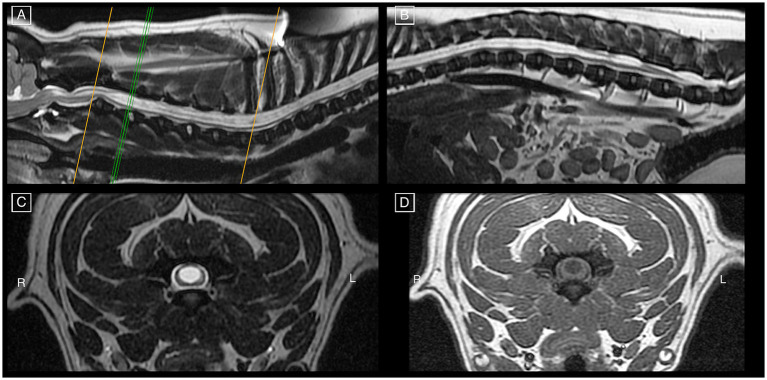
Holocord syringomyelia (HSM) is characterized by a continuous spinal cord cavitation along its entire length and is currently poorly documented in dogs. This retrospective multicentric case series investigates the clinical and MRI findings in 18 dogs with HSM. The median age at presentation was 82 months (range 9-108 months) and French Bulldogs were overrepresented (50%). Signs of myelopathy attributed to HSM were detected in 12 dogs (67%), spinal pain/paresthesia/allodynia in eight (44%), and four dogs (22%) had no HSM-associated signs. The most common neuroanatomical localization was C1-C5 spinal cord segments. On MRI, the cranial limit of HSM was at C1 vertebra in seven (39%) and at C2 in 11 dogs (61%). The caudal limit extended to L3 in four dogs (22%), L4 or L5 in six dogs (33%) each, and L6 in two dogs (11%). The conus medullaris terminated at L5 in one dog (6%), L6 in 11 (61%), and L7 in six dogs (33%). Seventeen dogs (94%) exhibited MRI features of Chiari-like and/or other intracranial/cranio-cervical junction malformations. One dog (6%) was treated surgically, 11 (61%) medically, and six (33%) received no treatment. Over a median follow-up of 12 months (range 2-65 months) in 16 dogs, one dog (6%) improved, nine (56%) deteriorated, four (25%) were static, and two (13%) remained free of HSM-associated signs. This is the first study to describe canine HSM, highlighting a possible breed predisposition in French Bulldogs. The frequent occurrence of myelopathy and disease progression underscores the need for further research into the underlying etiopathogenesis, natural disease evolution, and response to therapeutic interventions.
期刊介绍:
Frontiers in Veterinary Science is a global, peer-reviewed, Open Access journal that bridges animal and human health, brings a comparative approach to medical and surgical challenges, and advances innovative biotechnology and therapy.
Veterinary research today is interdisciplinary, collaborative, and socially relevant, transforming how we understand and investigate animal health and disease. Fundamental research in emerging infectious diseases, predictive genomics, stem cell therapy, and translational modelling is grounded within the integrative social context of public and environmental health, wildlife conservation, novel biomarkers, societal well-being, and cutting-edge clinical practice and specialization. Frontiers in Veterinary Science brings a 21st-century approach—networked, collaborative, and Open Access—to communicate this progress and innovation to both the specialist and to the wider audience of readers in the field.
Frontiers in Veterinary Science publishes articles on outstanding discoveries across a wide spectrum of translational, foundational, and clinical research. The journal''s mission is to bring all relevant veterinary sciences together on a single platform with the goal of improving animal and human health.






 京公网安备 11010802042870号
京ICP备2023020795号-1
京公网安备 11010802042870号
京ICP备2023020795号-1

 分享
分享
 求助内容:
求助内容: 应助结果提醒方式:
 扫码关注我们
