Szczepan W Baran, Susan E Bolin, Stefano Gaburro, Marcel M van Gaalen, Megan R LaFollette, Chang-Ning Liu, Sean Maguire, Lucas P J J Noldus, Natalie Bratcher-Petersen, Brian R Berridge
{"title":"Validation framework for <i>in vivo</i> digital measures.","authors":"Szczepan W Baran, Susan E Bolin, Stefano Gaburro, Marcel M van Gaalen, Megan R LaFollette, Chang-Ning Liu, Sean Maguire, Lucas P J J Noldus, Natalie Bratcher-Petersen, Brian R Berridge","doi":"10.3389/ftox.2024.1484895","DOIUrl":null,"url":null,"abstract":"<p><p>The adoption of <i>in vivo</i> digital measures in pharmaceutical research and development (R&D) presents an opportunity to enhance the efficiency and effectiveness of discovering and developing new therapeutics. For clinical measures, the Digital Medicine Society's (DiMe) V3 Framework is a comprehensive validation framework that encompasses verification, analytical validation, and clinical validation. This manuscript describes collaborative efforts to adapt this framework to ensure the reliability and relevance of digital measures for a preclinical context. Verification ensures that digital technologies accurately capture and store raw data. Analytical validation assesses the precision and accuracy of algorithms that transform raw data into meaningful biological metrics. Clinical validation confirms that these digital measures accurately reflect the biological or functional states in animal models relevant to their context of use. By widely adopting this structured approach, stakeholders-including researchers, technology developers, and regulators-can enhance the reliability and applicability of digital measures in preclinical research, ultimately supporting more robust and translatable drug discovery and development processes.</p>","PeriodicalId":73111,"journal":{"name":"Frontiers in toxicology","volume":"6 ","pages":"1484895"},"PeriodicalIF":4.6000,"publicationDate":"2025-01-08","publicationTypes":"Journal Article","fieldsOfStudy":null,"isOpenAccess":false,"openAccessPdf":"https://www.ncbi.nlm.nih.gov/pmc/articles/PMC11751004/pdf/","citationCount":"0","resultStr":null,"platform":"Semanticscholar","paperid":null,"PeriodicalName":"Frontiers in toxicology","FirstCategoryId":"1085","ListUrlMain":"https://doi.org/10.3389/ftox.2024.1484895","RegionNum":0,"RegionCategory":null,"ArticlePicture":[],"TitleCN":null,"AbstractTextCN":null,"PMCID":null,"EPubDate":"2024/1/1 0:00:00","PubModel":"eCollection","JCR":"Q2","JCRName":"TOXICOLOGY","Score":null,"Total":0}
引用次数: 0
Abstract
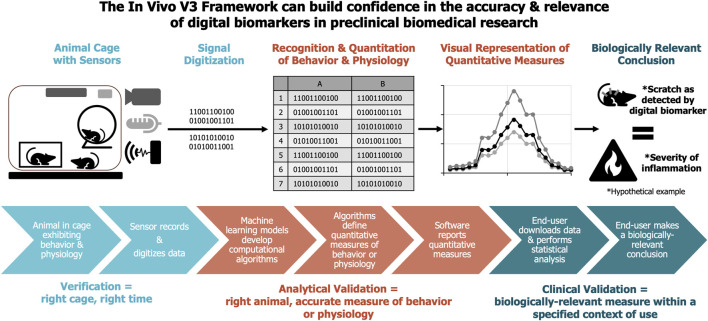
The adoption of in vivo digital measures in pharmaceutical research and development (R&D) presents an opportunity to enhance the efficiency and effectiveness of discovering and developing new therapeutics. For clinical measures, the Digital Medicine Society's (DiMe) V3 Framework is a comprehensive validation framework that encompasses verification, analytical validation, and clinical validation. This manuscript describes collaborative efforts to adapt this framework to ensure the reliability and relevance of digital measures for a preclinical context. Verification ensures that digital technologies accurately capture and store raw data. Analytical validation assesses the precision and accuracy of algorithms that transform raw data into meaningful biological metrics. Clinical validation confirms that these digital measures accurately reflect the biological or functional states in animal models relevant to their context of use. By widely adopting this structured approach, stakeholders-including researchers, technology developers, and regulators-can enhance the reliability and applicability of digital measures in preclinical research, ultimately supporting more robust and translatable drug discovery and development processes.



 京公网安备 11010802042870号
京ICP备2023020795号-1
京公网安备 11010802042870号
京ICP备2023020795号-1

 分享
分享

 求助内容:
求助内容: 应助结果提醒方式:
 扫码关注我们
