{"title":"Educational attainment, Aβ, tau, and structural brain reserve in Alzheimer's disease","authors":"Yue Cai, Lili Fang, Anqi Li, Jie Yang, Xin Zhou, Zhengbo He, Pan Sun, Qingyong Wang, Tengfei Guo, Alzheimer's Disease Neuroimaging Initiative","doi":"10.1002/alz.14400","DOIUrl":null,"url":null,"abstract":"<div>\n \n \n <section>\n \n <h3> INTRODUCTION</h3>\n \n <p>Alzheimer's disease (AD) patients with higher educational attainment (EA) often exhibit better cognitive function. However, the relationship among EA status, AD pathology, structural brain reserve, and cognitive decline requires further investigation.</p>\n </section>\n \n <section>\n \n <h3> METHODS</h3>\n \n <p>We compared cognitive performance across different amyloid beta (Aβ) positron emission tomography (A ±) statuses and EA levels (High EA/Low EA). We examined the effects of Aβ plaques, tau tangles, and gray matter volume (GMV) on the relationship between EA and domain-specific cognitive decline.</p>\n </section>\n \n <section>\n \n <h3> RESULTS</h3>\n \n <p>A+/High-EA individuals exhibited slower cognitive decline in global cognition and language domains than A+/Low-EA individuals. This cognitive benefit was independently and synergistically explained by reduced AD pathology, including lower Aβ and tau burdens, as well as preserved GMV. Additionally, High-EA individuals experienced a median delay of 1.9 years in the onset of significant brain atrophy among A+ individuals.</p>\n </section>\n \n <section>\n \n <h3> DISCUSSION</h3>\n \n <p>These findings highlight the independent and synergistic contributions of EA-associated AD pathology and GMV alterations to longitudinal cognitive decline.</p>\n </section>\n \n <section>\n \n <h3> Highlights</h3>\n \n <div>\n <ul>\n \n <li>Alzheimer's disease (AD) individuals with high educational attainment (EA) show slower declines in global cognition and language.</li>\n \n <li>EA-related slower cognitive decline is linked to reduced tau and greater gray matter volume in AD.</li>\n \n <li>AD individuals with high EA show a median 1.9 year delayed onset of brain atrophy.</li>\n </ul>\n </div>\n </section>\n </div>","PeriodicalId":7471,"journal":{"name":"Alzheimer's & Dementia","volume":"21 2","pages":""},"PeriodicalIF":11.1000,"publicationDate":"2025-01-24","publicationTypes":"Journal Article","fieldsOfStudy":null,"isOpenAccess":false,"openAccessPdf":"https://onlinelibrary.wiley.com/doi/epdf/10.1002/alz.14400","citationCount":"0","resultStr":null,"platform":"Semanticscholar","paperid":null,"PeriodicalName":"Alzheimer's & Dementia","FirstCategoryId":"3","ListUrlMain":"https://alz-journals.onlinelibrary.wiley.com/doi/10.1002/alz.14400","RegionNum":1,"RegionCategory":"医学","ArticlePicture":[],"TitleCN":null,"AbstractTextCN":null,"PMCID":null,"EPubDate":"","PubModel":"","JCR":"Q1","JCRName":"CLINICAL NEUROLOGY","Score":null,"Total":0}
引用次数: 0
Abstract
INTRODUCTION
Alzheimer's disease (AD) patients with higher educational attainment (EA) often exhibit better cognitive function. However, the relationship among EA status, AD pathology, structural brain reserve, and cognitive decline requires further investigation.
METHODS
We compared cognitive performance across different amyloid beta (Aβ) positron emission tomography (A ±) statuses and EA levels (High EA/Low EA). We examined the effects of Aβ plaques, tau tangles, and gray matter volume (GMV) on the relationship between EA and domain-specific cognitive decline.
RESULTS
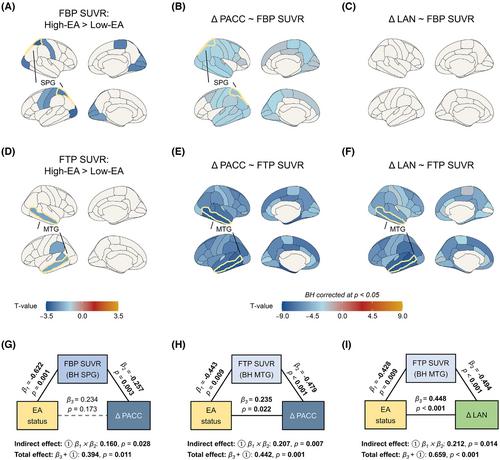
A+/High-EA individuals exhibited slower cognitive decline in global cognition and language domains than A+/Low-EA individuals. This cognitive benefit was independently and synergistically explained by reduced AD pathology, including lower Aβ and tau burdens, as well as preserved GMV. Additionally, High-EA individuals experienced a median delay of 1.9 years in the onset of significant brain atrophy among A+ individuals.
DISCUSSION
These findings highlight the independent and synergistic contributions of EA-associated AD pathology and GMV alterations to longitudinal cognitive decline.
Highlights
Alzheimer's disease (AD) individuals with high educational attainment (EA) show slower declines in global cognition and language.
EA-related slower cognitive decline is linked to reduced tau and greater gray matter volume in AD.
AD individuals with high EA show a median 1.9 year delayed onset of brain atrophy.
期刊介绍:
Alzheimer's & Dementia is a peer-reviewed journal that aims to bridge knowledge gaps in dementia research by covering the entire spectrum, from basic science to clinical trials to social and behavioral investigations. It provides a platform for rapid communication of new findings and ideas, optimal translation of research into practical applications, increasing knowledge across diverse disciplines for early detection, diagnosis, and intervention, and identifying promising new research directions. In July 2008, Alzheimer's & Dementia was accepted for indexing by MEDLINE, recognizing its scientific merit and contribution to Alzheimer's research.





 京公网安备 11010802042870号
京ICP备2023020795号-1
京公网安备 11010802042870号
京ICP备2023020795号-1

 分享
分享
 求助内容:
求助内容: 应助结果提醒方式:
 扫码关注我们
