{"title":"Peripheral Evolution of Tanshinone IIA and Cryptotanshinone for Discovery of a Potent and Specific NLRP3 Inflammasome Inhibitor","authors":"Wenqi Zhu, Xiaodong Bao, Yuyan Yang, Muqiong Xing, Sijie Xiong, Siyu Chen, Yongxin Zhong, Xueping Hu, Qianrang Lu, Kairong Wang, Qi Ling, Sunliang Cui","doi":"10.1021/acs.jmedchem.4c02648","DOIUrl":null,"url":null,"abstract":"Natural products (NPs) continue to serve as an invaluable source in drug discovery, and peripheral evolution of NPs is a highly efficient evolution strategy. Herein, we describe a unified “methyl to amide” peripheral evolution of Tanshinone IIA and Cryptotanshinone for discovery of NLRP3 inflammasome inhibitors. There were 54 compounds designed and prepared, while the chemoinformatic analysis revealed that these evolved NP analogues occupy a unique chemical space. Biological evaluation identified <b>5m</b> as an NLRP3 inflammasome inhibitor, and <b>5m</b> could directly bind to the NACHT domain of the NLRP3 protein and block the interaction of NLRP3 and ASC, thus suppressing ASC oligomerization and NLRP3 inflammasome assembly. Molecular dynamic stimulations revealed that the amide moiety played a vital role in the binding mode. Moreover, <b>5m</b> exhibited therapeutical efficacy in sepsis and the NASH mouse model. In conclusion, this protocol provides a new vision of NPs’ peripheral evolution and a novel NLRP3 inflammasome inhibitor.","PeriodicalId":46,"journal":{"name":"Journal of Medicinal Chemistry","volume":"5 1","pages":""},"PeriodicalIF":6.8000,"publicationDate":"2025-01-23","publicationTypes":"Journal Article","fieldsOfStudy":null,"isOpenAccess":false,"openAccessPdf":"","citationCount":"0","resultStr":null,"platform":"Semanticscholar","paperid":null,"PeriodicalName":"Journal of Medicinal Chemistry","FirstCategoryId":"3","ListUrlMain":"https://doi.org/10.1021/acs.jmedchem.4c02648","RegionNum":1,"RegionCategory":"医学","ArticlePicture":[],"TitleCN":null,"AbstractTextCN":null,"PMCID":null,"EPubDate":"","PubModel":"","JCR":"Q1","JCRName":"CHEMISTRY, MEDICINAL","Score":null,"Total":0}
引用次数: 0
Abstract
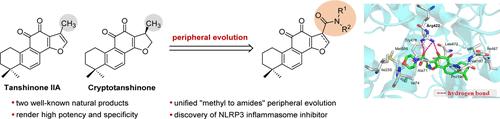
Natural products (NPs) continue to serve as an invaluable source in drug discovery, and peripheral evolution of NPs is a highly efficient evolution strategy. Herein, we describe a unified “methyl to amide” peripheral evolution of Tanshinone IIA and Cryptotanshinone for discovery of NLRP3 inflammasome inhibitors. There were 54 compounds designed and prepared, while the chemoinformatic analysis revealed that these evolved NP analogues occupy a unique chemical space. Biological evaluation identified 5m as an NLRP3 inflammasome inhibitor, and 5m could directly bind to the NACHT domain of the NLRP3 protein and block the interaction of NLRP3 and ASC, thus suppressing ASC oligomerization and NLRP3 inflammasome assembly. Molecular dynamic stimulations revealed that the amide moiety played a vital role in the binding mode. Moreover, 5m exhibited therapeutical efficacy in sepsis and the NASH mouse model. In conclusion, this protocol provides a new vision of NPs’ peripheral evolution and a novel NLRP3 inflammasome inhibitor.
期刊介绍:
The Journal of Medicinal Chemistry is a prestigious biweekly peer-reviewed publication that focuses on the multifaceted field of medicinal chemistry. Since its inception in 1959 as the Journal of Medicinal and Pharmaceutical Chemistry, it has evolved to become a cornerstone in the dissemination of research findings related to the design, synthesis, and development of therapeutic agents.
The Journal of Medicinal Chemistry is recognized for its significant impact in the scientific community, as evidenced by its 2022 impact factor of 7.3. This metric reflects the journal's influence and the importance of its content in shaping the future of drug discovery and development. The journal serves as a vital resource for chemists, pharmacologists, and other researchers interested in the molecular mechanisms of drug action and the optimization of therapeutic compounds.




 京公网安备 11010802042870号
京ICP备2023020795号-1
京公网安备 11010802042870号
京ICP备2023020795号-1

 分享
分享
 求助内容:
求助内容: 应助结果提醒方式:
 扫码关注我们
