{"title":"Using feedback in pooled experiments augmented with imputation for high genotyping accuracy at reduced cost.","authors":"Camille Clouard, Carl Nettelblad","doi":"10.1093/g3journal/jkaf010","DOIUrl":null,"url":null,"abstract":"<p><p>Conducting genomic selection (GS) in plant breeding programs can substantially speed up the development of new varieties. GS provides more reliable insights when it is based on dense marker data, in which the rare variants can be particularly informative. Despite the availability of new technologies, the cost of large-scale genotyping remains a major limitation to the implementation of GS. We suggest to combine pooled genotyping with population-based imputation as a cost-effective computational strategy for genotyping SNPs. Pooling saves genotyping tests and has proven to accurately capture the rare variants that are usually missed by imputation. In this study, we investigate adding iterative coupling to a joint model of pooling and imputation that we have previously proposed. In each iteration, the imputed genotype probabilities serve as feedback input for adjusting the per-sample prior genotype probabilities, before running a new imputation based on these adjusted data. This flexible setup indirectly imposes consistency between the imputed genotypes and the pooled observations. We demonstrate that repeated cycles of feedback can take advantage of the strengths in both pooling and imputation when an appropriate set of reference haplotypes is available for imputation. The iterations improve greatly upon the initial genotype predictions, achieving very high genotype accuracy for both low- and high-frequency variants. We enhance the average concordance from 94.5% to 98.4% at limited computational cost and without requiring any additional genotype testing.</p>","PeriodicalId":12468,"journal":{"name":"G3: Genes|Genomes|Genetics","volume":" ","pages":""},"PeriodicalIF":2.2000,"publicationDate":"2025-03-18","publicationTypes":"Journal Article","fieldsOfStudy":null,"isOpenAccess":false,"openAccessPdf":"https://www.ncbi.nlm.nih.gov/pmc/articles/PMC11917477/pdf/","citationCount":"0","resultStr":null,"platform":"Semanticscholar","paperid":null,"PeriodicalName":"G3: Genes|Genomes|Genetics","FirstCategoryId":"99","ListUrlMain":"https://doi.org/10.1093/g3journal/jkaf010","RegionNum":3,"RegionCategory":"生物学","ArticlePicture":[],"TitleCN":null,"AbstractTextCN":null,"PMCID":null,"EPubDate":"","PubModel":"","JCR":"Q3","JCRName":"GENETICS & HEREDITY","Score":null,"Total":0}
引用次数: 0
Abstract
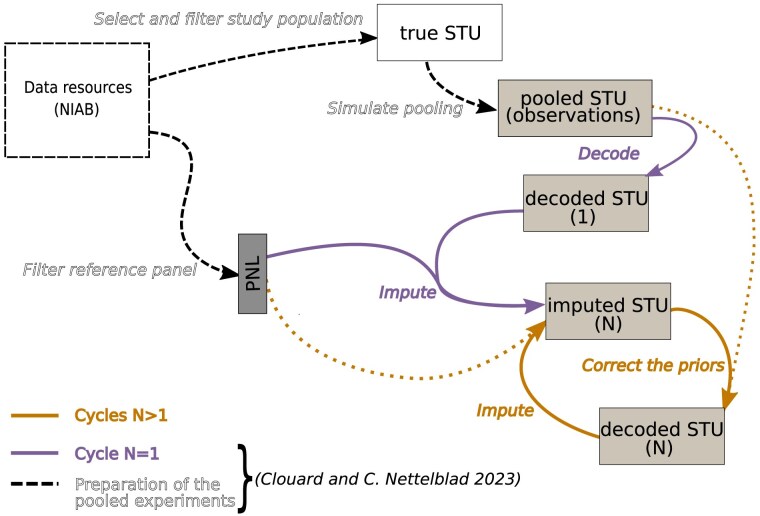
Conducting genomic selection (GS) in plant breeding programs can substantially speed up the development of new varieties. GS provides more reliable insights when it is based on dense marker data, in which the rare variants can be particularly informative. Despite the availability of new technologies, the cost of large-scale genotyping remains a major limitation to the implementation of GS. We suggest to combine pooled genotyping with population-based imputation as a cost-effective computational strategy for genotyping SNPs. Pooling saves genotyping tests and has proven to accurately capture the rare variants that are usually missed by imputation. In this study, we investigate adding iterative coupling to a joint model of pooling and imputation that we have previously proposed. In each iteration, the imputed genotype probabilities serve as feedback input for adjusting the per-sample prior genotype probabilities, before running a new imputation based on these adjusted data. This flexible setup indirectly imposes consistency between the imputed genotypes and the pooled observations. We demonstrate that repeated cycles of feedback can take advantage of the strengths in both pooling and imputation when an appropriate set of reference haplotypes is available for imputation. The iterations improve greatly upon the initial genotype predictions, achieving very high genotype accuracy for both low- and high-frequency variants. We enhance the average concordance from 94.5% to 98.4% at limited computational cost and without requiring any additional genotype testing.
期刊介绍:
G3: Genes, Genomes, Genetics provides a forum for the publication of high‐quality foundational research, particularly research that generates useful genetic and genomic information such as genome maps, single gene studies, genome‐wide association and QTL studies, as well as genome reports, mutant screens, and advances in methods and technology. The Editorial Board of G3 believes that rapid dissemination of these data is the necessary foundation for analysis that leads to mechanistic insights.
G3, published by the Genetics Society of America, meets the critical and growing need of the genetics community for rapid review and publication of important results in all areas of genetics. G3 offers the opportunity to publish the puzzling finding or to present unpublished results that may not have been submitted for review and publication due to a perceived lack of a potential high-impact finding. G3 has earned the DOAJ Seal, which is a mark of certification for open access journals, awarded by DOAJ to journals that achieve a high level of openness, adhere to Best Practice and high publishing standards.






 京公网安备 11010802042870号
京ICP备2023020795号-1
京公网安备 11010802042870号
京ICP备2023020795号-1

 分享
分享
 求助内容:
求助内容: 应助结果提醒方式:
 扫码关注我们
