{"title":"Research progress on the relationship between fine motor skills and academic ability in children: a systematic review and meta-analysis.","authors":"Yucen Li, Xin Wu, Danni Ye, Jinye Zuo, Liu Liu","doi":"10.3389/fspor.2024.1386967","DOIUrl":null,"url":null,"abstract":"<p><strong>Background: </strong>In recent years, an increasing number of scholars have begun to focus on the relationship between children's motor development and school activities, with the relationship between children's fine motor skills and academic achievement being a particularly researched area. However, due to different research perspectives among scholars, the results in this field have been somewhat controversial. Therefore, this study aims to delve deeper into the relationship between children's fine motor skills and their various academic abilities through systematic review and meta-analysis.</p><p><strong>Method: </strong>English databases (PubMed, Web of Science, Embase) and Chinese databases (CNKI, Wei Pu) were searched, and a quantitative meta-analysis was conducted using STATA software, along with a systematic descriptive analysis of the included literature.</p><p><strong>Results: </strong>From the 1,147 documents retrieved, 11 studies were ultimately included. All meta-analysis results are significant, and there is a medium correlation between fine motor skills and reading ability, a larger correlation is observed with mathematical ability. In the subgroup analysis of each fine motor skill component and academic ability, except for the fine motor coordination, which shows only a small correlation with reading ability, the variables in the other subgroups all exhibit a medium degree of correlation. Notably, the correlation between visual-motor integration and mathematical ability is the strongest in subgroup (<i>r</i> = 0.47).</p><p><strong>Conclusion: </strong>The meta-analysis provides evidence supporting a positive and statistically significant correlation between preschool children's fine motor skills and learning outcomes. However, the scope of academic abilities examined in this domain is predominantly confined to mathematics and reading. Moreover, existing research largely focuses on surface-level correlational analyses, necessitating deeper exploration into the underlying mechanisms.</p><p><strong>Systematic review registration: </strong>https://www.crd.york.ac.uk/PROSPERO/, identifier (CRD42023415498).</p>","PeriodicalId":12716,"journal":{"name":"Frontiers in Sports and Active Living","volume":"6 ","pages":"1386967"},"PeriodicalIF":2.6000,"publicationDate":"2025-01-09","publicationTypes":"Journal Article","fieldsOfStudy":null,"isOpenAccess":false,"openAccessPdf":"https://www.ncbi.nlm.nih.gov/pmc/articles/PMC11754413/pdf/","citationCount":"0","resultStr":null,"platform":"Semanticscholar","paperid":null,"PeriodicalName":"Frontiers in Sports and Active Living","FirstCategoryId":"1085","ListUrlMain":"https://doi.org/10.3389/fspor.2024.1386967","RegionNum":0,"RegionCategory":null,"ArticlePicture":[],"TitleCN":null,"AbstractTextCN":null,"PMCID":null,"EPubDate":"2024/1/1 0:00:00","PubModel":"eCollection","JCR":"Q2","JCRName":"SPORT SCIENCES","Score":null,"Total":0}
引用次数: 0
Abstract
Background: In recent years, an increasing number of scholars have begun to focus on the relationship between children's motor development and school activities, with the relationship between children's fine motor skills and academic achievement being a particularly researched area. However, due to different research perspectives among scholars, the results in this field have been somewhat controversial. Therefore, this study aims to delve deeper into the relationship between children's fine motor skills and their various academic abilities through systematic review and meta-analysis.
Method: English databases (PubMed, Web of Science, Embase) and Chinese databases (CNKI, Wei Pu) were searched, and a quantitative meta-analysis was conducted using STATA software, along with a systematic descriptive analysis of the included literature.
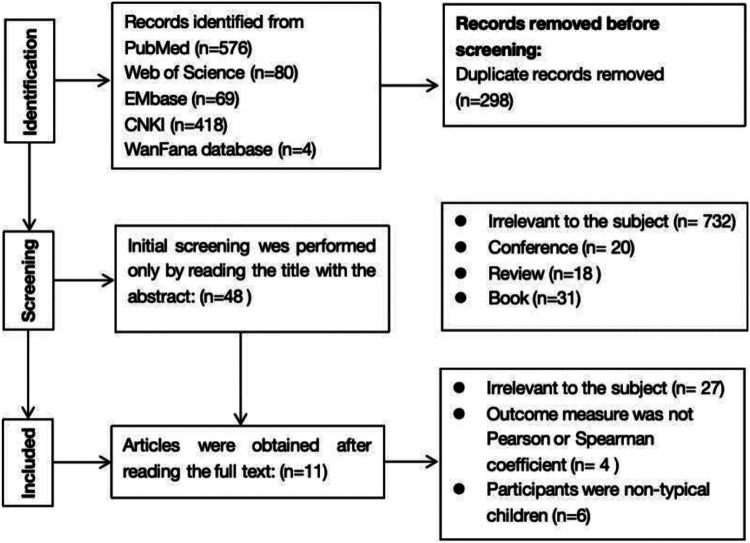
Results: From the 1,147 documents retrieved, 11 studies were ultimately included. All meta-analysis results are significant, and there is a medium correlation between fine motor skills and reading ability, a larger correlation is observed with mathematical ability. In the subgroup analysis of each fine motor skill component and academic ability, except for the fine motor coordination, which shows only a small correlation with reading ability, the variables in the other subgroups all exhibit a medium degree of correlation. Notably, the correlation between visual-motor integration and mathematical ability is the strongest in subgroup (r = 0.47).
Conclusion: The meta-analysis provides evidence supporting a positive and statistically significant correlation between preschool children's fine motor skills and learning outcomes. However, the scope of academic abilities examined in this domain is predominantly confined to mathematics and reading. Moreover, existing research largely focuses on surface-level correlational analyses, necessitating deeper exploration into the underlying mechanisms.
背景:近年来,越来越多的学者开始关注儿童运动发展与学校活动的关系,其中儿童精细运动技能与学业成绩的关系是一个特别的研究领域。然而,由于学者们的研究视角不同,这一领域的研究结果存在一定的争议。因此,本研究旨在通过系统回顾和荟萃分析的方法,深入探讨儿童精细运动技能与其各项学业能力之间的关系。方法:检索英文数据库(PubMed、Web of Science、Embase)和中文数据库(CNKI、卫普),采用STATA软件进行定量meta分析,并对纳入的文献进行系统的描述性分析。结果:从检索到的1147份文献中,最终纳入了11项研究。所有meta分析结果均显著,精细运动技能与阅读能力存在中等相关性,与数学能力存在较大相关性。在各精细运动技能成分与学业能力的子组分析中,除精细运动协调与阅读能力的相关性较小外,其他子组变量均呈现中等程度的相关性。其中,视觉运动整合与数学能力的相关性在亚组中最强(r = 0.47)。结论:本荟萃分析为学龄前儿童精细运动技能与学习成绩之间存在显著正相关关系提供了证据。然而,在这一领域所考察的学术能力范围主要局限于数学和阅读。此外,现有的研究主要集中在表面水平的相关性分析,需要对潜在机制进行更深入的探索。系统评价注册:https://www.crd.york.ac.uk/PROSPERO/,标识符(CRD42023415498)。






 京公网安备 11010802042870号
京ICP备2023020795号-1
京公网安备 11010802042870号
京ICP备2023020795号-1

 分享
分享
 求助内容:
求助内容: 应助结果提醒方式:
 扫码关注我们
