Dandan Wu, Ran Chen, Jerry Zhang, Wu Yan, Mengyin Chen, Dongqing Xia, Xiaonan Li, Yanyan Dai, Yinhua Chen, Rong Li
{"title":"DNA copy number variations and craniofacial abnormalities in 1,457 children with neurodevelopmental disorders.","authors":"Dandan Wu, Ran Chen, Jerry Zhang, Wu Yan, Mengyin Chen, Dongqing Xia, Xiaonan Li, Yanyan Dai, Yinhua Chen, Rong Li","doi":"10.1186/s13052-025-01839-6","DOIUrl":null,"url":null,"abstract":"<p><strong>Background: </strong>This study aimed to investigate deoxyribonucleic acid (DNA) copy number variations (CNVs) in children with neurodevelopmental disorders and their association with craniofacial abnormalities.</p><p><strong>Methods: </strong>A total of 1,457 children who visited the Child Health Department of our hospital for unexplained Neurodevelopmental disorders (NDDs) between November 2019 and December 2022 were enrolled. Peripheral venous blood samples (2 mL) were collected from the children and their parents for whole-exome sequencing. Positive results were verified through Sanger sequencing for locus and pedigree validation. Simultaneously, a specific sign-scoring scale was created to evaluate characteristics related to the developments of eyes, nose, ears, eyebrows, head, mouth, face, trunk, limbs, and reproductive, urinary, and cardiovascular systems.</p><p><strong>Results: </strong>A total of 536 children (36.78%, 536/1,457) were found to have genetic variations, with 379 (70.71%, 379/536) exhibiting pathogenic monogenic mutations. Furthermore, 157 children (29.29%, 157/536) harbored DNA copy number variants, encompassing microdeletions (68.15%, 107/157) and microduplications (31.85%, 50/157). Regarding the pathogenicity of CNVs, 91 (57.96%, 91/157) were identified as pathogenic, 28 (17.83%, 28/157) as variants of uncertain clinical significance (VOUS), and 38 (24.20%, 38/157) as benign according to the American College of Medical Genetics and Genomics (ACMG).Using a specific sign-scoring scale, the proportion of pathogenic CNVs in children graded 1 point or higher (64%, 58/91) was significantly higher than that of non-pathogenic CNVs (43%, 29/66) (P < 0.05). Furthermore, the proportion of microdeletions in children graded 1 point or higher (60.75%, 65/107) was significantly higher than those carrying microduplications (44%, 22/50) (P < 0.05). The proportion of pathogenic microdeletions in children graded 1 point or higher (73.43%,47/64) was significantly higher than those carrying pathogenic microduplications (40.74%, 11/27) (P < 0.05).</p><p><strong>Conclusion: </strong>The positive rate of whole-exome sequencing for children with combined craniofacial abnormalities and NDDs exceeds the international average in our study cohort. Thus, whole-exome sequencing may be recommended for precise diagnosis of neurogenetic diseases in such cases.</p>","PeriodicalId":14511,"journal":{"name":"Italian Journal of Pediatrics","volume":"51 1","pages":"9"},"PeriodicalIF":3.1000,"publicationDate":"2025-01-23","publicationTypes":"Journal Article","fieldsOfStudy":null,"isOpenAccess":false,"openAccessPdf":"https://www.ncbi.nlm.nih.gov/pmc/articles/PMC11756179/pdf/","citationCount":"0","resultStr":null,"platform":"Semanticscholar","paperid":null,"PeriodicalName":"Italian Journal of Pediatrics","FirstCategoryId":"3","ListUrlMain":"https://doi.org/10.1186/s13052-025-01839-6","RegionNum":3,"RegionCategory":"医学","ArticlePicture":[],"TitleCN":null,"AbstractTextCN":null,"PMCID":null,"EPubDate":"","PubModel":"","JCR":"Q1","JCRName":"PEDIATRICS","Score":null,"Total":0}
引用次数: 0
Abstract
Background: This study aimed to investigate deoxyribonucleic acid (DNA) copy number variations (CNVs) in children with neurodevelopmental disorders and their association with craniofacial abnormalities.
Methods: A total of 1,457 children who visited the Child Health Department of our hospital for unexplained Neurodevelopmental disorders (NDDs) between November 2019 and December 2022 were enrolled. Peripheral venous blood samples (2 mL) were collected from the children and their parents for whole-exome sequencing. Positive results were verified through Sanger sequencing for locus and pedigree validation. Simultaneously, a specific sign-scoring scale was created to evaluate characteristics related to the developments of eyes, nose, ears, eyebrows, head, mouth, face, trunk, limbs, and reproductive, urinary, and cardiovascular systems.
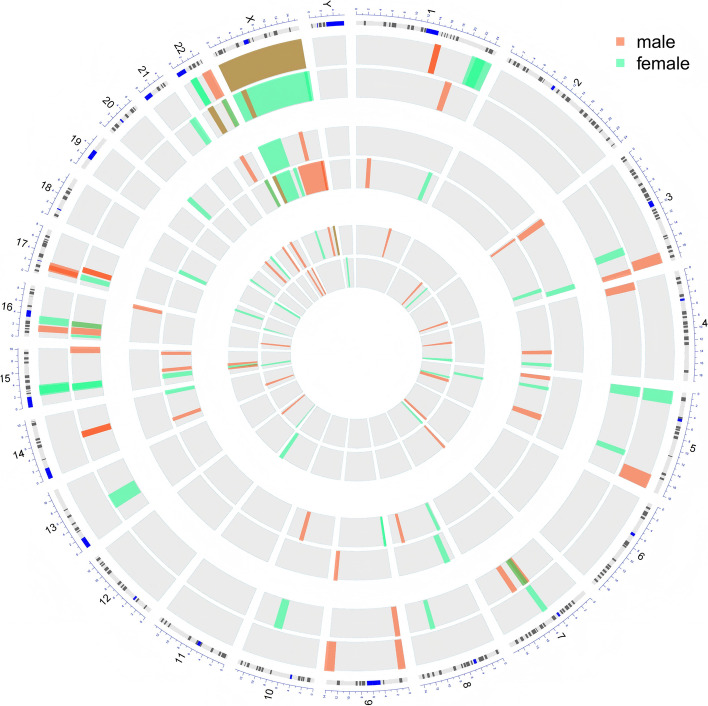
Results: A total of 536 children (36.78%, 536/1,457) were found to have genetic variations, with 379 (70.71%, 379/536) exhibiting pathogenic monogenic mutations. Furthermore, 157 children (29.29%, 157/536) harbored DNA copy number variants, encompassing microdeletions (68.15%, 107/157) and microduplications (31.85%, 50/157). Regarding the pathogenicity of CNVs, 91 (57.96%, 91/157) were identified as pathogenic, 28 (17.83%, 28/157) as variants of uncertain clinical significance (VOUS), and 38 (24.20%, 38/157) as benign according to the American College of Medical Genetics and Genomics (ACMG).Using a specific sign-scoring scale, the proportion of pathogenic CNVs in children graded 1 point or higher (64%, 58/91) was significantly higher than that of non-pathogenic CNVs (43%, 29/66) (P < 0.05). Furthermore, the proportion of microdeletions in children graded 1 point or higher (60.75%, 65/107) was significantly higher than those carrying microduplications (44%, 22/50) (P < 0.05). The proportion of pathogenic microdeletions in children graded 1 point or higher (73.43%,47/64) was significantly higher than those carrying pathogenic microduplications (40.74%, 11/27) (P < 0.05).
Conclusion: The positive rate of whole-exome sequencing for children with combined craniofacial abnormalities and NDDs exceeds the international average in our study cohort. Thus, whole-exome sequencing may be recommended for precise diagnosis of neurogenetic diseases in such cases.
期刊介绍:
Italian Journal of Pediatrics is an open access peer-reviewed journal that includes all aspects of pediatric medicine. The journal also covers health service and public health research that addresses primary care issues.
The journal provides a high-quality forum for pediatricians and other healthcare professionals to report and discuss up-to-the-minute research and expert reviews in the field of pediatric medicine. The journal will continue to develop the range of articles published to enable this invaluable resource to stay at the forefront of the field.
Italian Journal of Pediatrics, which commenced in 1975 as Rivista Italiana di Pediatria, provides a high-quality forum for pediatricians and other healthcare professionals to report and discuss up-to-the-minute research and expert reviews in the field of pediatric medicine. The journal will continue to develop the range of articles published to enable this invaluable resource to stay at the forefront of the field.



 京公网安备 11010802042870号
京ICP备2023020795号-1
京公网安备 11010802042870号
京ICP备2023020795号-1

 分享
分享
 求助内容:
求助内容: 应助结果提醒方式:
 扫码关注我们
