Hyunju Kim, Kyoung-Sook Kim, Young-Choon Lee, Jong Hyun Cho
{"title":"Chloroform Extract from Fermented <i>Viola mandshurica</i> Regulates LPS-Induced Inflammation Response in RAW 264.7 Cells by Inhibiting iNOS and COX-2.","authors":"Hyunju Kim, Kyoung-Sook Kim, Young-Choon Lee, Jong Hyun Cho","doi":"10.4014/jmb.2408.08047","DOIUrl":null,"url":null,"abstract":"<p><p>Inflammatory is a crucial part of the immune system of body protect it from harmful invaders, such as bacteria, viruses, and other foreign substances. In this study, the effects of chloroform extract of fermented <i>Viola mandshurica</i> (CEFV) on lipopolysaccharide (LPS)-induced inflammatory response in RAW264.7 macrophages were investigated. The CEFV significantly inhibited NO production and reduced the expression of inducible nitric oxide synthase (iNOS) at both protein and mRNA levels in a dose-dependent manner. Also, CEFV decreased PGE2 production, suppressed COX-2 expression, and inhibited the activation of the ERK and JNK pathways but not the p38 pathway. Taken together, CEFV suppressed NF-κB activation, which is a key regulator in the inflammatory response. The main phenolic compounds identified in CEFV were tectoridin, luteolin, resveratrol, and hesperetin. Therefore, in this study, CEFC exhibits potent anti-inflammatory effects by downregulating the production of pro-inflammatory mediators and inhibiting key inflammatory pathway in RAW264.7 cells.</p>","PeriodicalId":16481,"journal":{"name":"Journal of microbiology and biotechnology","volume":"35 ","pages":"e2408047"},"PeriodicalIF":3.1000,"publicationDate":"2024-12-12","publicationTypes":"Journal Article","fieldsOfStudy":null,"isOpenAccess":false,"openAccessPdf":"https://www.ncbi.nlm.nih.gov/pmc/articles/PMC11813387/pdf/","citationCount":"0","resultStr":null,"platform":"Semanticscholar","paperid":null,"PeriodicalName":"Journal of microbiology and biotechnology","FirstCategoryId":"5","ListUrlMain":"https://doi.org/10.4014/jmb.2408.08047","RegionNum":4,"RegionCategory":"生物学","ArticlePicture":[],"TitleCN":null,"AbstractTextCN":null,"PMCID":null,"EPubDate":"","PubModel":"","JCR":"Q3","JCRName":"BIOTECHNOLOGY & APPLIED MICROBIOLOGY","Score":null,"Total":0}
引用次数: 0
Abstract
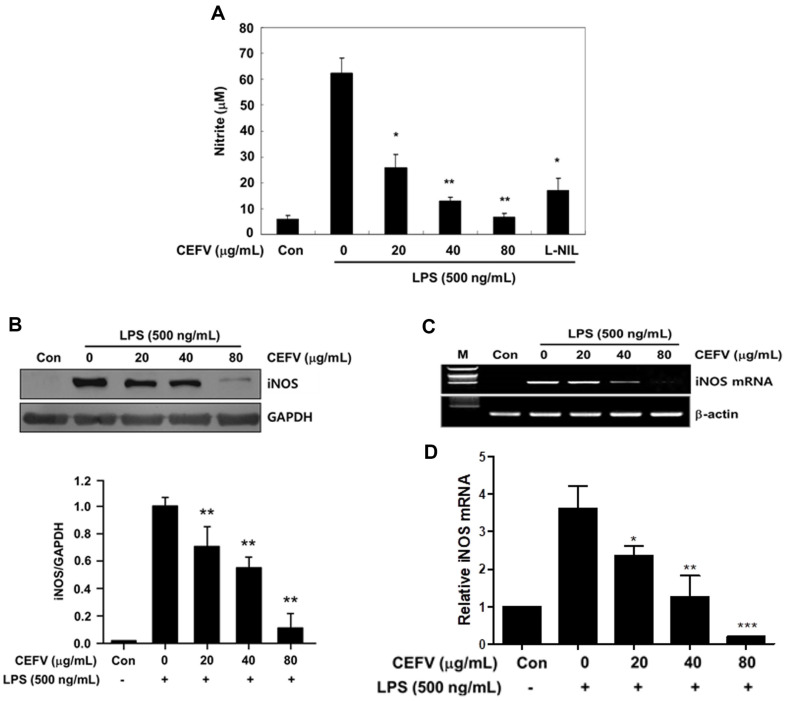
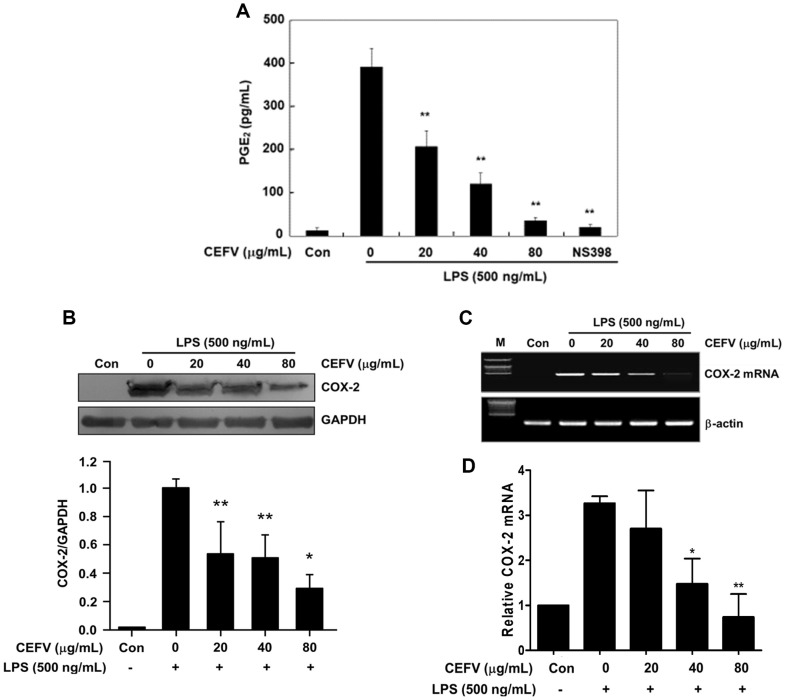
Inflammatory is a crucial part of the immune system of body protect it from harmful invaders, such as bacteria, viruses, and other foreign substances. In this study, the effects of chloroform extract of fermented Viola mandshurica (CEFV) on lipopolysaccharide (LPS)-induced inflammatory response in RAW264.7 macrophages were investigated. The CEFV significantly inhibited NO production and reduced the expression of inducible nitric oxide synthase (iNOS) at both protein and mRNA levels in a dose-dependent manner. Also, CEFV decreased PGE2 production, suppressed COX-2 expression, and inhibited the activation of the ERK and JNK pathways but not the p38 pathway. Taken together, CEFV suppressed NF-κB activation, which is a key regulator in the inflammatory response. The main phenolic compounds identified in CEFV were tectoridin, luteolin, resveratrol, and hesperetin. Therefore, in this study, CEFC exhibits potent anti-inflammatory effects by downregulating the production of pro-inflammatory mediators and inhibiting key inflammatory pathway in RAW264.7 cells.
期刊介绍:
The Journal of Microbiology and Biotechnology (JMB) is a monthly international journal devoted to the advancement and dissemination of scientific knowledge pertaining to microbiology, biotechnology, and related academic disciplines. It covers various scientific and technological aspects of Molecular and Cellular Microbiology, Environmental Microbiology and Biotechnology, Food Biotechnology, and Biotechnology and Bioengineering (subcategories are listed below). Launched in March 1991, the JMB is published by the Korean Society for Microbiology and Biotechnology (KMB) and distributed worldwide.





 京公网安备 11010802042870号
京ICP备2023020795号-1
京公网安备 11010802042870号
京ICP备2023020795号-1

 分享
分享
 求助内容:
求助内容: 应助结果提醒方式:
 扫码关注我们
