Ioannis Doumas, Thierry Lejeune, Martin Edwards, Gaëtan Stoquart, Yves Vandermeeren, Bruno Dehez, Stephanie Dehem
{"title":"Clinical validation of an individualized auto-adaptative serious game for combined cognitive and upper limb motor robotic rehabilitation after stroke.","authors":"Ioannis Doumas, Thierry Lejeune, Martin Edwards, Gaëtan Stoquart, Yves Vandermeeren, Bruno Dehez, Stephanie Dehem","doi":"10.1186/s12984-025-01551-w","DOIUrl":null,"url":null,"abstract":"<p><strong>Background: </strong>Intensive rehabilitation through challenging and individualized tasks are recommended to enhance upper limb recovery after stroke. Robot-assisted therapy (RAT) and serious games could be used to enhance functional recovery by providing simultaneous motor and cognitive rehabilitation.</p><p><strong>Objective: </strong>The aim of this study is to clinically validate the dynamic difficulty adjustment (DDA) mechanism of ROBiGAME, a robot serious game designed for simultaneous rehabilitation of motor impairments and hemispatial neglect.</p><p><strong>Methods: </strong>A proof of concept, with 24 participants in subacute and chronic stroke, was conducted using a 5-day protocol (two days were dedicated to assessment and three days to consecutive training sessions). Participants performed three consecutive ROBiGAME sessions during which overall task difficulty was determined through simultaneous DDA of motor and attentional parameters. Relationships between clinical and robotic assessment scores with respective task-difficulty parameters were analyzed using a multivariate regression model and a principal component analysis.</p><p><strong>Results: </strong>Game difficulty rapidly (within approximately thirty minutes) auto-adapted to match individual impairment levels. The relationship between task-difficulty parameters with motor (Fugl Meyer Assessment: r = 0.84 p < 0.05) and with attentional impairments (Bells test total omissions: r = 0.617 p < 0.05) showed that task-difficulty during RAT adapted to each participant's degree of impairment. Principal component analysis identified two data subsets determining overall task-difficulty, one subset for motor and the other for cognitive functional evaluation scores with respective task-difficulty parameters.</p><p><strong>Conclusions: </strong>This proof of concept clinically validated a DDA mechanism and showed how task-difficulty adequately adapted to match individual degrees of impairment during RAT after stroke. ROBiGAME provided simultaneous motor and attentional exercises with parameters determining task-difficulty strongly related with respective clinical and robotic evaluation scores. Individualized levels of game difficulty and rapid adjustment of the system suggest implementation in clinical practice. Registry number This study was registered at ClinicalTrials.gov (NCT02543424).</p>","PeriodicalId":16384,"journal":{"name":"Journal of NeuroEngineering and Rehabilitation","volume":"22 1","pages":"10"},"PeriodicalIF":5.2000,"publicationDate":"2025-01-23","publicationTypes":"Journal Article","fieldsOfStudy":null,"isOpenAccess":false,"openAccessPdf":"https://www.ncbi.nlm.nih.gov/pmc/articles/PMC11756148/pdf/","citationCount":"0","resultStr":null,"platform":"Semanticscholar","paperid":null,"PeriodicalName":"Journal of NeuroEngineering and Rehabilitation","FirstCategoryId":"5","ListUrlMain":"https://doi.org/10.1186/s12984-025-01551-w","RegionNum":2,"RegionCategory":"医学","ArticlePicture":[],"TitleCN":null,"AbstractTextCN":null,"PMCID":null,"EPubDate":"","PubModel":"","JCR":"Q1","JCRName":"ENGINEERING, BIOMEDICAL","Score":null,"Total":0}
引用次数: 0
Abstract
Background: Intensive rehabilitation through challenging and individualized tasks are recommended to enhance upper limb recovery after stroke. Robot-assisted therapy (RAT) and serious games could be used to enhance functional recovery by providing simultaneous motor and cognitive rehabilitation.
Objective: The aim of this study is to clinically validate the dynamic difficulty adjustment (DDA) mechanism of ROBiGAME, a robot serious game designed for simultaneous rehabilitation of motor impairments and hemispatial neglect.
Methods: A proof of concept, with 24 participants in subacute and chronic stroke, was conducted using a 5-day protocol (two days were dedicated to assessment and three days to consecutive training sessions). Participants performed three consecutive ROBiGAME sessions during which overall task difficulty was determined through simultaneous DDA of motor and attentional parameters. Relationships between clinical and robotic assessment scores with respective task-difficulty parameters were analyzed using a multivariate regression model and a principal component analysis.
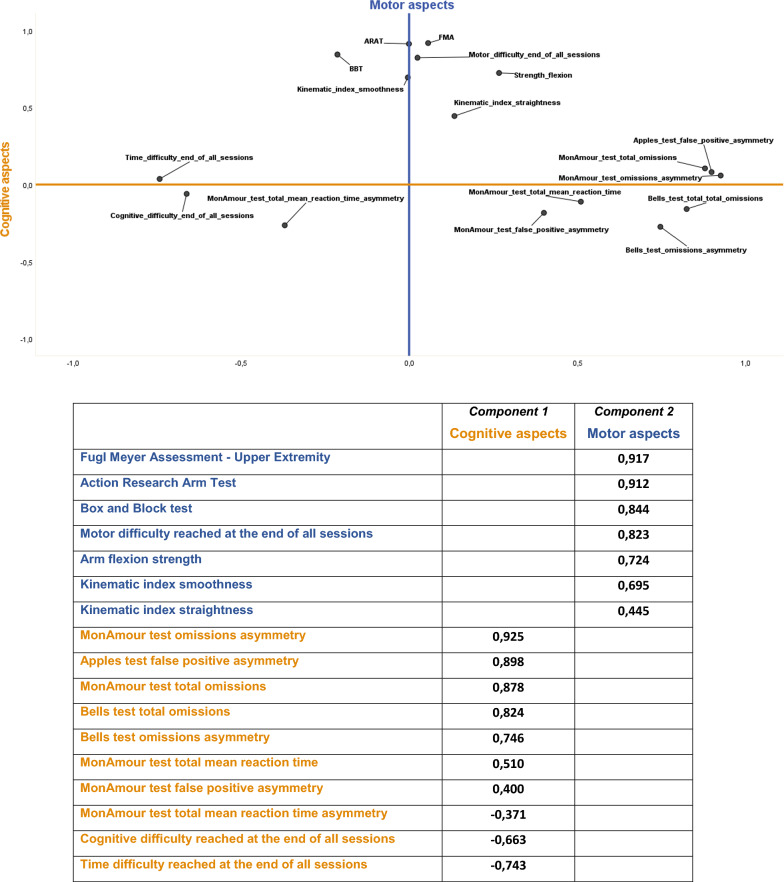
Results: Game difficulty rapidly (within approximately thirty minutes) auto-adapted to match individual impairment levels. The relationship between task-difficulty parameters with motor (Fugl Meyer Assessment: r = 0.84 p < 0.05) and with attentional impairments (Bells test total omissions: r = 0.617 p < 0.05) showed that task-difficulty during RAT adapted to each participant's degree of impairment. Principal component analysis identified two data subsets determining overall task-difficulty, one subset for motor and the other for cognitive functional evaluation scores with respective task-difficulty parameters.
Conclusions: This proof of concept clinically validated a DDA mechanism and showed how task-difficulty adequately adapted to match individual degrees of impairment during RAT after stroke. ROBiGAME provided simultaneous motor and attentional exercises with parameters determining task-difficulty strongly related with respective clinical and robotic evaluation scores. Individualized levels of game difficulty and rapid adjustment of the system suggest implementation in clinical practice. Registry number This study was registered at ClinicalTrials.gov (NCT02543424).
期刊介绍:
Journal of NeuroEngineering and Rehabilitation considers manuscripts on all aspects of research that result from cross-fertilization of the fields of neuroscience, biomedical engineering, and physical medicine & rehabilitation.





 京公网安备 11010802042870号
京ICP备2023020795号-1
京公网安备 11010802042870号
京ICP备2023020795号-1

 分享
分享
 求助内容:
求助内容: 应助结果提醒方式:
 扫码关注我们
