Keitaro Ohashi, Kosei Nishimura, Kaito Nagita, Takuya Hashimoto, Shoko Nakahata, Takashi Harada, Toshiaki Ina, Prof. Dr. Shuji Nakanishi, Prof. Dr. Kazuhide Kamiya
{"title":"Size-Dependency of Electrochemically Grown Copper Nanoclusters Derived from Single Copper Atoms for the CO Reduction Reaction","authors":"Keitaro Ohashi, Kosei Nishimura, Kaito Nagita, Takuya Hashimoto, Shoko Nakahata, Takashi Harada, Toshiaki Ina, Prof. Dr. Shuji Nakanishi, Prof. Dr. Kazuhide Kamiya","doi":"10.1002/cssc.202402576","DOIUrl":null,"url":null,"abstract":"<p>Electrochemically grown copper nanoclusters (CuNCs: <3 nm) from single-atom catalysts have recently attracted intensive attention as electrocatalysts for CO<sub>2</sub> and CO reduction reaction (CO<sub>2</sub>RR/CORR) because they exhibit distinct product selectivity compared with conventional Cu nanoparticles (typically larger than 10nm). Herein, we conducted a detailed investigation into the size dependence of CuNCs on selectivity for multicarbon (C<sub>2+</sub>) production in CORR. These nanoclusters were electrochemically grown from single Cu atoms dispersed on covalent triazine frameworks (Cu-CTFs). <i>Operando</i> X-ray absorption fine structure analysis revealed that Cu-CTFs containing 1.21 wt % and 0.41 wt % Cu (Cu(h)-CTFs and Cu(l)-CTFs, respectively) formed CuNCs of 2.0 and 1.1 nm, respectively, at −1.0 V <i>vs</i>. RHE. The selectivity for CORR products was particularly dependent on the size of CuNCs, with the Faraday efficiencies of C<sub>2+</sub> products being 52.3 % and 32.7 % at −1.0 V <i>vs</i>. RHE with Cu(h)-CTFs and Cu(l)-CTFs, respectively. Spherical CuNCs modeling revealed that larger cluster sizes led to a greater proportion of a surface coordination number (SCN) of 8 or 9. Density functional calculations revealed that the CO dimerization reaction was more likely to proceed at SCNs of 8 or 9 compared to SCN of 7 because of the stability of the *OCCO intermediate.</p>","PeriodicalId":149,"journal":{"name":"ChemSusChem","volume":"18 10","pages":""},"PeriodicalIF":6.6000,"publicationDate":"2025-01-24","publicationTypes":"Journal Article","fieldsOfStudy":null,"isOpenAccess":false,"openAccessPdf":"https://onlinelibrary.wiley.com/doi/epdf/10.1002/cssc.202402576","citationCount":"0","resultStr":null,"platform":"Semanticscholar","paperid":null,"PeriodicalName":"ChemSusChem","FirstCategoryId":"92","ListUrlMain":"https://chemistry-europe.onlinelibrary.wiley.com/doi/10.1002/cssc.202402576","RegionNum":2,"RegionCategory":"化学","ArticlePicture":[],"TitleCN":null,"AbstractTextCN":null,"PMCID":null,"EPubDate":"","PubModel":"","JCR":"Q1","JCRName":"CHEMISTRY, MULTIDISCIPLINARY","Score":null,"Total":0}
引用次数: 0
Abstract
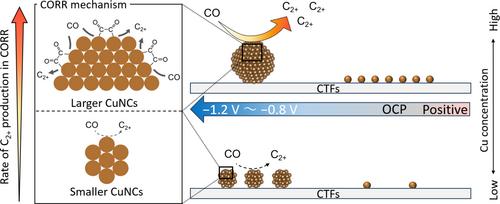
Electrochemically grown copper nanoclusters (CuNCs: <3 nm) from single-atom catalysts have recently attracted intensive attention as electrocatalysts for CO2 and CO reduction reaction (CO2RR/CORR) because they exhibit distinct product selectivity compared with conventional Cu nanoparticles (typically larger than 10nm). Herein, we conducted a detailed investigation into the size dependence of CuNCs on selectivity for multicarbon (C2+) production in CORR. These nanoclusters were electrochemically grown from single Cu atoms dispersed on covalent triazine frameworks (Cu-CTFs). Operando X-ray absorption fine structure analysis revealed that Cu-CTFs containing 1.21 wt % and 0.41 wt % Cu (Cu(h)-CTFs and Cu(l)-CTFs, respectively) formed CuNCs of 2.0 and 1.1 nm, respectively, at −1.0 V vs. RHE. The selectivity for CORR products was particularly dependent on the size of CuNCs, with the Faraday efficiencies of C2+ products being 52.3 % and 32.7 % at −1.0 V vs. RHE with Cu(h)-CTFs and Cu(l)-CTFs, respectively. Spherical CuNCs modeling revealed that larger cluster sizes led to a greater proportion of a surface coordination number (SCN) of 8 or 9. Density functional calculations revealed that the CO dimerization reaction was more likely to proceed at SCNs of 8 or 9 compared to SCN of 7 because of the stability of the *OCCO intermediate.
期刊介绍:
ChemSusChem
Impact Factor (2016): 7.226
Scope:
Interdisciplinary journal
Focuses on research at the interface of chemistry and sustainability
Features the best research on sustainability and energy
Areas Covered:
Chemistry
Materials Science
Chemical Engineering
Biotechnology






 京公网安备 11010802042870号
京ICP备2023020795号-1
京公网安备 11010802042870号
京ICP备2023020795号-1

 分享
分享
 求助内容:
求助内容: 应助结果提醒方式:
 扫码关注我们
