Bone Marrow Stromal Cells Generate a Pro-Healing Inflammasome When Cultured on Titanium-Aluminum-Vanadium Surfaces with Microscale/Nanoscale Structural Features.
David J Cohen, Christine M Van Duyn, Jingyao Deng, Musaddiq K Lodi, Michelle B Gallagher, James T Sugar, Jeremy J Rawlinson, Preetam Ghosh, Barbara D Boyan, Zvi Schwartz
{"title":"Bone Marrow Stromal Cells Generate a Pro-Healing Inflammasome When Cultured on Titanium-Aluminum-Vanadium Surfaces with Microscale/Nanoscale Structural Features.","authors":"David J Cohen, Christine M Van Duyn, Jingyao Deng, Musaddiq K Lodi, Michelle B Gallagher, James T Sugar, Jeremy J Rawlinson, Preetam Ghosh, Barbara D Boyan, Zvi Schwartz","doi":"10.3390/biomimetics10010066","DOIUrl":null,"url":null,"abstract":"<p><p>The surface topography and chemistry of titanium-aluminum-vanadium (Ti6Al4V) implants play critical roles in the osteoblast differentiation of human bone marrow stromal cells (MSCs) and the creation of an osteogenic microenvironment. To assess the effects of a microscale/nanoscale (MN) topography, this study compared the effects of MN-modified, anodized, and smooth Ti6Al4V surfaces on MSC response, and for the first time, directly contrasted MN-induced osteoblast differentiation with culture on tissue culture polystyrene (TCPS) in osteogenic medium (OM). Surface characterization revealed distinct differences in microroughness, composition, and topography among the Ti6Al4V substrates. MSCs on MN surfaces exhibited enhanced osteoblastic differentiation, evidenced by increased expression of RUNX2, SP7, BGLAP, BMP2, and BMPR1A (fold increases: 3.2, 1.8, 1.4, 1.3, and 1.2). The MN surface also induced a pro-healing inflammasome with upregulation of anti-inflammatory mediators (170-200% increase) and downregulation of pro-inflammatory factors (40-82% reduction). Integrin expression shifted towards osteoblast-associated integrins on MN surfaces. RNA-seq analysis revealed distinct gene expression profiles between MSCs on MN surfaces and those in OM, with only 199 shared genes out of over 1000 differentially expressed genes. Pathway analysis showed that MN surfaces promoted bone formation, maturation, and remodeling through non-canonical Wnt signaling, while OM stimulated endochondral bone development and mineralization via canonical Wnt3a signaling. These findings highlight the importance of Ti6Al4V surface properties in directing MSC differentiation and indicate that MN-modified surfaces act via signaling pathways that differ from OM culture methods, more accurately mimicking peri-implant osteogenesis in vivo.</p>","PeriodicalId":8907,"journal":{"name":"Biomimetics","volume":"10 1","pages":""},"PeriodicalIF":3.9000,"publicationDate":"2025-01-19","publicationTypes":"Journal Article","fieldsOfStudy":null,"isOpenAccess":false,"openAccessPdf":"https://www.ncbi.nlm.nih.gov/pmc/articles/PMC11759188/pdf/","citationCount":"0","resultStr":null,"platform":"Semanticscholar","paperid":null,"PeriodicalName":"Biomimetics","FirstCategoryId":"5","ListUrlMain":"https://doi.org/10.3390/biomimetics10010066","RegionNum":3,"RegionCategory":"医学","ArticlePicture":[],"TitleCN":null,"AbstractTextCN":null,"PMCID":null,"EPubDate":"","PubModel":"","JCR":"Q1","JCRName":"ENGINEERING, MULTIDISCIPLINARY","Score":null,"Total":0}
引用次数: 0
Abstract
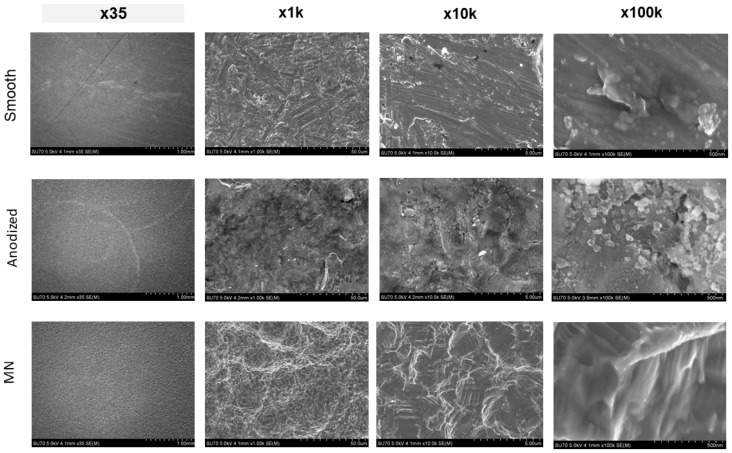
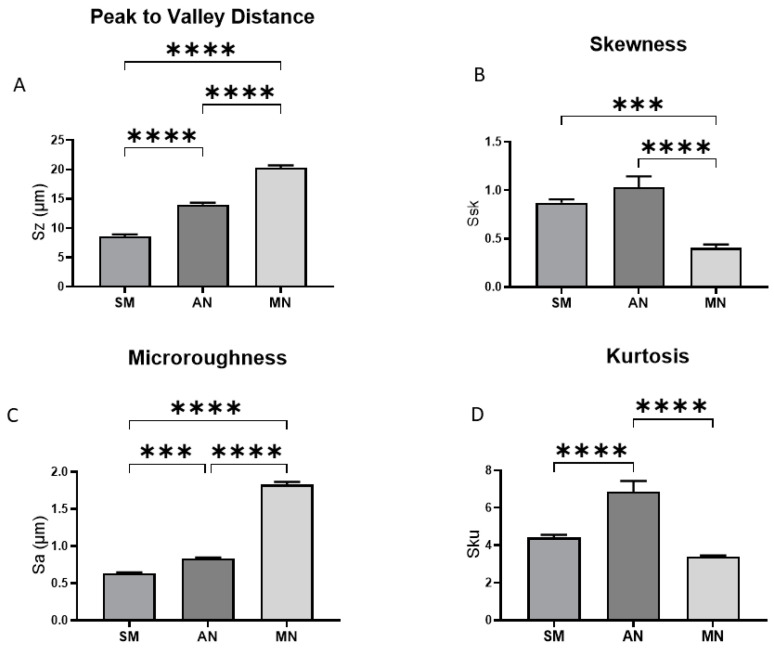
The surface topography and chemistry of titanium-aluminum-vanadium (Ti6Al4V) implants play critical roles in the osteoblast differentiation of human bone marrow stromal cells (MSCs) and the creation of an osteogenic microenvironment. To assess the effects of a microscale/nanoscale (MN) topography, this study compared the effects of MN-modified, anodized, and smooth Ti6Al4V surfaces on MSC response, and for the first time, directly contrasted MN-induced osteoblast differentiation with culture on tissue culture polystyrene (TCPS) in osteogenic medium (OM). Surface characterization revealed distinct differences in microroughness, composition, and topography among the Ti6Al4V substrates. MSCs on MN surfaces exhibited enhanced osteoblastic differentiation, evidenced by increased expression of RUNX2, SP7, BGLAP, BMP2, and BMPR1A (fold increases: 3.2, 1.8, 1.4, 1.3, and 1.2). The MN surface also induced a pro-healing inflammasome with upregulation of anti-inflammatory mediators (170-200% increase) and downregulation of pro-inflammatory factors (40-82% reduction). Integrin expression shifted towards osteoblast-associated integrins on MN surfaces. RNA-seq analysis revealed distinct gene expression profiles between MSCs on MN surfaces and those in OM, with only 199 shared genes out of over 1000 differentially expressed genes. Pathway analysis showed that MN surfaces promoted bone formation, maturation, and remodeling through non-canonical Wnt signaling, while OM stimulated endochondral bone development and mineralization via canonical Wnt3a signaling. These findings highlight the importance of Ti6Al4V surface properties in directing MSC differentiation and indicate that MN-modified surfaces act via signaling pathways that differ from OM culture methods, more accurately mimicking peri-implant osteogenesis in vivo.





 京公网安备 11010802042870号
京ICP备2023020795号-1
京公网安备 11010802042870号
京ICP备2023020795号-1

 分享
分享
 求助内容:
求助内容: 应助结果提醒方式:
 扫码关注我们
