Katharina Suntinger, Adrian Dalbert, Lukas Prochazka, Milena Tegelkamp, Peter Kronen, Karina Klein, Christof Röösli, Alexander Huber, Flurin Pfiffner
{"title":"Normative Values of Brainstem Auditory-Evoked Responses in Sheep.","authors":"Katharina Suntinger, Adrian Dalbert, Lukas Prochazka, Milena Tegelkamp, Peter Kronen, Karina Klein, Christof Röösli, Alexander Huber, Flurin Pfiffner","doi":"10.3390/brainsci15010069","DOIUrl":null,"url":null,"abstract":"<p><p><b>Background:</b> The brainstem auditory-evoked response (BAER) is an established electrophysiological measure of neural activity from the auditory nerve up to the brain stem. The BAER is used to diagnose abnormalities in auditory pathways and in neurophysiological human and animal research. However, normative data for BAERs in sheep, which represent an adequate large animal model for translational and basic otological research, are lacking. <b>Objective:</b> The aim of this study was to assess the function of the ovine auditory nervous system by determining normative values for the BAER and to compare sheep with human BAER data. <b>Methods:</b> In this retrospective study, BAER data for click stimuli at a range of sound pressure levels (SPLs) were analyzed. A series of 15 samples from six sheep with a mean age of 41.8 months was included. <b>Results:</b> The mean BAER threshold was 45.3 dB SPL. At 100 dB SPL, the mean (±standard deviation, SD) latency of wave V was 4.35 (±0.18) ms, that of wave III was 2.44 (±0.15) ms, and that of wave I was 0.88 (±0.13) ms. At 100 dB SPL, the mean interpeak latency of waves I-III was 1.56 (±0.18) ms, that of waves III-V was 1.91 (±0.16) ms, and that of waves I-V was 3.47 (±0.20) ms. The mean amplitudes at 100 dB SPL were 0.04 (±0.03) µV for wave I, 0.50 (±0.24) µV for wave III, and 0.40 (±0.25) µV for wave V. <b>Conclusions:</b> The normative values for sheep BAERs were reproducible and similar to those of humans. The normative BAER values further support sheep as an adequate animal model for otological research.</p>","PeriodicalId":9095,"journal":{"name":"Brain Sciences","volume":"15 1","pages":""},"PeriodicalIF":2.8000,"publicationDate":"2025-01-14","publicationTypes":"Journal Article","fieldsOfStudy":null,"isOpenAccess":false,"openAccessPdf":"https://www.ncbi.nlm.nih.gov/pmc/articles/PMC11763452/pdf/","citationCount":"0","resultStr":null,"platform":"Semanticscholar","paperid":null,"PeriodicalName":"Brain Sciences","FirstCategoryId":"3","ListUrlMain":"https://doi.org/10.3390/brainsci15010069","RegionNum":3,"RegionCategory":"医学","ArticlePicture":[],"TitleCN":null,"AbstractTextCN":null,"PMCID":null,"EPubDate":"","PubModel":"","JCR":"Q3","JCRName":"NEUROSCIENCES","Score":null,"Total":0}
引用次数: 0
Abstract
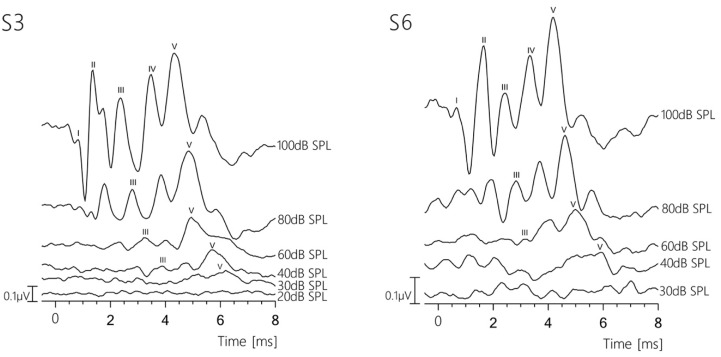
Background: The brainstem auditory-evoked response (BAER) is an established electrophysiological measure of neural activity from the auditory nerve up to the brain stem. The BAER is used to diagnose abnormalities in auditory pathways and in neurophysiological human and animal research. However, normative data for BAERs in sheep, which represent an adequate large animal model for translational and basic otological research, are lacking. Objective: The aim of this study was to assess the function of the ovine auditory nervous system by determining normative values for the BAER and to compare sheep with human BAER data. Methods: In this retrospective study, BAER data for click stimuli at a range of sound pressure levels (SPLs) were analyzed. A series of 15 samples from six sheep with a mean age of 41.8 months was included. Results: The mean BAER threshold was 45.3 dB SPL. At 100 dB SPL, the mean (±standard deviation, SD) latency of wave V was 4.35 (±0.18) ms, that of wave III was 2.44 (±0.15) ms, and that of wave I was 0.88 (±0.13) ms. At 100 dB SPL, the mean interpeak latency of waves I-III was 1.56 (±0.18) ms, that of waves III-V was 1.91 (±0.16) ms, and that of waves I-V was 3.47 (±0.20) ms. The mean amplitudes at 100 dB SPL were 0.04 (±0.03) µV for wave I, 0.50 (±0.24) µV for wave III, and 0.40 (±0.25) µV for wave V. Conclusions: The normative values for sheep BAERs were reproducible and similar to those of humans. The normative BAER values further support sheep as an adequate animal model for otological research.
期刊介绍:
Brain Sciences (ISSN 2076-3425) is a peer-reviewed scientific journal that publishes original articles, critical reviews, research notes and short communications in the areas of cognitive neuroscience, developmental neuroscience, molecular and cellular neuroscience, neural engineering, neuroimaging, neurolinguistics, neuropathy, systems neuroscience, and theoretical and computational neuroscience. Our aim is to encourage scientists to publish their experimental and theoretical results in as much detail as possible. There is no restriction on the length of the papers. The full experimental details must be provided so that the results can be reproduced. Electronic files or software regarding the full details of the calculation and experimental procedure, if unable to be published in a normal way, can be deposited as supplementary material.





 京公网安备 11010802042870号
京ICP备2023020795号-1
京公网安备 11010802042870号
京ICP备2023020795号-1

 分享
分享
 求助内容:
求助内容: 应助结果提醒方式:
 扫码关注我们
