Rishishankar E Suresh, M S Zobaer, Matthew J Triano, Brian F Saway, Parneet Grewal, Nathan C Rowland
{"title":"Exploring Machine Learning Classification of Movement Phases in Hemiparetic Stroke Patients: A Controlled EEG-tDCS Study.","authors":"Rishishankar E Suresh, M S Zobaer, Matthew J Triano, Brian F Saway, Parneet Grewal, Nathan C Rowland","doi":"10.3390/brainsci15010028","DOIUrl":null,"url":null,"abstract":"<p><strong>Background/objectives: </strong>Noninvasive brain stimulation (NIBS) can boost motor recovery after a stroke. Certain movement phases are more responsive to NIBS, so a system that auto-detects these phases would optimize stimulation timing. This study assessed the effectiveness of various machine learning models in identifying movement phases in hemiparetic individuals undergoing simultaneous NIBS and EEG recordings. We hypothesized that transcranial direct current stimulation (tDCS), a form of NIBS, would enhance EEG signals related to movement phases and improve classification accuracy compared to sham stimulation.</p><p><strong>Methods: </strong>EEG data from 10 chronic stroke patients and 11 healthy controls were recorded before, during, and after tDCS. Eight machine learning algorithms and five ensemble methods were used to classify two movement phases (hold posture and reaching) during each of these periods. Data preprocessing included z-score normalization and frequency band power binning.</p><p><strong>Results: </strong>In chronic stroke participants who received active tDCS, the classification accuracy for hold vs. reach phases increased from pre-stimulation to the late intra-stimulation period (72.2% to 75.2%, <i>p</i> < 0.0001). Late active tDCS surpassed late sham tDCS classification (75.2% vs. 71.5%, <i>p</i> < 0.0001). Linear discriminant analysis was the most accurate (74.6%) algorithm with the shortest training time (0.9 s). Among ensemble methods, low gamma frequency (30-50 Hz) achieved the highest accuracy (74.5%), although this result did not achieve statistical significance for actively stimulated chronic stroke participants.</p><p><strong>Conclusions: </strong>Machine learning algorithms showed enhanced movement phase classification during active tDCS in chronic stroke participants. These results suggest their feasibility for real-time movement detection in neurorehabilitation, including brain-computer interfaces for stroke recovery.</p>","PeriodicalId":9095,"journal":{"name":"Brain Sciences","volume":"15 1","pages":""},"PeriodicalIF":2.8000,"publicationDate":"2024-12-29","publicationTypes":"Journal Article","fieldsOfStudy":null,"isOpenAccess":false,"openAccessPdf":"https://www.ncbi.nlm.nih.gov/pmc/articles/PMC11764431/pdf/","citationCount":"0","resultStr":null,"platform":"Semanticscholar","paperid":null,"PeriodicalName":"Brain Sciences","FirstCategoryId":"3","ListUrlMain":"https://doi.org/10.3390/brainsci15010028","RegionNum":3,"RegionCategory":"医学","ArticlePicture":[],"TitleCN":null,"AbstractTextCN":null,"PMCID":null,"EPubDate":"","PubModel":"","JCR":"Q3","JCRName":"NEUROSCIENCES","Score":null,"Total":0}
引用次数: 0
Abstract
Background/objectives: Noninvasive brain stimulation (NIBS) can boost motor recovery after a stroke. Certain movement phases are more responsive to NIBS, so a system that auto-detects these phases would optimize stimulation timing. This study assessed the effectiveness of various machine learning models in identifying movement phases in hemiparetic individuals undergoing simultaneous NIBS and EEG recordings. We hypothesized that transcranial direct current stimulation (tDCS), a form of NIBS, would enhance EEG signals related to movement phases and improve classification accuracy compared to sham stimulation.
Methods: EEG data from 10 chronic stroke patients and 11 healthy controls were recorded before, during, and after tDCS. Eight machine learning algorithms and five ensemble methods were used to classify two movement phases (hold posture and reaching) during each of these periods. Data preprocessing included z-score normalization and frequency band power binning.
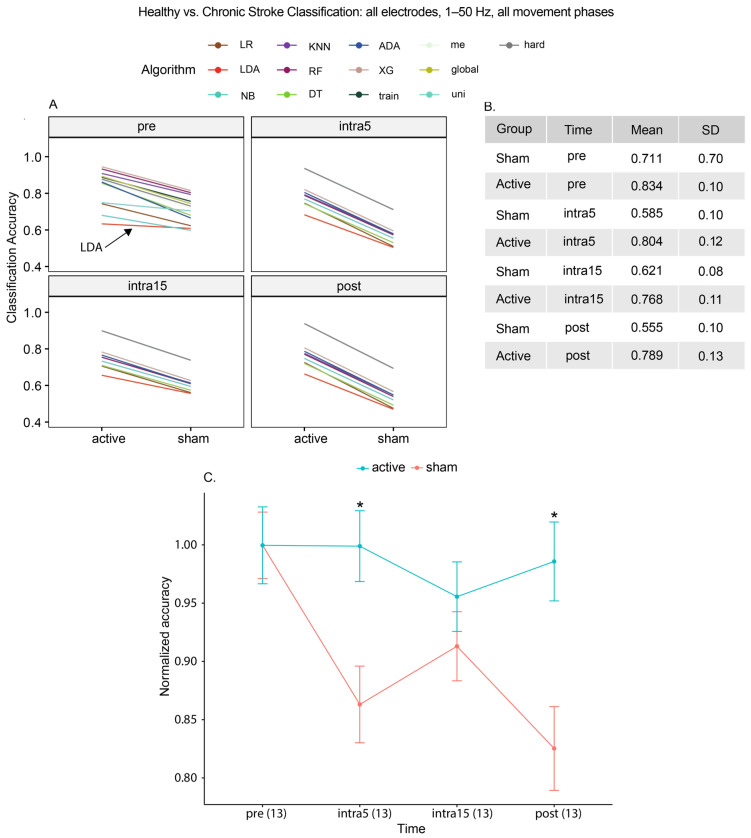
Results: In chronic stroke participants who received active tDCS, the classification accuracy for hold vs. reach phases increased from pre-stimulation to the late intra-stimulation period (72.2% to 75.2%, p < 0.0001). Late active tDCS surpassed late sham tDCS classification (75.2% vs. 71.5%, p < 0.0001). Linear discriminant analysis was the most accurate (74.6%) algorithm with the shortest training time (0.9 s). Among ensemble methods, low gamma frequency (30-50 Hz) achieved the highest accuracy (74.5%), although this result did not achieve statistical significance for actively stimulated chronic stroke participants.
Conclusions: Machine learning algorithms showed enhanced movement phase classification during active tDCS in chronic stroke participants. These results suggest their feasibility for real-time movement detection in neurorehabilitation, including brain-computer interfaces for stroke recovery.
期刊介绍:
Brain Sciences (ISSN 2076-3425) is a peer-reviewed scientific journal that publishes original articles, critical reviews, research notes and short communications in the areas of cognitive neuroscience, developmental neuroscience, molecular and cellular neuroscience, neural engineering, neuroimaging, neurolinguistics, neuropathy, systems neuroscience, and theoretical and computational neuroscience. Our aim is to encourage scientists to publish their experimental and theoretical results in as much detail as possible. There is no restriction on the length of the papers. The full experimental details must be provided so that the results can be reproduced. Electronic files or software regarding the full details of the calculation and experimental procedure, if unable to be published in a normal way, can be deposited as supplementary material.





 京公网安备 11010802042870号
京ICP备2023020795号-1
京公网安备 11010802042870号
京ICP备2023020795号-1

 分享
分享
 求助内容:
求助内容: 应助结果提醒方式:
 扫码关注我们
