Anne Bettina Beeskow, Holger Gößmann, Hans-Jonas Meyer, Daniel Seehofer, Thomas Berg, Florian van Bömmel, Aaron Schindler, Manuel Florian Struck, Timm Denecke, Sebastian Ebel
{"title":"Comparison of CT-Guided Microwave Ablation of Liver Malignancies with and Without Intra-Arterial Catheter Placement for Contrast Administration.","authors":"Anne Bettina Beeskow, Holger Gößmann, Hans-Jonas Meyer, Daniel Seehofer, Thomas Berg, Florian van Bömmel, Aaron Schindler, Manuel Florian Struck, Timm Denecke, Sebastian Ebel","doi":"10.3390/curroncol32010028","DOIUrl":null,"url":null,"abstract":"<p><strong>Background: </strong>The aim of this study was to compare microwave ablation (MWA) with and without prior placement of an intra-arterial catheter for the purpose of application of contrast medium (CM).</p><p><strong>Methods: </strong>148 patients (45 female, 65.1 ± 14.9 years) with liver tumors who underwent CT-guided MWA were included. Of these, 25 patients had an IA catheter placed in the hepatic artery.</p><p><strong>Results: </strong>37 patients underwent planning imaging for MWA without CM. A total of 86 patients received a standard dose of 80 mL intravenous (IV) CM for the planning scans. The patients with an IA catheter (<i>n</i> = 25) received an IA application of 10 mL CM. A total of 29 patients received contrast-enhanced scans in the PV phase for control of needle positioning after IV application of a standard dose of 80 mL CM. In patients with an IA catheter, control of the needle position was performed by single-slice scans. IA CM application during the ablation enabled monitoring of the ablation zone. Over the entire intervention, patients with IA catheters received less CM as compared to patients without an IA catheter (39.1 ± 10.4 mL vs. 141 ± 39.69 mL; <i>p</i> < 0.001).</p><p><strong>Conclusions: </strong>IA catheter placement was associated with a significant decrease of the amount of CM during MWA and enabled monitoring of the ablation zone.</p>","PeriodicalId":11012,"journal":{"name":"Current oncology","volume":"32 1","pages":""},"PeriodicalIF":3.4000,"publicationDate":"2025-01-02","publicationTypes":"Journal Article","fieldsOfStudy":null,"isOpenAccess":false,"openAccessPdf":"https://www.ncbi.nlm.nih.gov/pmc/articles/PMC11764381/pdf/","citationCount":"0","resultStr":null,"platform":"Semanticscholar","paperid":null,"PeriodicalName":"Current oncology","FirstCategoryId":"3","ListUrlMain":"https://doi.org/10.3390/curroncol32010028","RegionNum":4,"RegionCategory":"医学","ArticlePicture":[],"TitleCN":null,"AbstractTextCN":null,"PMCID":null,"EPubDate":"","PubModel":"","JCR":"Q2","JCRName":"ONCOLOGY","Score":null,"Total":0}
引用次数: 0
Abstract
Background: The aim of this study was to compare microwave ablation (MWA) with and without prior placement of an intra-arterial catheter for the purpose of application of contrast medium (CM).
Methods: 148 patients (45 female, 65.1 ± 14.9 years) with liver tumors who underwent CT-guided MWA were included. Of these, 25 patients had an IA catheter placed in the hepatic artery.
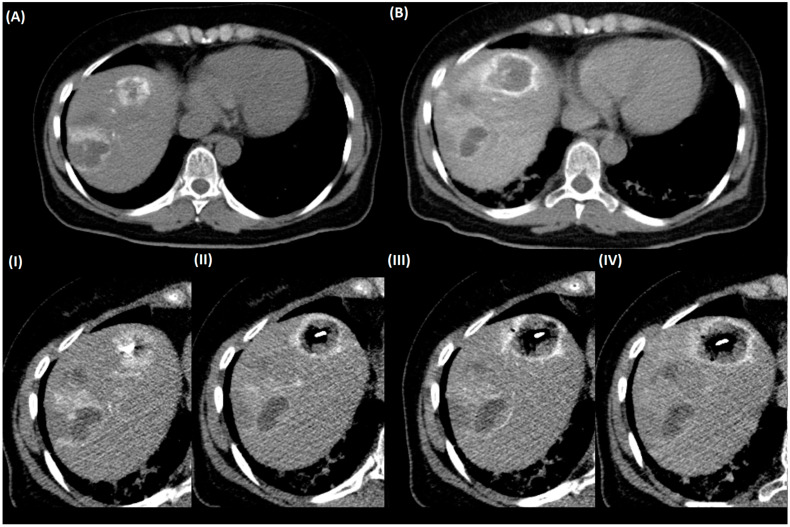
Results: 37 patients underwent planning imaging for MWA without CM. A total of 86 patients received a standard dose of 80 mL intravenous (IV) CM for the planning scans. The patients with an IA catheter (n = 25) received an IA application of 10 mL CM. A total of 29 patients received contrast-enhanced scans in the PV phase for control of needle positioning after IV application of a standard dose of 80 mL CM. In patients with an IA catheter, control of the needle position was performed by single-slice scans. IA CM application during the ablation enabled monitoring of the ablation zone. Over the entire intervention, patients with IA catheters received less CM as compared to patients without an IA catheter (39.1 ± 10.4 mL vs. 141 ± 39.69 mL; p < 0.001).
Conclusions: IA catheter placement was associated with a significant decrease of the amount of CM during MWA and enabled monitoring of the ablation zone.
背景:本研究的目的是比较微波消融(MWA)是否预先放置动脉内导管以应用造影剂(CM)。方法:148例肝癌患者(女性45例,65.1±14.9岁)行ct引导下MWA。其中,25例患者在肝动脉内放置了IA导管。结果:37例患者行无CM的MWA计划影像学检查。共有86例患者接受标准剂量的80ml静脉注射(IV) CM进行计划扫描。放置IA导管的患者(n = 25)接受10 mL CM的IA应用。共有29例患者在静脉注射标准剂量80 mL CM后,在PV期接受了对比增强扫描,以控制针头的定位。在使用IA导管的患者中,通过单排片扫描来控制针的位置。在消融过程中应用IA CM,可以对消融区域进行监测。在整个干预过程中,与未使用IA导管的患者相比,使用IA导管的患者接受的CM较少(39.1±10.4 mL vs 141±39.69 mL;P < 0.001)。结论:在MWA期间放置IA导管与CM数量的显著减少有关,并使消融区监测成为可能。
期刊介绍:
Current Oncology is a peer-reviewed, Canadian-based and internationally respected journal. Current Oncology represents a multidisciplinary medium encompassing health care workers in the field of cancer therapy in Canada to report upon and to review progress in the management of this disease.
We encourage submissions from all fields of cancer medicine, including radiation oncology, surgical oncology, medical oncology, pediatric oncology, pathology, and cancer rehabilitation and survivorship. Articles published in the journal typically contain information that is relevant directly to clinical oncology practice, and have clear potential for application to the current or future practice of cancer medicine.



 京公网安备 11010802042870号
京ICP备2023020795号-1
京公网安备 11010802042870号
京ICP备2023020795号-1

 分享
分享
 求助内容:
求助内容: 应助结果提醒方式:
 扫码关注我们
