Development of Aspergillus oryzae BCC7051 as a Robust Cell Factory Towards the Transcriptional Regulation of Protease-Encoding Genes for Industrial Applications.
{"title":"Development of <i>Aspergillus oryzae</i> BCC7051 as a Robust Cell Factory Towards the Transcriptional Regulation of Protease-Encoding Genes for Industrial Applications.","authors":"Sarocha Panchanawaporn, Chanikul Chutrakul, Sukanya Jeennor, Jutamas Anantayanon, Kobkul Laoteng","doi":"10.3390/jof11010006","DOIUrl":null,"url":null,"abstract":"<p><p>Enzyme-mediated protein degradation is a major concern in industrial fungal strain improvement, making low-proteolytic strains preferable for enhanced protein production. Here, we improved food-grade <i>Aspergillus oryzae</i> BCC7051 by manipulating the transcriptional regulation of protease-encoding genes. Genome mining of the transcription factor <i>AoprtR</i> and computational analysis confirmed its deduced amino acid sequence sharing evolutionary conservation across <i>Aspergillus</i> and <i>Penicillium</i> spp. The AoPrtR protein, which is classified into the Zn(II)2-Cys6-type transcription factor family, manipulates both intra- and extracellular proteolytic enzymes. Our transcriptional analysis indicated that the regulation of several protease-encoding genes was AoPrtR-dependent, with AoPrtR acting as a potent activator for extracellular acid-protease-encoding genes and a likely repressor for intracellular non-acid-protease-encoding genes. An indirect regulatory mechanism independent of PrtR may enhance proteolysis. Moreover, AoPrtR disruption increased extracellular esterase production by 2.55-fold, emphasizing its role in protein secretion. Our findings highlight the complexity of AoPrtR-mediated regulation by <i>A. oryzae</i>. Manipulation of regulatory processes through AoPrtR prevents secreted protein degradation and enhances the quantity of extracellular proteins, suggesting the low-proteolytic variant as a promising platform for the production of these proteins. This modified strain has biotechnological potential for further refinement and sustainable production of bio-based products in the food, feed, and nutraceutical industries.</p>","PeriodicalId":15878,"journal":{"name":"Journal of Fungi","volume":"11 1","pages":""},"PeriodicalIF":4.2000,"publicationDate":"2024-12-25","publicationTypes":"Journal Article","fieldsOfStudy":null,"isOpenAccess":false,"openAccessPdf":"https://www.ncbi.nlm.nih.gov/pmc/articles/PMC11765966/pdf/","citationCount":"0","resultStr":null,"platform":"Semanticscholar","paperid":null,"PeriodicalName":"Journal of Fungi","FirstCategoryId":"99","ListUrlMain":"https://doi.org/10.3390/jof11010006","RegionNum":2,"RegionCategory":"生物学","ArticlePicture":[],"TitleCN":null,"AbstractTextCN":null,"PMCID":null,"EPubDate":"","PubModel":"","JCR":"Q2","JCRName":"MICROBIOLOGY","Score":null,"Total":0}
引用次数: 0
Abstract
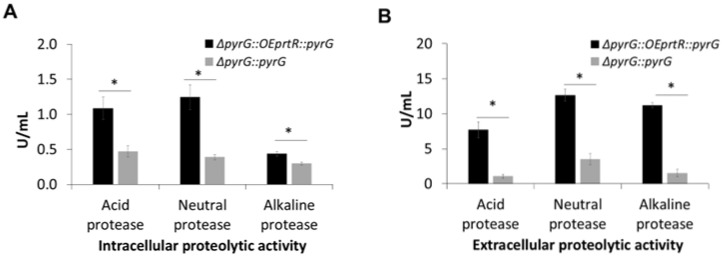
Enzyme-mediated protein degradation is a major concern in industrial fungal strain improvement, making low-proteolytic strains preferable for enhanced protein production. Here, we improved food-grade Aspergillus oryzae BCC7051 by manipulating the transcriptional regulation of protease-encoding genes. Genome mining of the transcription factor AoprtR and computational analysis confirmed its deduced amino acid sequence sharing evolutionary conservation across Aspergillus and Penicillium spp. The AoPrtR protein, which is classified into the Zn(II)2-Cys6-type transcription factor family, manipulates both intra- and extracellular proteolytic enzymes. Our transcriptional analysis indicated that the regulation of several protease-encoding genes was AoPrtR-dependent, with AoPrtR acting as a potent activator for extracellular acid-protease-encoding genes and a likely repressor for intracellular non-acid-protease-encoding genes. An indirect regulatory mechanism independent of PrtR may enhance proteolysis. Moreover, AoPrtR disruption increased extracellular esterase production by 2.55-fold, emphasizing its role in protein secretion. Our findings highlight the complexity of AoPrtR-mediated regulation by A. oryzae. Manipulation of regulatory processes through AoPrtR prevents secreted protein degradation and enhances the quantity of extracellular proteins, suggesting the low-proteolytic variant as a promising platform for the production of these proteins. This modified strain has biotechnological potential for further refinement and sustainable production of bio-based products in the food, feed, and nutraceutical industries.
期刊介绍:
Journal of Fungi (ISSN 2309-608X) is an international, peer-reviewed scientific open access journal that provides an advanced forum for studies related to pathogenic fungi, fungal biology, and all other aspects of fungal research. The journal publishes reviews, regular research papers, and communications in quarterly issues. Our aim is to encourage scientists to publish their experimental and theoretical results in as much detail as possible. Therefore, there is no restriction on paper length. Full experimental details must be provided so that the results can be reproduced.




 京公网安备 11010802042870号
京ICP备2023020795号-1
京公网安备 11010802042870号
京ICP备2023020795号-1

 分享
分享
 求助内容:
求助内容: 应助结果提醒方式:
 扫码关注我们
