{"title":"Vistla: identifying influence paths with information theory.","authors":"Miron B Kursa","doi":"10.1093/bioinformatics/btaf036","DOIUrl":null,"url":null,"abstract":"<p><strong>Motivation: </strong>It is a challenging task to decipher the mechanisms of a complex system from observational data, especially in biology, where systems are sophisticated, measurements coarse, and multi-modality common. The typical approaches of inferring a network of relationships between a system's components struggle with the quality and feasibility of estimation, as well as with the interpretability of the results they yield. Said issues can be avoided, however, when dealing with a simpler problem of tracking only the influence paths, defined as circuits relying on the information of an experimental perturbation as it spreads through the system. Such an approach can be formalized with information theory and leads to a relatively streamlined, interpretable output, in contrast to the incomprehensibly dense 'haystack' networks produced by typical tools.</p><p><strong>Results: </strong>Following this idea, the paper introduces Vistla, a novel method built around tri-variate mutual information and data processing inequality, combined with a higher-order generalization of the widest path problem. Vistla can be used standalone, in a machine learning pipeline to aid interpretability, or as a tool for mediation analysis; the paper demonstrates its efficiency both in synthetic and real-world problems.</p><p><strong>Availability and implementation: </strong>The R package implementing the method is available at https://gitlab.com/mbq/vistla, as well as on CRAN.</p>","PeriodicalId":93899,"journal":{"name":"Bioinformatics (Oxford, England)","volume":" ","pages":""},"PeriodicalIF":5.4000,"publicationDate":"2025-02-04","publicationTypes":"Journal Article","fieldsOfStudy":null,"isOpenAccess":false,"openAccessPdf":"https://www.ncbi.nlm.nih.gov/pmc/articles/PMC11806950/pdf/","citationCount":"0","resultStr":null,"platform":"Semanticscholar","paperid":null,"PeriodicalName":"Bioinformatics (Oxford, England)","FirstCategoryId":"1085","ListUrlMain":"https://doi.org/10.1093/bioinformatics/btaf036","RegionNum":0,"RegionCategory":null,"ArticlePicture":[],"TitleCN":null,"AbstractTextCN":null,"PMCID":null,"EPubDate":"","PubModel":"","JCR":"","JCRName":"","Score":null,"Total":0}
引用次数: 0
Abstract
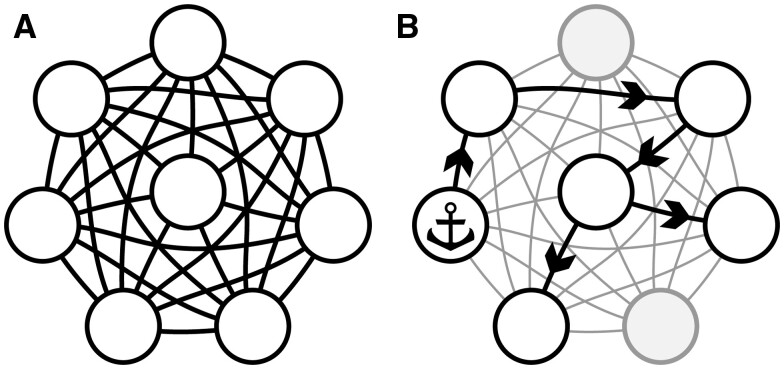
Motivation: It is a challenging task to decipher the mechanisms of a complex system from observational data, especially in biology, where systems are sophisticated, measurements coarse, and multi-modality common. The typical approaches of inferring a network of relationships between a system's components struggle with the quality and feasibility of estimation, as well as with the interpretability of the results they yield. Said issues can be avoided, however, when dealing with a simpler problem of tracking only the influence paths, defined as circuits relying on the information of an experimental perturbation as it spreads through the system. Such an approach can be formalized with information theory and leads to a relatively streamlined, interpretable output, in contrast to the incomprehensibly dense 'haystack' networks produced by typical tools.
Results: Following this idea, the paper introduces Vistla, a novel method built around tri-variate mutual information and data processing inequality, combined with a higher-order generalization of the widest path problem. Vistla can be used standalone, in a machine learning pipeline to aid interpretability, or as a tool for mediation analysis; the paper demonstrates its efficiency both in synthetic and real-world problems.
Availability and implementation: The R package implementing the method is available at https://gitlab.com/mbq/vistla, as well as on CRAN.





 京公网安备 11010802042870号
京ICP备2023020795号-1
京公网安备 11010802042870号
京ICP备2023020795号-1

 分享
分享

 求助内容:
求助内容: 应助结果提醒方式:
 扫码关注我们
