{"title":"An Embedding-Based Semantic Analysis Approach: A Preliminary Study on Redundancy Detection in Psychological Concepts Operationalized by Scales.","authors":"Zhen Huang, Yitian Long, Kaiping Peng, Song Tong","doi":"10.3390/jintelligence13010011","DOIUrl":null,"url":null,"abstract":"<p><p>As psychological research progresses, the issue of concept overlap becomes increasing evident, adding to participant burden and complicating data interpretation. This study introduces an Embedding-based Semantic Analysis Approach (ESAA) for detecting redundancy in psychological concepts, which are operationalized through their respective scales, using natural language processing techniques. The ESAA utilizes OpenAI's text-embedding-3-large model to generate high-dimensional semantic vectors (i.e., embeddings) of scale items and applies hierarchical clustering to group semantically similar items, revealing potential redundancy. Three preliminary experiments evaluated the ESAA's ability to (1) identify semantically similar items, (2) differentiate semantically distinct items, and (3) uncover overlap between scales of concepts known for redundancy issues. Additionally, comparative analyses assessed the ESAA's robustness and incremental validity against the advanced chatbots based on GPT-4. The results demonstrated that the ESAA consistently produced stable outcomes and outperformed all evaluated chatbots. As an objective approach for analyzing relationships between concepts operationalized as scales, the ESAA holds promise for advancing research on theory refinement and scale optimization.</p>","PeriodicalId":52279,"journal":{"name":"Journal of Intelligence","volume":"13 1","pages":""},"PeriodicalIF":3.4000,"publicationDate":"2025-01-16","publicationTypes":"Journal Article","fieldsOfStudy":null,"isOpenAccess":false,"openAccessPdf":"https://www.ncbi.nlm.nih.gov/pmc/articles/PMC11766606/pdf/","citationCount":"0","resultStr":null,"platform":"Semanticscholar","paperid":null,"PeriodicalName":"Journal of Intelligence","FirstCategoryId":"102","ListUrlMain":"https://doi.org/10.3390/jintelligence13010011","RegionNum":3,"RegionCategory":"心理学","ArticlePicture":[],"TitleCN":null,"AbstractTextCN":null,"PMCID":null,"EPubDate":"","PubModel":"","JCR":"Q1","JCRName":"PSYCHOLOGY, MULTIDISCIPLINARY","Score":null,"Total":0}
引用次数: 0
Abstract
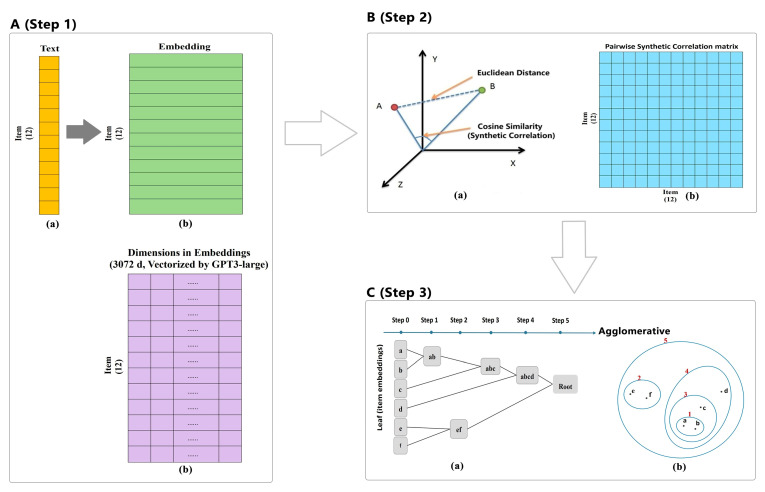
As psychological research progresses, the issue of concept overlap becomes increasing evident, adding to participant burden and complicating data interpretation. This study introduces an Embedding-based Semantic Analysis Approach (ESAA) for detecting redundancy in psychological concepts, which are operationalized through their respective scales, using natural language processing techniques. The ESAA utilizes OpenAI's text-embedding-3-large model to generate high-dimensional semantic vectors (i.e., embeddings) of scale items and applies hierarchical clustering to group semantically similar items, revealing potential redundancy. Three preliminary experiments evaluated the ESAA's ability to (1) identify semantically similar items, (2) differentiate semantically distinct items, and (3) uncover overlap between scales of concepts known for redundancy issues. Additionally, comparative analyses assessed the ESAA's robustness and incremental validity against the advanced chatbots based on GPT-4. The results demonstrated that the ESAA consistently produced stable outcomes and outperformed all evaluated chatbots. As an objective approach for analyzing relationships between concepts operationalized as scales, the ESAA holds promise for advancing research on theory refinement and scale optimization.






 京公网安备 11010802042870号
京ICP备2023020795号-1
京公网安备 11010802042870号
京ICP备2023020795号-1

 分享
分享
 求助内容:
求助内容: 应助结果提醒方式:
 扫码关注我们
