Maria De Risi, Lorenzo Cusimano, Xabier Bujanda Cundin, Mariateresa Pizzo, Ylenia Gigante, Mariagrazia Monaco, Chiara Di Eugenio, Elvira De Leonibus
{"title":"D1 dopamine receptor antagonists as a new therapeutic strategy to treat autistic-like behaviours in lysosomal storage disorders","authors":"Maria De Risi, Lorenzo Cusimano, Xabier Bujanda Cundin, Mariateresa Pizzo, Ylenia Gigante, Mariagrazia Monaco, Chiara Di Eugenio, Elvira De Leonibus","doi":"10.1038/s41380-025-02904-6","DOIUrl":null,"url":null,"abstract":"Lysosomal storage disorders characterized by defective heparan sulfate (HS) degradation, such as Mucopolysaccharidosis type IIIA-D (MPS-IIIA-D), result in neurodegeneration and dementia in children. However, dementia is preceded by severe autistic-like behaviours (ALBs), presenting as hyperactivity, stereotypies, social interaction deficits, and sleep disturbances. The absence of experimental studies on ALBs’ mechanisms in MPS-III has led clinicians to adopt symptomatic treatments, such as antipsychotics, which are used for non-genetic neuropsychiatric disorders. However, they have limited efficacy in MPS-III and lead to higher extrapyramidal effects, leaving ALBs in MPS-IIIA as an unmet medical need with a significant burden on patients and their families. Using mouse and cellular models of MPS-IIIA, we have previously shown that ALBs result from increased proliferation of mesencephalic dopamine neurons during embryogenesis. In adulthood, MPS-IIIA mice exhibit an imbalance of dopaminergic receptor subtypes, resulting in striatal overstimulation of the D1 dopamine receptor (D1R)-direct pathway, contrasting with a downregulation of the D2 dopamine receptor (D2R)-indirect pathway. In this study, we aimed to provide an evidence-based pharmacological approach for managing ALBs in MPS-IIIA. We hypothesized that rebalancing dopaminergic receptor signalling with a D1R antagonist, rather than a D2 antagonist, would lead to safe and effective treatment. Neither risperidone nor methylphenidate improves ALBs in the MPS-IIIA mouse model, with the former showing increased cataleptic (extrapyramidal-like) side effects compared to littermate wild-type animals. Methylphenidate, however, showed some beneficial effects on neuroinflammation and later manifesting dementia-like behaviours. In contrast, ecopipam, a D1 antagonist already used in the clinic for other neuropsychiatric disorders, rescues ALBs, cognition, D1 hyperactivity, and does not worsen neurodegenerative signs. These results align with recent evidence highlighting the clinical relevance of D1 antagonists for neuropsychiatric disorders and pave the way for their use in managing psychotic symptoms in neurodegenerative disorders such as dementia with Lewy bodies.","PeriodicalId":19008,"journal":{"name":"Molecular Psychiatry","volume":"30 7","pages":"2980-2993"},"PeriodicalIF":10.1000,"publicationDate":"2025-01-26","publicationTypes":"Journal Article","fieldsOfStudy":null,"isOpenAccess":false,"openAccessPdf":"https://www.nature.comhttps://www.nature.com/articles/s41380-025-02904-6.pdf","citationCount":"0","resultStr":null,"platform":"Semanticscholar","paperid":null,"PeriodicalName":"Molecular Psychiatry","FirstCategoryId":"3","ListUrlMain":"https://www.nature.com/articles/s41380-025-02904-6","RegionNum":1,"RegionCategory":"医学","ArticlePicture":[],"TitleCN":null,"AbstractTextCN":null,"PMCID":null,"EPubDate":"","PubModel":"","JCR":"Q1","JCRName":"BIOCHEMISTRY & MOLECULAR BIOLOGY","Score":null,"Total":0}
引用次数: 0
Abstract
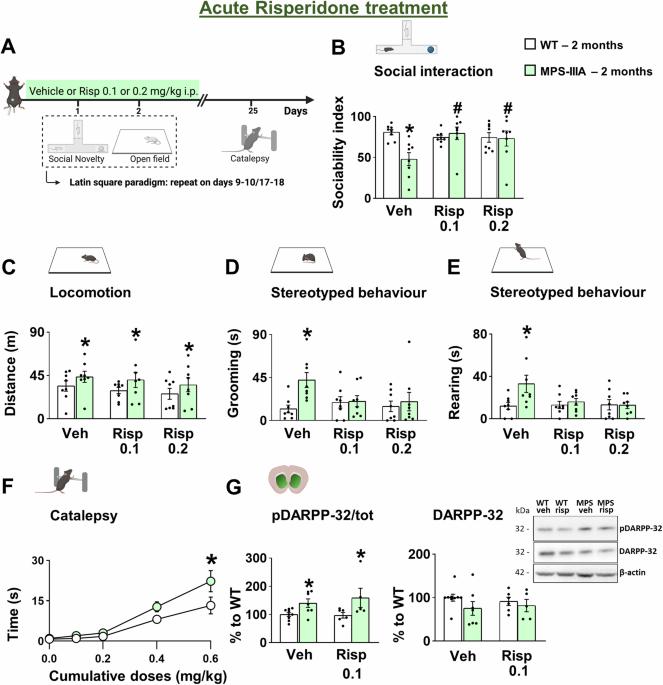
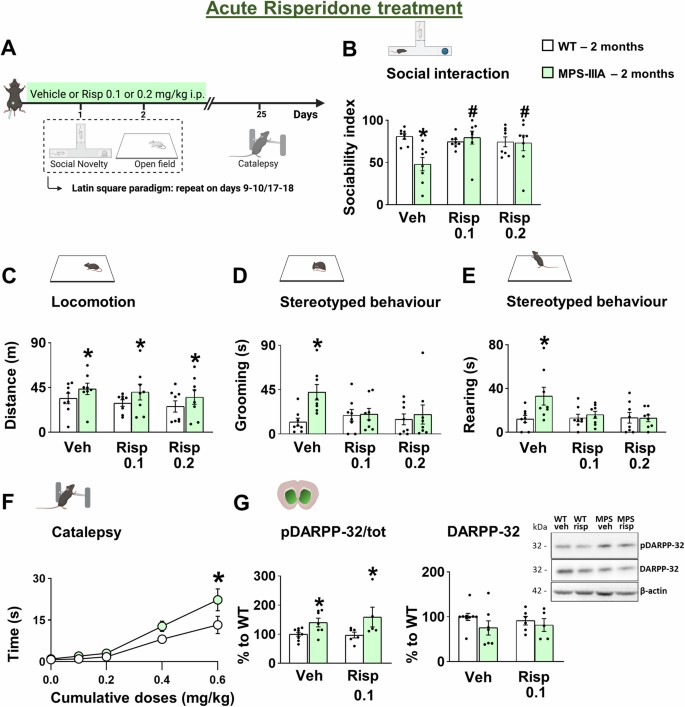
Lysosomal storage disorders characterized by defective heparan sulfate (HS) degradation, such as Mucopolysaccharidosis type IIIA-D (MPS-IIIA-D), result in neurodegeneration and dementia in children. However, dementia is preceded by severe autistic-like behaviours (ALBs), presenting as hyperactivity, stereotypies, social interaction deficits, and sleep disturbances. The absence of experimental studies on ALBs’ mechanisms in MPS-III has led clinicians to adopt symptomatic treatments, such as antipsychotics, which are used for non-genetic neuropsychiatric disorders. However, they have limited efficacy in MPS-III and lead to higher extrapyramidal effects, leaving ALBs in MPS-IIIA as an unmet medical need with a significant burden on patients and their families. Using mouse and cellular models of MPS-IIIA, we have previously shown that ALBs result from increased proliferation of mesencephalic dopamine neurons during embryogenesis. In adulthood, MPS-IIIA mice exhibit an imbalance of dopaminergic receptor subtypes, resulting in striatal overstimulation of the D1 dopamine receptor (D1R)-direct pathway, contrasting with a downregulation of the D2 dopamine receptor (D2R)-indirect pathway. In this study, we aimed to provide an evidence-based pharmacological approach for managing ALBs in MPS-IIIA. We hypothesized that rebalancing dopaminergic receptor signalling with a D1R antagonist, rather than a D2 antagonist, would lead to safe and effective treatment. Neither risperidone nor methylphenidate improves ALBs in the MPS-IIIA mouse model, with the former showing increased cataleptic (extrapyramidal-like) side effects compared to littermate wild-type animals. Methylphenidate, however, showed some beneficial effects on neuroinflammation and later manifesting dementia-like behaviours. In contrast, ecopipam, a D1 antagonist already used in the clinic for other neuropsychiatric disorders, rescues ALBs, cognition, D1 hyperactivity, and does not worsen neurodegenerative signs. These results align with recent evidence highlighting the clinical relevance of D1 antagonists for neuropsychiatric disorders and pave the way for their use in managing psychotic symptoms in neurodegenerative disorders such as dementia with Lewy bodies.
期刊介绍:
Molecular Psychiatry focuses on publishing research that aims to uncover the biological mechanisms behind psychiatric disorders and their treatment. The journal emphasizes studies that bridge pre-clinical and clinical research, covering cellular, molecular, integrative, clinical, imaging, and psychopharmacology levels.




 京公网安备 11010802042870号
京ICP备2023020795号-1
京公网安备 11010802042870号
京ICP备2023020795号-1

 分享
分享
 求助内容:
求助内容: 应助结果提醒方式:
 扫码关注我们
