Kenly Wuputra , Wen-Hung Hsu , Chia-Chen Ku , Ya-Han Yang , Kung-Kai Kuo , Fang-Jung Yu , Hsin-Su Yu , Kyosuke Nagata , Deng-Chyang Wu , Chao-Hung Kuo , Kazunari K. Yokoyama
{"title":"The AHR–NRF2–JDP2 gene battery: Ligand–induced AHR transcriptional activation","authors":"Kenly Wuputra , Wen-Hung Hsu , Chia-Chen Ku , Ya-Han Yang , Kung-Kai Kuo , Fang-Jung Yu , Hsin-Su Yu , Kyosuke Nagata , Deng-Chyang Wu , Chao-Hung Kuo , Kazunari K. Yokoyama","doi":"10.1016/j.bcp.2025.116761","DOIUrl":null,"url":null,"abstract":"<div><div>Aryl hydrocarbon receptor (AHR) and nuclear factor-erythroid 2-related factor 2 (NRF2) can regulate a series of genes encoding the detoxifying phase I and II enzymes, via a signaling crosstalk known as the “AHR–NRF2 gene battery”. The chromatin transcriptional regulator Jun dimerization protein 2 (JDP2) plays a central role in the<!--> <!-->transcription of <em>AHR</em> gene in response to the phase I enzyme ligand 2,3,7,8-tetrachlorodibenzo-<em>p</em>-dioxin. It forms a transcriptional complex with AHR–AHR nuclear translocator (ARNT) and NRF2-small musculoaponeurotic fibrosarcoma proteins (sMAF), which are then recruited to the respective <em>cis</em>-elements, such as dioxin response elements and antioxidant response elements, respectively, in the AHR promoter. Here, we present a revised description of the AHR–NRF2 gene battery as the AHR–NRF2–JDP2 gene battery for transactivating the AHR promoter by phase I enzyme ligands. The chromatin regulator JDP2 was found to be involved in the movement of AHR–NRF2 complexes from the dioxin response element to the antioxidant response element in the AHR promoter, during its activation in a spatiotemporal manner. This new epigenetic and chromatin remodeling role of AHR–NRF2–JDP2 axis is useful for identifying new therapeutic targets for various diseases, including immunological response, detoxification, development, and cancer-related diseases.</div></div>","PeriodicalId":8806,"journal":{"name":"Biochemical pharmacology","volume":"233 ","pages":"Article 116761"},"PeriodicalIF":5.6000,"publicationDate":"2025-01-23","publicationTypes":"Journal Article","fieldsOfStudy":null,"isOpenAccess":false,"openAccessPdf":"","citationCount":"0","resultStr":null,"platform":"Semanticscholar","paperid":null,"PeriodicalName":"Biochemical pharmacology","FirstCategoryId":"3","ListUrlMain":"https://www.sciencedirect.com/science/article/pii/S0006295225000231","RegionNum":2,"RegionCategory":"医学","ArticlePicture":[],"TitleCN":null,"AbstractTextCN":null,"PMCID":null,"EPubDate":"","PubModel":"","JCR":"Q1","JCRName":"PHARMACOLOGY & PHARMACY","Score":null,"Total":0}
引用次数: 0
Abstract
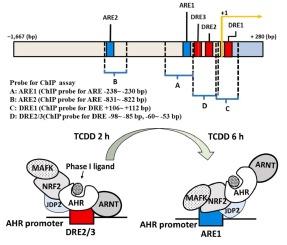
Aryl hydrocarbon receptor (AHR) and nuclear factor-erythroid 2-related factor 2 (NRF2) can regulate a series of genes encoding the detoxifying phase I and II enzymes, via a signaling crosstalk known as the “AHR–NRF2 gene battery”. The chromatin transcriptional regulator Jun dimerization protein 2 (JDP2) plays a central role in the transcription of AHR gene in response to the phase I enzyme ligand 2,3,7,8-tetrachlorodibenzo-p-dioxin. It forms a transcriptional complex with AHR–AHR nuclear translocator (ARNT) and NRF2-small musculoaponeurotic fibrosarcoma proteins (sMAF), which are then recruited to the respective cis-elements, such as dioxin response elements and antioxidant response elements, respectively, in the AHR promoter. Here, we present a revised description of the AHR–NRF2 gene battery as the AHR–NRF2–JDP2 gene battery for transactivating the AHR promoter by phase I enzyme ligands. The chromatin regulator JDP2 was found to be involved in the movement of AHR–NRF2 complexes from the dioxin response element to the antioxidant response element in the AHR promoter, during its activation in a spatiotemporal manner. This new epigenetic and chromatin remodeling role of AHR–NRF2–JDP2 axis is useful for identifying new therapeutic targets for various diseases, including immunological response, detoxification, development, and cancer-related diseases.
期刊介绍:
Biochemical Pharmacology publishes original research findings, Commentaries and review articles related to the elucidation of cellular and tissue function(s) at the biochemical and molecular levels, the modification of cellular phenotype(s) by genetic, transcriptional/translational or drug/compound-induced modifications, as well as the pharmacodynamics and pharmacokinetics of xenobiotics and drugs, the latter including both small molecules and biologics.
The journal''s target audience includes scientists engaged in the identification and study of the mechanisms of action of xenobiotics, biologics and drugs and in the drug discovery and development process.
All areas of cellular biology and cellular, tissue/organ and whole animal pharmacology fall within the scope of the journal. Drug classes covered include anti-infectives, anti-inflammatory agents, chemotherapeutics, cardiovascular, endocrinological, immunological, metabolic, neurological and psychiatric drugs, as well as research on drug metabolism and kinetics. While medicinal chemistry is a topic of complimentary interest, manuscripts in this area must contain sufficient biological data to characterize pharmacologically the compounds reported. Submissions describing work focused predominately on chemical synthesis and molecular modeling will not be considered for review.
While particular emphasis is placed on reporting the results of molecular and biochemical studies, research involving the use of tissue and animal models of human pathophysiology and toxicology is of interest to the extent that it helps define drug mechanisms of action, safety and efficacy.



 京公网安备 11010802042870号
京ICP备2023020795号-1
京公网安备 11010802042870号
京ICP备2023020795号-1

 分享
分享
 求助内容:
求助内容: 应助结果提醒方式:
 扫码关注我们
