Leonid Tarassishin, Taegyu Kim, Jianzhong Hu, Amelie Barre, Alexa Rendon, Mellissa Picker, Rosemary Chen, Kaitlyn Weinstein, Anne Thjømøe, Einar Mørk, Joanne Stone, Joana Torres, Jean-Frederic Colombel, Manasi Agrawal, Inga Peter
{"title":"Elevated Fecal Lipocalin-2 Levels During Early Life Are Associated with Maternal Inflammatory Bowel Disease Diagnosis.","authors":"Leonid Tarassishin, Taegyu Kim, Jianzhong Hu, Amelie Barre, Alexa Rendon, Mellissa Picker, Rosemary Chen, Kaitlyn Weinstein, Anne Thjømøe, Einar Mørk, Joanne Stone, Joana Torres, Jean-Frederic Colombel, Manasi Agrawal, Inga Peter","doi":"10.1007/s10620-025-08864-9","DOIUrl":null,"url":null,"abstract":"<p><strong>Background: </strong>Fecal lipocalin-2 (LCN2) is a biomarker of neutrophil activation, which is elevated in patients with inflammatory bowel disease (IBD); however, its dynamic changes during pregnancy and early life are largely unknown. We characterized LCN2 levels by maternal IBD diagnosis, offspring feeding behavior, and gut microbiota composition.</p><p><strong>Methods: </strong>In the prospective MECONIUM (Exploring Mechanisms of Disease Transmission In Utero through the Microbiome) study, we analyzed 559 fecal samples from 91 pregnant women with IBD, 78 healthy controls, and their 147 offspring for LCN2 levels at each trimester of pregnancy and multiple time points during early life using linear mixed-effects model and multiple logistic regression analyses. Gut microbiota community compositions were evaluated following 16S rRNA gene sequencing.</p><p><strong>Results: </strong>IBD cases had higher LCN2 levels throughout pregnancy compared to controls. In offspring, significantly higher LCN2 was found in babies born to mothers with IBD, compared to those without IBD, at 3 months, 1 year, and 4 years (all p < 0.03), with offspring LCN2 levels being predictive of maternal IBD case status with > 85% accuracy at ages 1 and 4. We also detected correlations between LCN2 levels and certain IBD-associated bacterial taxa in both mothers and babies. Exclusively breastfed babies had lower LCN2 in the first weeks of life compared to formula or mixed-fed counterparts.</p><p><strong>Conclusions: </strong>Babies born to mother with IBD had significantly higher LCN2 during early life compared to controls with exclusive breastfeeding impacting LCN2 levels early on. LCN2 levels correlated with IBD-associated microbial taxa in both mothers and babies. Future studies should identify the biological drivers and health-related consequences of elevated LCN2 during early childhood.</p>","PeriodicalId":11378,"journal":{"name":"Digestive Diseases and Sciences","volume":" ","pages":"1150-1159"},"PeriodicalIF":2.8000,"publicationDate":"2025-03-01","publicationTypes":"Journal Article","fieldsOfStudy":null,"isOpenAccess":false,"openAccessPdf":"https://www.ncbi.nlm.nih.gov/pmc/articles/PMC11919928/pdf/","citationCount":"0","resultStr":null,"platform":"Semanticscholar","paperid":null,"PeriodicalName":"Digestive Diseases and Sciences","FirstCategoryId":"3","ListUrlMain":"https://doi.org/10.1007/s10620-025-08864-9","RegionNum":4,"RegionCategory":"医学","ArticlePicture":[],"TitleCN":null,"AbstractTextCN":null,"PMCID":null,"EPubDate":"2025/1/24 0:00:00","PubModel":"Epub","JCR":"Q2","JCRName":"GASTROENTEROLOGY & HEPATOLOGY","Score":null,"Total":0}
引用次数: 0
Abstract
Background: Fecal lipocalin-2 (LCN2) is a biomarker of neutrophil activation, which is elevated in patients with inflammatory bowel disease (IBD); however, its dynamic changes during pregnancy and early life are largely unknown. We characterized LCN2 levels by maternal IBD diagnosis, offspring feeding behavior, and gut microbiota composition.
Methods: In the prospective MECONIUM (Exploring Mechanisms of Disease Transmission In Utero through the Microbiome) study, we analyzed 559 fecal samples from 91 pregnant women with IBD, 78 healthy controls, and their 147 offspring for LCN2 levels at each trimester of pregnancy and multiple time points during early life using linear mixed-effects model and multiple logistic regression analyses. Gut microbiota community compositions were evaluated following 16S rRNA gene sequencing.
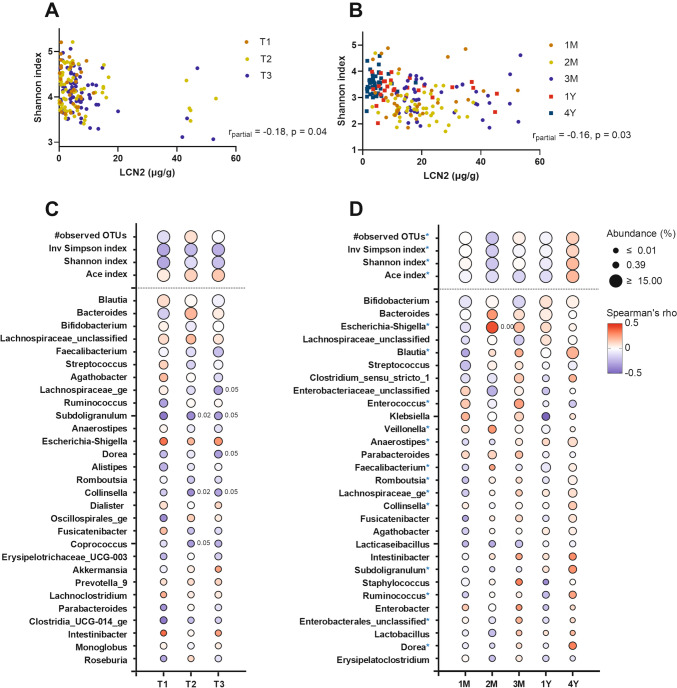
Results: IBD cases had higher LCN2 levels throughout pregnancy compared to controls. In offspring, significantly higher LCN2 was found in babies born to mothers with IBD, compared to those without IBD, at 3 months, 1 year, and 4 years (all p < 0.03), with offspring LCN2 levels being predictive of maternal IBD case status with > 85% accuracy at ages 1 and 4. We also detected correlations between LCN2 levels and certain IBD-associated bacterial taxa in both mothers and babies. Exclusively breastfed babies had lower LCN2 in the first weeks of life compared to formula or mixed-fed counterparts.
Conclusions: Babies born to mother with IBD had significantly higher LCN2 during early life compared to controls with exclusive breastfeeding impacting LCN2 levels early on. LCN2 levels correlated with IBD-associated microbial taxa in both mothers and babies. Future studies should identify the biological drivers and health-related consequences of elevated LCN2 during early childhood.
背景:粪便脂钙素-2 (LCN2)是中性粒细胞活化的生物标志物,在炎症性肠病(IBD)患者中升高;然而,它在怀孕和生命早期的动态变化在很大程度上是未知的。我们通过母体IBD诊断、子代摄食行为和肠道菌群组成来表征LCN2水平。方法:在MECONIUM (Exploring Mechanisms of Disease Transmission In the Utero through the Microbiome)前瞻性研究中,我们使用线性混合效应模型和多元逻辑回归分析了91名IBD孕妇、78名健康对照者及其147名后代的559份粪便样本在妊娠各三个月和生命早期多个时间点的LCN2水平。采用16S rRNA基因测序法评估肠道菌群群落组成。结果:与对照组相比,IBD患者在整个妊娠期间的LCN2水平较高。在后代中,与没有IBD的婴儿相比,IBD母亲所生的婴儿在3个月、1岁和4岁时的LCN2明显更高(1岁和4岁时的准确率均为85%)。我们还在母亲和婴儿中检测到LCN2水平与某些ibd相关细菌分类群之间的相关性。与配方奶粉或混合喂养的婴儿相比,纯母乳喂养的婴儿在出生后的头几周的LCN2较低。结论:与对照组相比,IBD母亲所生的婴儿在生命早期的LCN2水平明显更高,纯母乳喂养影响了早期的LCN2水平。在母亲和婴儿中,LCN2水平与ibd相关的微生物分类群相关。未来的研究应确定儿童早期LCN2升高的生物学驱动因素和与健康相关的后果。
期刊介绍:
Digestive Diseases and Sciences publishes high-quality, peer-reviewed, original papers addressing aspects of basic/translational and clinical research in gastroenterology, hepatology, and related fields. This well-illustrated journal features comprehensive coverage of basic pathophysiology, new technological advances, and clinical breakthroughs; insights from prominent academicians and practitioners concerning new scientific developments and practical medical issues; and discussions focusing on the latest changes in local and worldwide social, economic, and governmental policies that affect the delivery of care within the disciplines of gastroenterology and hepatology.






 京公网安备 11010802042870号
京ICP备2023020795号-1
京公网安备 11010802042870号
京ICP备2023020795号-1

 分享
分享
 求助内容:
求助内容: 应助结果提醒方式:
 扫码关注我们
