{"title":"Integrative Analysis of Radiation-Induced Senescence-Associated Secretory Phenotype Factors in Kidney Cancer Progression.","authors":"Shubhankar Suman","doi":"10.3390/genes16010085","DOIUrl":null,"url":null,"abstract":"<p><strong>Background: </strong>Ionizing radiation (IR) is a well-known inducer of cellular senescence and the senescence-associated secretory phenotype (SASP). SASP factors play dual roles in cancer, either promoting or inhibiting its development. This study investigates IR-induced SASP factors specifically secreted by renal cortical epithelial (RCE) cells and their role in promoting renal cell carcinoma (RCC) progression.</p><p><strong>Methods: </strong>Proteomic data from the SASP Atlas were analyzed to identify IR-induced factors unique to RCE cells, with subsequent evaluations performed at both the gene and protein levels. Thirty-seven proteins were identified as exclusively upregulated and secreted by senescent RCE cells. Gene expression analysis of these RCE-specific SASP factors was conducted using the Gene Expression database of Normal and Tumor tissues (GENT2) and The Cancer Genome Atlas (TCGA). To assess their prognostic relevance in RCC, the corresponding proteins were further analyzed using the Human Protein Atlas (HPA), emphasizing the relationship between SASP factor expression and RCC progression.</p><p><strong>Results: </strong>ALDH18A1 and ASPH emerged as key RCE-specific SASP factors with significant upregulation at both the gene and protein levels (Log2 ratio > 1.15, <i>p</i> < 0.05). These proteins are implicated in pro-cancer activities and are strongly associated with poor prognostic outcomes in RCC. Their critical roles in RCC progression underscore their potential as promising therapeutic targets for the prevention and treatment of the disease.</p><p><strong>Conclusions: </strong>This study provides novel insights into the role of IR-induced SASP in renal carcinogenesis, marking the first identification of ALDH18A1 and ASPH as specific secreted proteins associated with tumor progression in RCC. This study suggests that ALDH18A1 and ASPH hold promise as early biomarkers for RCC and as therapeutic targets for disease prevention and treatment.</p>","PeriodicalId":12688,"journal":{"name":"Genes","volume":"16 1","pages":""},"PeriodicalIF":2.8000,"publicationDate":"2025-01-15","publicationTypes":"Journal Article","fieldsOfStudy":null,"isOpenAccess":false,"openAccessPdf":"https://www.ncbi.nlm.nih.gov/pmc/articles/PMC11765417/pdf/","citationCount":"0","resultStr":null,"platform":"Semanticscholar","paperid":null,"PeriodicalName":"Genes","FirstCategoryId":"99","ListUrlMain":"https://doi.org/10.3390/genes16010085","RegionNum":3,"RegionCategory":"生物学","ArticlePicture":[],"TitleCN":null,"AbstractTextCN":null,"PMCID":null,"EPubDate":"","PubModel":"","JCR":"Q2","JCRName":"GENETICS & HEREDITY","Score":null,"Total":0}
引用次数: 0
Abstract
Background: Ionizing radiation (IR) is a well-known inducer of cellular senescence and the senescence-associated secretory phenotype (SASP). SASP factors play dual roles in cancer, either promoting or inhibiting its development. This study investigates IR-induced SASP factors specifically secreted by renal cortical epithelial (RCE) cells and their role in promoting renal cell carcinoma (RCC) progression.
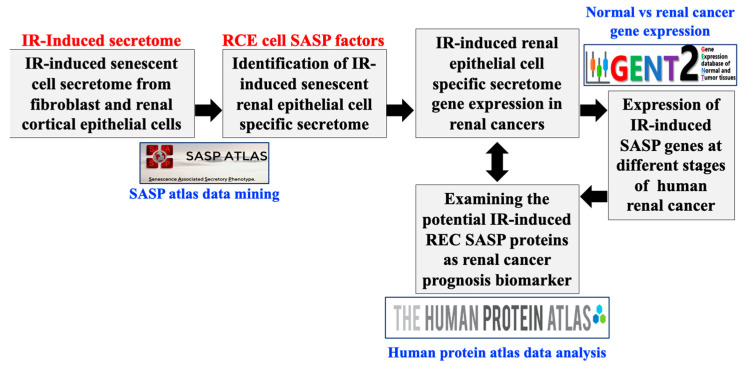
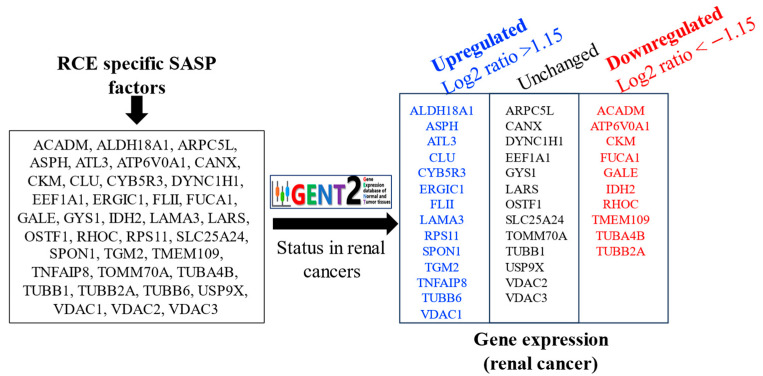
Methods: Proteomic data from the SASP Atlas were analyzed to identify IR-induced factors unique to RCE cells, with subsequent evaluations performed at both the gene and protein levels. Thirty-seven proteins were identified as exclusively upregulated and secreted by senescent RCE cells. Gene expression analysis of these RCE-specific SASP factors was conducted using the Gene Expression database of Normal and Tumor tissues (GENT2) and The Cancer Genome Atlas (TCGA). To assess their prognostic relevance in RCC, the corresponding proteins were further analyzed using the Human Protein Atlas (HPA), emphasizing the relationship between SASP factor expression and RCC progression.
Results: ALDH18A1 and ASPH emerged as key RCE-specific SASP factors with significant upregulation at both the gene and protein levels (Log2 ratio > 1.15, p < 0.05). These proteins are implicated in pro-cancer activities and are strongly associated with poor prognostic outcomes in RCC. Their critical roles in RCC progression underscore their potential as promising therapeutic targets for the prevention and treatment of the disease.
Conclusions: This study provides novel insights into the role of IR-induced SASP in renal carcinogenesis, marking the first identification of ALDH18A1 and ASPH as specific secreted proteins associated with tumor progression in RCC. This study suggests that ALDH18A1 and ASPH hold promise as early biomarkers for RCC and as therapeutic targets for disease prevention and treatment.
背景:电离辐射(IR)是众所周知的细胞衰老和衰老相关分泌表型(SASP)的诱导剂。SASP因子在癌症中起着促进或抑制其发展的双重作用。本研究探讨ir诱导肾皮质上皮细胞(RCE)特异性分泌的SASP因子及其在促进肾细胞癌(RCC)进展中的作用。方法:分析来自SASP图谱的蛋白质组学数据,以确定RCE细胞特有的ir诱导因子,并在基因和蛋白质水平上进行后续评估。37个蛋白在衰老的RCE细胞中被鉴定为完全上调和分泌。使用正常和肿瘤组织基因表达数据库(Gene expression database of Normal and Tumor tissue, GENT2)和癌症基因组图谱(the Cancer Genome Atlas, TCGA)对这些rce特异性SASP因子进行基因表达分析。为了评估其与RCC预后的相关性,我们使用人类蛋白图谱(Human Protein Atlas, HPA)进一步分析了相应的蛋白,强调了SASP因子表达与RCC进展之间的关系。结果:ALDH18A1和ASPH是rce特异性SASP的关键因子,在基因和蛋白水平均显著上调(Log2比> 1.15,p < 0.05)。这些蛋白与促癌活性有关,并与肾癌预后不良密切相关。它们在RCC进展中的关键作用强调了它们作为预防和治疗该疾病的有希望的治疗靶点的潜力。结论:本研究为ir诱导的SASP在肾癌发生中的作用提供了新的见解,标志着首次发现ALDH18A1和ASPH是与RCC肿瘤进展相关的特异性分泌蛋白。这项研究表明,ALDH18A1和ASPH有望成为RCC的早期生物标志物,并作为疾病预防和治疗的治疗靶点。
期刊介绍:
Genes (ISSN 2073-4425) is an international, peer-reviewed open access journal which provides an advanced forum for studies related to genes, genetics and genomics. It publishes reviews, research articles, communications and technical notes. There is no restriction on the length of the papers and we encourage scientists to publish their results in as much detail as possible.




 京公网安备 11010802042870号
京ICP备2023020795号-1
京公网安备 11010802042870号
京ICP备2023020795号-1

 分享
分享
 求助内容:
求助内容: 应助结果提醒方式:
 扫码关注我们
