{"title":"A Review of Immunological Evaluation of Patients with Recurrent Spontaneous Abortion (RSA).","authors":"Mihaela Andreescu, Alina Tanase, Bogdan Andreescu, Cosmin Moldovan","doi":"10.3390/ijms26020785","DOIUrl":null,"url":null,"abstract":"<p><p>In approximately half of the recurrent spontaneous abortion (RSA) cases, the underlying cause is unknown. However, most unexplained miscarriages are thought to be linked to immune dysfunction. This review summarizes the current evidence regarding the immunological evaluations of patients with RSA, with potential implications for clinical research. The immune system plays a crucial role in the successful outcome of pregnancy, as it tolerates the semi-allogeneic fetus while offering protection to both the mother and fetus from pathogens. The maternal-fetal interface is the place where the crosstalk between various immune cells such as macrophages, dendritic cells, natural killer (NK) cells, and T cells takes place. An adequate balance is required between these immune cells for pregnancy to progress. In RSA, a dysregulation between these immune players is witnessed. For example, in RSA, NK cells are not increased but also undergo a change in their activity, manifested as cytotoxic decidual NK. Similarly, regulatory T cells, which are crucial for fostering a tolerant immune environment, are decreased in RSA women. Similarly, imbalances between T-helper (Th1, Th2, Th17) cell subsets have been implicated in RSA. Furthermore, the imbalance between pro-inflammatory M1 and anti-inflammatory M2 macrophage phenotypes has been documented, with studies indicating a predominance of M1 macrophages in RSA patients. Targeting immune imbalances with therapies such as immunoglobulin administration, TNF inhibitors, and anticoagulants may improve pregnancy outcomes in women with RSA.</p>","PeriodicalId":14156,"journal":{"name":"International Journal of Molecular Sciences","volume":"26 2","pages":""},"PeriodicalIF":4.9000,"publicationDate":"2025-01-17","publicationTypes":"Journal Article","fieldsOfStudy":null,"isOpenAccess":false,"openAccessPdf":"https://www.ncbi.nlm.nih.gov/pmc/articles/PMC11765700/pdf/","citationCount":"0","resultStr":null,"platform":"Semanticscholar","paperid":null,"PeriodicalName":"International Journal of Molecular Sciences","FirstCategoryId":"99","ListUrlMain":"https://doi.org/10.3390/ijms26020785","RegionNum":2,"RegionCategory":"生物学","ArticlePicture":[],"TitleCN":null,"AbstractTextCN":null,"PMCID":null,"EPubDate":"","PubModel":"","JCR":"","JCRName":"","Score":null,"Total":0}
引用次数: 0
Abstract
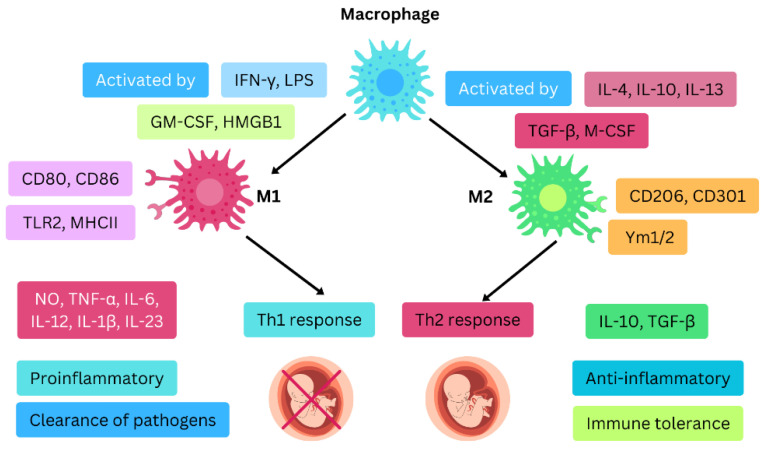
In approximately half of the recurrent spontaneous abortion (RSA) cases, the underlying cause is unknown. However, most unexplained miscarriages are thought to be linked to immune dysfunction. This review summarizes the current evidence regarding the immunological evaluations of patients with RSA, with potential implications for clinical research. The immune system plays a crucial role in the successful outcome of pregnancy, as it tolerates the semi-allogeneic fetus while offering protection to both the mother and fetus from pathogens. The maternal-fetal interface is the place where the crosstalk between various immune cells such as macrophages, dendritic cells, natural killer (NK) cells, and T cells takes place. An adequate balance is required between these immune cells for pregnancy to progress. In RSA, a dysregulation between these immune players is witnessed. For example, in RSA, NK cells are not increased but also undergo a change in their activity, manifested as cytotoxic decidual NK. Similarly, regulatory T cells, which are crucial for fostering a tolerant immune environment, are decreased in RSA women. Similarly, imbalances between T-helper (Th1, Th2, Th17) cell subsets have been implicated in RSA. Furthermore, the imbalance between pro-inflammatory M1 and anti-inflammatory M2 macrophage phenotypes has been documented, with studies indicating a predominance of M1 macrophages in RSA patients. Targeting immune imbalances with therapies such as immunoglobulin administration, TNF inhibitors, and anticoagulants may improve pregnancy outcomes in women with RSA.
期刊介绍:
The International Journal of Molecular Sciences (ISSN 1422-0067) provides an advanced forum for chemistry, molecular physics (chemical physics and physical chemistry) and molecular biology. It publishes research articles, reviews, communications and short notes. Our aim is to encourage scientists to publish their theoretical and experimental results in as much detail as possible. Therefore, there is no restriction on the length of the papers or the number of electronics supplementary files. For articles with computational results, the full experimental details must be provided so that the results can be reproduced. Electronic files regarding the full details of the calculation and experimental procedure, if unable to be published in a normal way, can be deposited as supplementary material (including animated pictures, videos, interactive Excel sheets, software executables and others).




 京公网安备 11010802042870号
京ICP备2023020795号-1
京公网安备 11010802042870号
京ICP备2023020795号-1

 分享
分享
 求助内容:
求助内容: 应助结果提醒方式:
 扫码关注我们
