{"title":"Association of novel metabolic status with asymptomatic intracranial arterial stenosis: A cross-sectional study","authors":"Liying Guo, Yongli Pan, Yumeng Yang, Xianglong Kong, Shiqing Song, Maoyu Li, Yuanyuan Zhao, Xiaotong Ma, Xiang Wang, Qinjian Sun","doi":"10.1038/s41366-025-01723-7","DOIUrl":null,"url":null,"abstract":"To investigate the association of metabolic status newly defined or obesity with asymptomatic intracranial arterial stenosis (aICAS) among populations in rural China. The cross-sectional study is based on the Rose asymptomatic IntraCranial Artery Stenosis (RICAS) cohort, which enrolled 2005 participants aged 40 years or older without a history of clinical stroke or transient ischemic attack. Metabolically healthy status (MH) was defined by a newly proposed criterion: (1) systolic blood pressure (SBP) < 130 mmHg and without antihypertensive medication; (2) a waist-to-hip ratio (WHR) below 1.03 for men and below 0.95 for women; (3) no diabetes. All participants were categorized based on their metabolic status and obesity. Multivariate logistic regression models were used to investigate the association between metabolic status or obesity and aICAS. Among 2005 participants, 1597 (79.65%) were defined as metabolically unhealthy status (MU) according to the new criterion. MU was significantly associated with aICAS (OR 2.02, 95% CI 1.11–3.68, P = 0.021), especially moderate-to-severe aICAS (OR 2.43, 95% CI 1.04–5.72, P = 0.042). The prevalence of aICAS increased with the numbers of metabolic disorders (P for linear trend <0.001). Both metabolically unhealthy normal-weight (MUN) (OR 2.11, 95% CI 1.10–4.03, P = 0.025) and metabolically unhealthy obesity (MUO) (OR 3.30, 95% CI 1.64–6.64, P = 0.001) were significantly correlated with aICAS, but not metabolically healthy obesity (MHO). Subgroup analysis further confirmed the association between MU and aICAS risk only in men (P for interaction = 0.042). MU defined by the new criterion was significantly associated with aICAS, especially with moderate-to-severe aICAS. This novel criterion effectively identifies individuals with a high prevalence of aICAS among populations with obesity, which could be crucial for stroke prevention.","PeriodicalId":14183,"journal":{"name":"International Journal of Obesity","volume":"49 6","pages":"1024-1030"},"PeriodicalIF":3.8000,"publicationDate":"2025-01-25","publicationTypes":"Journal Article","fieldsOfStudy":null,"isOpenAccess":false,"openAccessPdf":"","citationCount":"0","resultStr":null,"platform":"Semanticscholar","paperid":null,"PeriodicalName":"International Journal of Obesity","FirstCategoryId":"3","ListUrlMain":"https://www.nature.com/articles/s41366-025-01723-7","RegionNum":2,"RegionCategory":"医学","ArticlePicture":[],"TitleCN":null,"AbstractTextCN":null,"PMCID":null,"EPubDate":"","PubModel":"","JCR":"Q1","JCRName":"ENDOCRINOLOGY & METABOLISM","Score":null,"Total":0}
引用次数: 0
Abstract
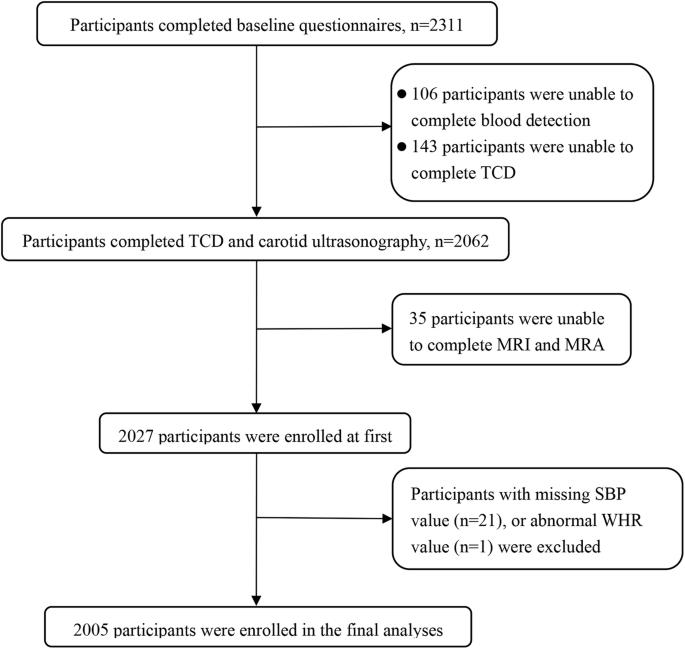
To investigate the association of metabolic status newly defined or obesity with asymptomatic intracranial arterial stenosis (aICAS) among populations in rural China. The cross-sectional study is based on the Rose asymptomatic IntraCranial Artery Stenosis (RICAS) cohort, which enrolled 2005 participants aged 40 years or older without a history of clinical stroke or transient ischemic attack. Metabolically healthy status (MH) was defined by a newly proposed criterion: (1) systolic blood pressure (SBP) < 130 mmHg and without antihypertensive medication; (2) a waist-to-hip ratio (WHR) below 1.03 for men and below 0.95 for women; (3) no diabetes. All participants were categorized based on their metabolic status and obesity. Multivariate logistic regression models were used to investigate the association between metabolic status or obesity and aICAS. Among 2005 participants, 1597 (79.65%) were defined as metabolically unhealthy status (MU) according to the new criterion. MU was significantly associated with aICAS (OR 2.02, 95% CI 1.11–3.68, P = 0.021), especially moderate-to-severe aICAS (OR 2.43, 95% CI 1.04–5.72, P = 0.042). The prevalence of aICAS increased with the numbers of metabolic disorders (P for linear trend <0.001). Both metabolically unhealthy normal-weight (MUN) (OR 2.11, 95% CI 1.10–4.03, P = 0.025) and metabolically unhealthy obesity (MUO) (OR 3.30, 95% CI 1.64–6.64, P = 0.001) were significantly correlated with aICAS, but not metabolically healthy obesity (MHO). Subgroup analysis further confirmed the association between MU and aICAS risk only in men (P for interaction = 0.042). MU defined by the new criterion was significantly associated with aICAS, especially with moderate-to-severe aICAS. This novel criterion effectively identifies individuals with a high prevalence of aICAS among populations with obesity, which could be crucial for stroke prevention.
目的:探讨中国农村人群中新定义的代谢状态或肥胖与无症状颅内动脉狭窄(aICAS)的关系。方法:横断面研究基于Rose无症状颅内动脉狭窄(RICAS)队列,该队列纳入了2005名年龄在40岁及以上,无临床卒中或短暂性脑缺血发作史的参与者。(1)收缩压(SBP)结果:在2005名参与者中,1597名(79.65%)被定义为代谢不健康状态(MU)。MU与aICAS显著相关(OR 2.02, 95% CI 1.11-3.68, P = 0.021),尤其是中重度aICAS (OR 2.43, 95% CI 1.04-5.72, P = 0.042)。结论:新标准定义的MU与aICAS显著相关,特别是与中重度aICAS相关。这一新的标准有效地识别了肥胖人群中aICAS患病率高的个体,这可能对预防中风至关重要。
期刊介绍:
The International Journal of Obesity is a multi-disciplinary forum for research describing basic, clinical and applied studies in biochemistry, physiology, genetics and nutrition, molecular, metabolic, psychological and epidemiological aspects of obesity and related disorders.
We publish a range of content types including original research articles, technical reports, reviews, correspondence and brief communications that elaborate on significant advances in the field and cover topical issues.



 京公网安备 11010802042870号
京ICP备2023020795号-1
京公网安备 11010802042870号
京ICP备2023020795号-1

 分享
分享
 求助内容:
求助内容: 应助结果提醒方式:
 扫码关注我们
