{"title":"Influence of parkinson's disease on complications and revisions in total hip and knee arthroplasty: insights from a matched pair analysis.","authors":"Dominik Emanuel Holzapfel, Tobias Kappenschneider, Marie Farina Schuster, Stefano Pagano, Fady Azar, Sabrina Holzapfel, Matthias Meyer","doi":"10.1007/s00264-024-06398-9","DOIUrl":null,"url":null,"abstract":"<p><strong>Purpose: </strong>The outcome of elective total joint arthroplasty (TJA) in patients with Parkinson's disease (PD) is controversial due to the concomitant risk profile. This study investigated postoperative complications and revision rates following total hip (THA) and knee arthroplasty (TKA) in patients with PD.</p><p><strong>Methods: </strong>Ninety-six patients with PD undergoing THA or TKA were matched 1:1 with non-PD patients using propensity score matching for age, sex and comorbidity (Charlson Comorbidity index, CCI). Rates of revisions, medical and surgical complications were compared. Univariate and multivariate regression analyses were calculated.</p><p><strong>Results: </strong>PD patients exhibited higher rates of revision-surgeries within 90 days (13.5% vs. 5.2%; p = 0.048), medical complications (68.8% vs. 43.8%; p < 0.001) and surgical complications (40.6% vs. 21.9%; p = 0.005). Multivariate regression analysis confirmed PD as a significant risk factor for complications and long-term revision-surgeries.</p><p><strong>Conclusion: </strong>PD increases the risk of adverse outcomes following THA and TKA. Improvements in pre-operative planning and post-operative care are critical to the improvement of outcomes in this vulnerable population.</p>","PeriodicalId":14450,"journal":{"name":"International Orthopaedics","volume":" ","pages":"559-572"},"PeriodicalIF":2.6000,"publicationDate":"2025-03-01","publicationTypes":"Journal Article","fieldsOfStudy":null,"isOpenAccess":false,"openAccessPdf":"https://www.ncbi.nlm.nih.gov/pmc/articles/PMC11889065/pdf/","citationCount":"0","resultStr":null,"platform":"Semanticscholar","paperid":null,"PeriodicalName":"International Orthopaedics","FirstCategoryId":"3","ListUrlMain":"https://doi.org/10.1007/s00264-024-06398-9","RegionNum":3,"RegionCategory":"医学","ArticlePicture":[],"TitleCN":null,"AbstractTextCN":null,"PMCID":null,"EPubDate":"2025/1/24 0:00:00","PubModel":"Epub","JCR":"Q2","JCRName":"ORTHOPEDICS","Score":null,"Total":0}
引用次数: 0
Abstract
Purpose: The outcome of elective total joint arthroplasty (TJA) in patients with Parkinson's disease (PD) is controversial due to the concomitant risk profile. This study investigated postoperative complications and revision rates following total hip (THA) and knee arthroplasty (TKA) in patients with PD.
Methods: Ninety-six patients with PD undergoing THA or TKA were matched 1:1 with non-PD patients using propensity score matching for age, sex and comorbidity (Charlson Comorbidity index, CCI). Rates of revisions, medical and surgical complications were compared. Univariate and multivariate regression analyses were calculated.
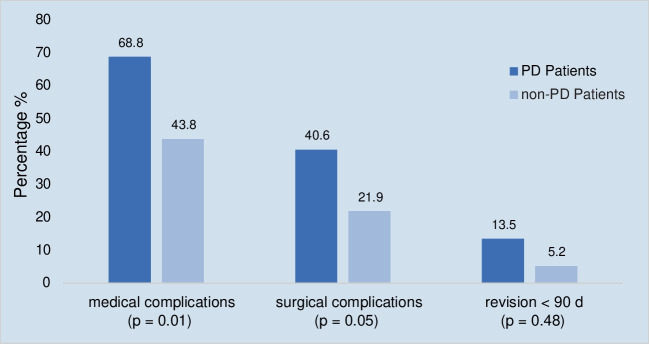
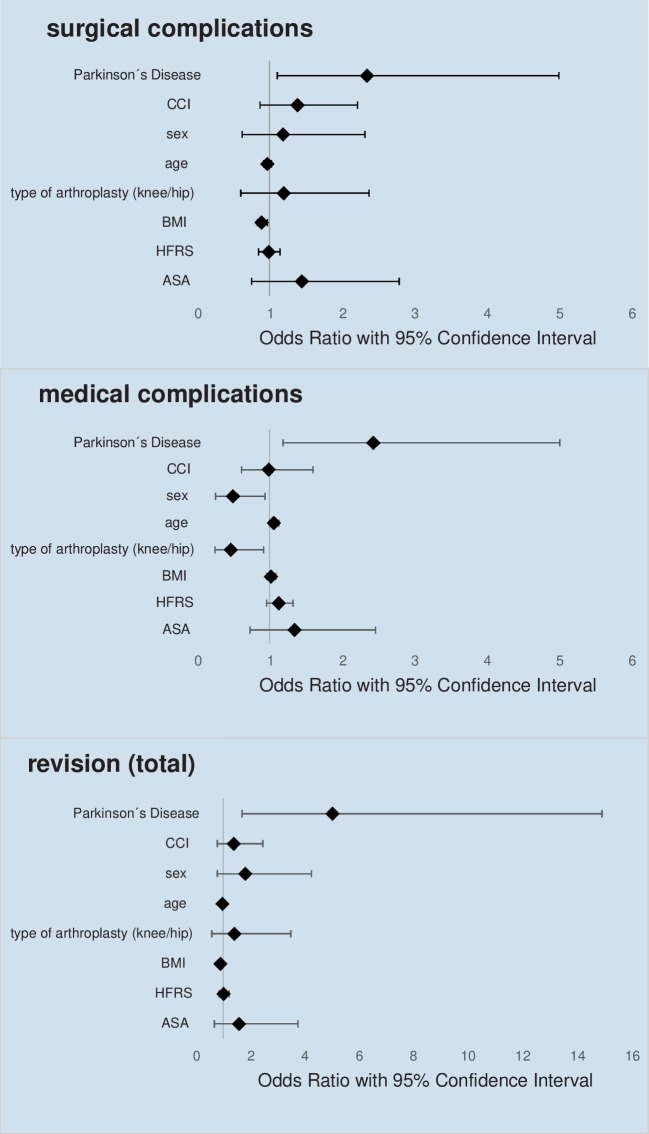
Results: PD patients exhibited higher rates of revision-surgeries within 90 days (13.5% vs. 5.2%; p = 0.048), medical complications (68.8% vs. 43.8%; p < 0.001) and surgical complications (40.6% vs. 21.9%; p = 0.005). Multivariate regression analysis confirmed PD as a significant risk factor for complications and long-term revision-surgeries.
Conclusion: PD increases the risk of adverse outcomes following THA and TKA. Improvements in pre-operative planning and post-operative care are critical to the improvement of outcomes in this vulnerable population.
目的:选择性全关节置换术(TJA)对帕金森病(PD)患者的治疗效果存在争议,原因是其存在风险。本研究调查了PD患者全髋关节置换术(THA)和膝关节置换术(TKA)的术后并发症和翻修率。方法:采用年龄、性别和合并症(Charlson comorbidity index, CCI)匹配倾向评分,将96例接受THA或TKA的PD患者与非PD患者进行1:1匹配。比较修复率、内科和外科并发症。计算单因素和多因素回归分析。结果:PD患者在90天内的翻修手术率更高(13.5% vs. 5.2%;P = 0.048),医疗并发症(68.8% vs. 43.8%;p结论:PD增加THA和TKA后不良结局的风险。改善术前计划和术后护理对改善这一弱势群体的预后至关重要。
期刊介绍:
International Orthopaedics, the Official Journal of the Société Internationale de Chirurgie Orthopédique et de Traumatologie (SICOT) , publishes original papers from all over the world. The articles deal with clinical orthopaedic surgery or basic research directly connected with orthopaedic surgery. International Orthopaedics will also link all the members of SICOT by means of an insert that will be concerned with SICOT matters.
Finally, it is expected that news and information regarding all aspects of orthopaedic surgery, including meetings, panels, instructional courses, etc. will be brought to the attention of the readers.
Manuscripts submitted for publication must contain a statement to the effect that all human studies have been approved by the appropriate ethics committee and have therefore been performed in accordance with the ethical standards laid down in the 1964 Declaration of Helsinki. It should also be stated clearly in the text that all persons gave their informed consent prior to their inclusion in the study. Details that might disclose the identity of the subjects under study should be omitted.
Reports of animal experiments must state that the "Principles of laboratory animal care" (NIH publication No. 85-23, revised 1985) were followed, as well as specific national laws (e.g. the current version of the German Law on the Protection of Animals) where applicable.
The editors reserve the right to reject manuscripts that do not comply with the above-mentioned requirements. The author will be held responsible for false statements or for failure to fulfil the above-mentioned requirements.




 京公网安备 11010802042870号
京ICP备2023020795号-1
京公网安备 11010802042870号
京ICP备2023020795号-1

 分享
分享
 求助内容:
求助内容: 应助结果提醒方式:
 扫码关注我们
