Hp eradication decreased the expression level of PG II in patients of Hp negative with gastric intestinal metaplasia: a retrospective cross-sectional study.
Yanhong Wang, Xixiang Cao, Baodong Shan, Song Chen, Shengnan Li, Sujuan Fei, Xunlei Pang
{"title":"Hp eradication decreased the expression level of PG II in patients of Hp negative with gastric intestinal metaplasia: a retrospective cross-sectional study.","authors":"Yanhong Wang, Xixiang Cao, Baodong Shan, Song Chen, Shengnan Li, Sujuan Fei, Xunlei Pang","doi":"10.1186/s41043-025-00756-y","DOIUrl":null,"url":null,"abstract":"<p><strong>Aims: </strong>This study aims to assess the serum levels of pepsinogen (PG)I, PG II, and gastrin (G17) in patients with gastric intestinal metaplasia (GIM) and evaluate their correlation with demographic characteristics.</p><p><strong>Methods: </strong>A total of 247 normal controls (NC) and 240 patients diagnosed with GIM were enrolled in this study. All participants underwent a gastroscopy procedure followed by pathological examination for diagnosis confirmation. The expression level of PGI, PG II, and G 17 was detected by fluorescence immunochromatography and Hp infection was detected by 13-carbon breath test. The demographic characteristics of the subjects were obtained through questionnaires.</p><p><strong>Results: </strong>Compared to the NC group, the GIM group showed a reduction in PG II expression level [10.71(6.40,16.89) VS 9.21(6.14,14.55), p = 0.010]. GIM patients had a higher prevalence of previous Hp eradication history (14.98% VS 23.75%, p = 0.014). The low PG II group exhibited a higher incidence rate of GIM compared to the high PG II group (54.10% VS 44.44%, p = 0 0.020). In the Hp-negative(Hp-) group, there was a decrease in both PGI and PG II expression levels when compared to the Hp-positive(Hp+) group [146.73 ± 78.53 VS 125.61 ± 68.75 and 10.19(7.27, 16.58) VS 7.36(5.62,12.53), p = 0.036 and p < 0.001]. Among patients without Hp eradication history, those with low PG II levels had a higher proportion of individuals with a history of Hp eradication than those with high PG II levels (29.31% VS 3.13%, p = 0.003). Additionally, within the subgroup that underwent Hp eradication, there was a decrease in PG II expression level compared to the subgroup without Hp eradication (6.16(5.13, 7.52) VS 8.73(5.67, 13.35), p = 0.041).</p><p><strong>Conclusion: </strong>The prevalence of GIM was significantly associated with low levels of PG II. There was a significant association between HP eradication history and the prevalence of GIM. Hp eradication history resulted in reduced expression levels of PG II in Hp- GIM patients.</p>","PeriodicalId":15969,"journal":{"name":"Journal of Health, Population, and Nutrition","volume":"44 1","pages":"20"},"PeriodicalIF":2.8000,"publicationDate":"2025-01-24","publicationTypes":"Journal Article","fieldsOfStudy":null,"isOpenAccess":false,"openAccessPdf":"https://www.ncbi.nlm.nih.gov/pmc/articles/PMC11762886/pdf/","citationCount":"0","resultStr":null,"platform":"Semanticscholar","paperid":null,"PeriodicalName":"Journal of Health, Population, and Nutrition","FirstCategoryId":"3","ListUrlMain":"https://doi.org/10.1186/s41043-025-00756-y","RegionNum":3,"RegionCategory":"医学","ArticlePicture":[],"TitleCN":null,"AbstractTextCN":null,"PMCID":null,"EPubDate":"","PubModel":"","JCR":"Q3","JCRName":"ENVIRONMENTAL SCIENCES","Score":null,"Total":0}
引用次数: 0
Abstract
Aims: This study aims to assess the serum levels of pepsinogen (PG)I, PG II, and gastrin (G17) in patients with gastric intestinal metaplasia (GIM) and evaluate their correlation with demographic characteristics.
Methods: A total of 247 normal controls (NC) and 240 patients diagnosed with GIM were enrolled in this study. All participants underwent a gastroscopy procedure followed by pathological examination for diagnosis confirmation. The expression level of PGI, PG II, and G 17 was detected by fluorescence immunochromatography and Hp infection was detected by 13-carbon breath test. The demographic characteristics of the subjects were obtained through questionnaires.
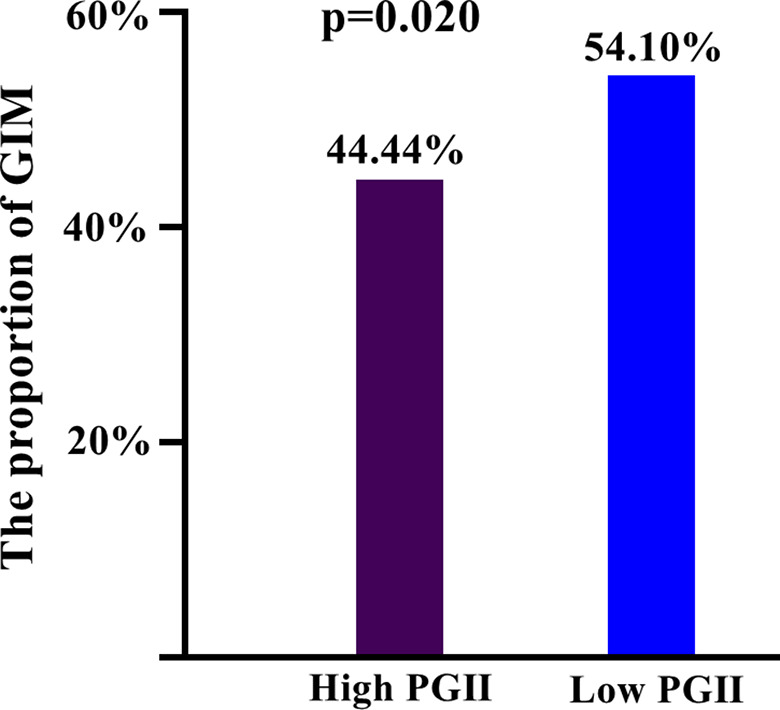
Results: Compared to the NC group, the GIM group showed a reduction in PG II expression level [10.71(6.40,16.89) VS 9.21(6.14,14.55), p = 0.010]. GIM patients had a higher prevalence of previous Hp eradication history (14.98% VS 23.75%, p = 0.014). The low PG II group exhibited a higher incidence rate of GIM compared to the high PG II group (54.10% VS 44.44%, p = 0 0.020). In the Hp-negative(Hp-) group, there was a decrease in both PGI and PG II expression levels when compared to the Hp-positive(Hp+) group [146.73 ± 78.53 VS 125.61 ± 68.75 and 10.19(7.27, 16.58) VS 7.36(5.62,12.53), p = 0.036 and p < 0.001]. Among patients without Hp eradication history, those with low PG II levels had a higher proportion of individuals with a history of Hp eradication than those with high PG II levels (29.31% VS 3.13%, p = 0.003). Additionally, within the subgroup that underwent Hp eradication, there was a decrease in PG II expression level compared to the subgroup without Hp eradication (6.16(5.13, 7.52) VS 8.73(5.67, 13.35), p = 0.041).
Conclusion: The prevalence of GIM was significantly associated with low levels of PG II. There was a significant association between HP eradication history and the prevalence of GIM. Hp eradication history resulted in reduced expression levels of PG II in Hp- GIM patients.
目的:本研究旨在评估胃肠道化生(GIM)患者血清胃蛋白酶原(PG)I、PG II和胃泌素(G17)水平,并评价其与人口学特征的相关性。方法:选取247例正常对照(NC)和240例确诊为GIM的患者进行研究。所有参与者都进行了胃镜检查,然后进行了病理检查以确认诊断。荧光免疫层析法检测PGI、PGⅱ和g17的表达水平,13碳呼气试验检测Hp感染情况。通过问卷调查获得研究对象的人口学特征。结果:与NC组相比,GIM组PG II表达水平降低[10.71(6.40,16.89)VS 9.21(6.14,14.55), p = 0.010]。GIM患者有较高的Hp根除史(14.98% VS 23.75%, p = 0.014)。低PG组的GIM发生率高于高PG组(54.10% VS 44.44%, p = 0.020)。Hp阴性(Hp-)组与Hp阳性(Hp+)组相比,PGI和PG II表达水平均降低[146.73±78.53 VS 125.61±68.75,10.19(7.27,16.58)VS 7.36(5.62,12.53), p = 0.036和p = 0.036]。结论:GIM患病率与PG II水平低有显著相关性。HP根除史与GIM流行之间存在显著关联。Hp根除史导致Hp- GIM患者PG II表达水平降低。
期刊介绍:
Journal of Health, Population and Nutrition brings together research on all aspects of issues related to population, nutrition and health. The journal publishes articles across a broad range of topics including global health, maternal and child health, nutrition, common illnesses and determinants of population health.




 京公网安备 11010802042870号
京ICP备2023020795号-1
京公网安备 11010802042870号
京ICP备2023020795号-1

 分享
分享
 求助内容:
求助内容: 应助结果提醒方式:
 扫码关注我们
