Izabela Szymczak-Pajor, Józef Drzewoski, Małgorzata Kozłowska, Jan Krekora, Agnieszka Śliwińska
{"title":"The Gut Microbiota-Related Antihyperglycemic Effect of Metformin.","authors":"Izabela Szymczak-Pajor, Józef Drzewoski, Małgorzata Kozłowska, Jan Krekora, Agnieszka Śliwińska","doi":"10.3390/ph18010055","DOIUrl":null,"url":null,"abstract":"<p><p>It is critical to sustain the diversity of the microbiota to maintain host homeostasis and health. Growing evidence indicates that changes in gut microbial biodiversity may be associated with the development of several pathologies, including type 2 diabetes mellitus (T2DM). Metformin is still the first-line drug for treatment of T2DM unless there are contra-indications. The drug primarily inhibits hepatic gluconeogenesis and increases the sensitivity of target cells (hepatocytes, adipocytes and myocytes) to insulin; however, increasing evidence suggests that it may also influence the gut. As T2DM patients exhibit gut dysbiosis, the intestinal microbiome has gained interest as a key target for metabolic diseases. Interestingly, changes in the gut microbiome were also observed in T2DM patients treated with metformin compared to those who were not. Therefore, the aim of this review is to present the current state of knowledge regarding the association of the gut microbiome with the antihyperglycemic effect of metformin. Numerous studies indicate that the reduction in glucose concentration observed in T2DM patients treated with metformin is due in part to changes in the biodiversity of the gut microbiota. These changes contribute to improved intestinal barrier integrity, increased production of short-chain fatty acids (SCFAs), regulation of bile acid metabolism, and enhanced glucose absorption. Therefore, in addition to the well-recognized reduction of gluconeogenesis, metformin also appears to exert its glucose-lowering effect by influencing gut microbiome biodiversity. However, we are only beginning to understand how metformin acts on specific microorganisms in the intestine, and further research is needed to understand its role in regulating glucose metabolism, including the impact of this remarkable drug on specific microorganisms in the gut.</p>","PeriodicalId":20198,"journal":{"name":"Pharmaceuticals","volume":"18 1","pages":""},"PeriodicalIF":4.8000,"publicationDate":"2025-01-06","publicationTypes":"Journal Article","fieldsOfStudy":null,"isOpenAccess":false,"openAccessPdf":"https://www.ncbi.nlm.nih.gov/pmc/articles/PMC11768994/pdf/","citationCount":"0","resultStr":null,"platform":"Semanticscholar","paperid":null,"PeriodicalName":"Pharmaceuticals","FirstCategoryId":"3","ListUrlMain":"https://doi.org/10.3390/ph18010055","RegionNum":3,"RegionCategory":"医学","ArticlePicture":[],"TitleCN":null,"AbstractTextCN":null,"PMCID":null,"EPubDate":"","PubModel":"","JCR":"Q2","JCRName":"CHEMISTRY, MEDICINAL","Score":null,"Total":0}
引用次数: 0
Abstract
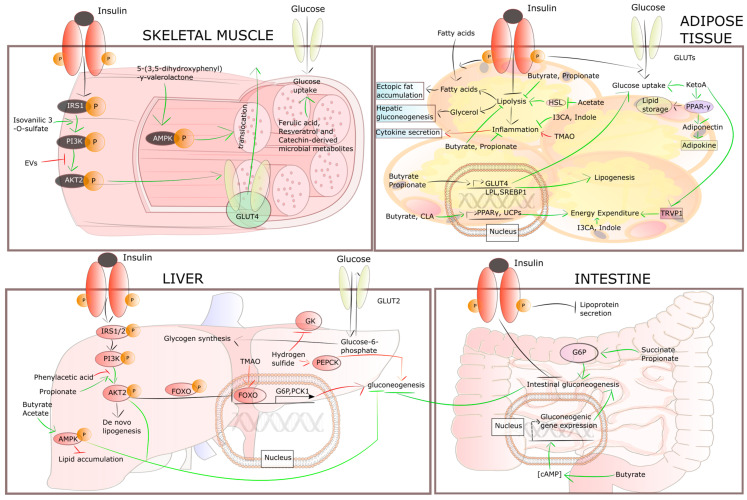
It is critical to sustain the diversity of the microbiota to maintain host homeostasis and health. Growing evidence indicates that changes in gut microbial biodiversity may be associated with the development of several pathologies, including type 2 diabetes mellitus (T2DM). Metformin is still the first-line drug for treatment of T2DM unless there are contra-indications. The drug primarily inhibits hepatic gluconeogenesis and increases the sensitivity of target cells (hepatocytes, adipocytes and myocytes) to insulin; however, increasing evidence suggests that it may also influence the gut. As T2DM patients exhibit gut dysbiosis, the intestinal microbiome has gained interest as a key target for metabolic diseases. Interestingly, changes in the gut microbiome were also observed in T2DM patients treated with metformin compared to those who were not. Therefore, the aim of this review is to present the current state of knowledge regarding the association of the gut microbiome with the antihyperglycemic effect of metformin. Numerous studies indicate that the reduction in glucose concentration observed in T2DM patients treated with metformin is due in part to changes in the biodiversity of the gut microbiota. These changes contribute to improved intestinal barrier integrity, increased production of short-chain fatty acids (SCFAs), regulation of bile acid metabolism, and enhanced glucose absorption. Therefore, in addition to the well-recognized reduction of gluconeogenesis, metformin also appears to exert its glucose-lowering effect by influencing gut microbiome biodiversity. However, we are only beginning to understand how metformin acts on specific microorganisms in the intestine, and further research is needed to understand its role in regulating glucose metabolism, including the impact of this remarkable drug on specific microorganisms in the gut.
PharmaceuticalsPharmacology, Toxicology and Pharmaceutics-Pharmaceutical Science
CiteScore
6.10
自引率
4.30%
发文量
1332
审稿时长
6 weeks
期刊介绍:
Pharmaceuticals (ISSN 1424-8247) is an international scientific journal of medicinal chemistry and related drug sciences.Our aim is to publish updated reviews as well as research articles with comprehensive theoretical and experimental details. Short communications are also accepted; therefore, there is no restriction on the maximum length of the papers.





 京公网安备 11010802042870号
京ICP备2023020795号-1
京公网安备 11010802042870号
京ICP备2023020795号-1

 分享
分享
 求助内容:
求助内容: 应助结果提醒方式:
 扫码关注我们
