Mauida F Hasoon Alkhallawi, Majed H Mohammed, Farhid Hemmatzadeh, Kiro Petrovski
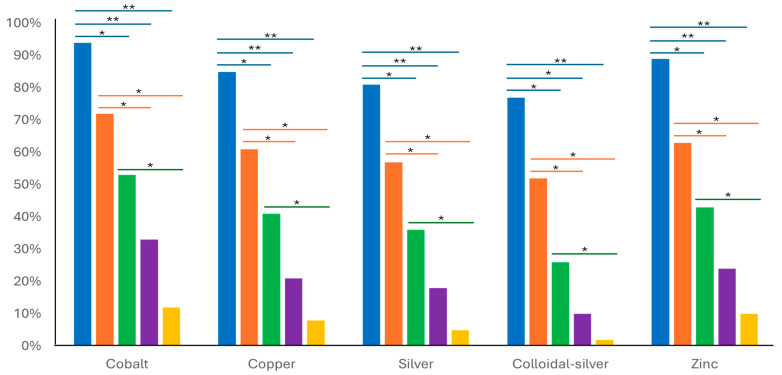
{"title":"Exploring Metal Ions as Potential Antimicrobial Agents to Combat Future Drug Resistance in <i>Mycoplasma bovis</i>.","authors":"Mauida F Hasoon Alkhallawi, Majed H Mohammed, Farhid Hemmatzadeh, Kiro Petrovski","doi":"10.3390/microorganisms13010169","DOIUrl":null,"url":null,"abstract":"<p><p>The rise in antimicrobial resistance (AMR) in <i>Mycoplasma bovis</i> underscores the urgent need for alternative treatments. This study evaluated the minimal inhibitory concentrations (MICs) of four metal ions (cobalt, copper, silver, and zinc) and colloidal silver against 15 clinical <i>M. bovis</i> isolates, alongside conventional antimicrobials (florfenicol, tetracycline, tulathromycin, and tylosin). Colloidal silver demonstrated the most effective antimicrobial activity, inhibiting 81.25% of isolates at 1.5 mg/L, while silver inhibited 93.7% of isolates at concentrations above 1.5 mg/L. Copper exhibited notable efficacy, inhibiting 37.5% of isolates at 1.5 mg/L, with a small proportion responding at 0.1 mg/L. Cobalt and zinc displayed variable activity, with MIC values ranging from 0.7 to 12.5 mg/L. In contrast, conventional antimicrobials showed limited effectiveness: tetracycline inhibited 31.25% of isolates at ≥16 mg/L, tylosin inhibited 25% at 16 mg/L, and tulathromycin MICs ranged from 0.5 to 8 mg/L. Time-kill assays revealed a reduction in <i>M. bovis</i> viability after eight hours of exposure to silver and colloidal silver, though higher concentrations (4×-8× MIC) were required for complete eradication. These findings highlight the significant potential of colloidal silver and copper as alternatives for treating <i>M. bovis</i> infections and combating AMR. Further research is essential to explore their standalone and synergistic applications for therapeutic use.</p>","PeriodicalId":18667,"journal":{"name":"Microorganisms","volume":"13 1","pages":""},"PeriodicalIF":4.2000,"publicationDate":"2025-01-15","publicationTypes":"Journal Article","fieldsOfStudy":null,"isOpenAccess":false,"openAccessPdf":"https://www.ncbi.nlm.nih.gov/pmc/articles/PMC11767636/pdf/","citationCount":"0","resultStr":null,"platform":"Semanticscholar","paperid":null,"PeriodicalName":"Microorganisms","FirstCategoryId":"99","ListUrlMain":"https://doi.org/10.3390/microorganisms13010169","RegionNum":2,"RegionCategory":"生物学","ArticlePicture":[],"TitleCN":null,"AbstractTextCN":null,"PMCID":null,"EPubDate":"","PubModel":"","JCR":"Q2","JCRName":"MICROBIOLOGY","Score":null,"Total":0}
引用次数: 0
Abstract
The rise in antimicrobial resistance (AMR) in Mycoplasma bovis underscores the urgent need for alternative treatments. This study evaluated the minimal inhibitory concentrations (MICs) of four metal ions (cobalt, copper, silver, and zinc) and colloidal silver against 15 clinical M. bovis isolates, alongside conventional antimicrobials (florfenicol, tetracycline, tulathromycin, and tylosin). Colloidal silver demonstrated the most effective antimicrobial activity, inhibiting 81.25% of isolates at 1.5 mg/L, while silver inhibited 93.7% of isolates at concentrations above 1.5 mg/L. Copper exhibited notable efficacy, inhibiting 37.5% of isolates at 1.5 mg/L, with a small proportion responding at 0.1 mg/L. Cobalt and zinc displayed variable activity, with MIC values ranging from 0.7 to 12.5 mg/L. In contrast, conventional antimicrobials showed limited effectiveness: tetracycline inhibited 31.25% of isolates at ≥16 mg/L, tylosin inhibited 25% at 16 mg/L, and tulathromycin MICs ranged from 0.5 to 8 mg/L. Time-kill assays revealed a reduction in M. bovis viability after eight hours of exposure to silver and colloidal silver, though higher concentrations (4×-8× MIC) were required for complete eradication. These findings highlight the significant potential of colloidal silver and copper as alternatives for treating M. bovis infections and combating AMR. Further research is essential to explore their standalone and synergistic applications for therapeutic use.
期刊介绍:
Microorganisms (ISSN 2076-2607) is an international, peer-reviewed open access journal which provides an advanced forum for studies related to prokaryotic and eukaryotic microorganisms, viruses and prions. It publishes reviews, research papers and communications. Our aim is to encourage scientists to publish their experimental and theoretical results in as much detail as possible. There is no restriction on the length of the papers. The full experimental details must be provided so that the results can be reproduced. Electronic files and software regarding the full details of the calculation or experimental procedure, if unable to be published in a normal way, can be deposited as supplementary electronic material.



 京公网安备 11010802042870号
京ICP备2023020795号-1
京公网安备 11010802042870号
京ICP备2023020795号-1

 分享
分享
 求助内容:
求助内容: 应助结果提醒方式:
 扫码关注我们
