{"title":"Inhibition of ERα signaling induces lineage plasticity in vivo","authors":"","doi":"10.1038/s43018-024-00897-9","DOIUrl":null,"url":null,"abstract":"Mutations in ESR1, which encodes estrogen receptor-α (ERα), drive resistance to approved endocrine therapies in breast cancer. We studied the molecular response to the investigational ERα antagonist and degrader, giredestrant, in preclinical models and biopsy samples. We found that long-term inhibition or dysfunction of ERα result in cell plasticity with implications for therapeutic sensitivity.","PeriodicalId":18885,"journal":{"name":"Nature cancer","volume":"6 2","pages":"237-238"},"PeriodicalIF":28.5000,"publicationDate":"2025-01-24","publicationTypes":"Journal Article","fieldsOfStudy":null,"isOpenAccess":false,"openAccessPdf":"","citationCount":"0","resultStr":null,"platform":"Semanticscholar","paperid":null,"PeriodicalName":"Nature cancer","FirstCategoryId":"3","ListUrlMain":"https://www.nature.com/articles/s43018-024-00897-9","RegionNum":1,"RegionCategory":"医学","ArticlePicture":[],"TitleCN":null,"AbstractTextCN":null,"PMCID":null,"EPubDate":"","PubModel":"","JCR":"Q1","JCRName":"ONCOLOGY","Score":null,"Total":0}
引用次数: 0
Abstract
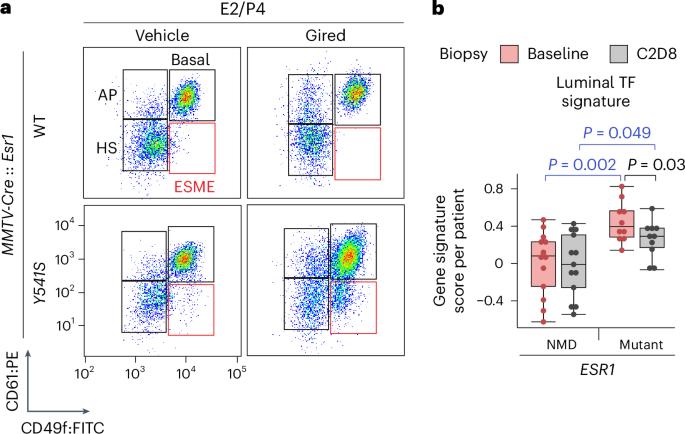
Mutations in ESR1, which encodes estrogen receptor-α (ERα), drive resistance to approved endocrine therapies in breast cancer. We studied the molecular response to the investigational ERα antagonist and degrader, giredestrant, in preclinical models and biopsy samples. We found that long-term inhibition or dysfunction of ERα result in cell plasticity with implications for therapeutic sensitivity.
期刊介绍:
Cancer is a devastating disease responsible for millions of deaths worldwide. However, many of these deaths could be prevented with improved prevention and treatment strategies. To achieve this, it is crucial to focus on accurate diagnosis, effective treatment methods, and understanding the socioeconomic factors that influence cancer rates.
Nature Cancer aims to serve as a unique platform for sharing the latest advancements in cancer research across various scientific fields, encompassing life sciences, physical sciences, applied sciences, and social sciences. The journal is particularly interested in fundamental research that enhances our understanding of tumor development and progression, as well as research that translates this knowledge into clinical applications through innovative diagnostic and therapeutic approaches. Additionally, Nature Cancer welcomes clinical studies that inform cancer diagnosis, treatment, and prevention, along with contributions exploring the societal impact of cancer on a global scale.
In addition to publishing original research, Nature Cancer will feature Comments, Reviews, News & Views, Features, and Correspondence that hold significant value for the diverse field of cancer research.



 京公网安备 11010802042870号
京ICP备2023020795号-1
京公网安备 11010802042870号
京ICP备2023020795号-1

 分享
分享
 求助内容:
求助内容: 应助结果提醒方式:
 扫码关注我们
