{"title":"Identification of fine antigenic epitopes of Tamdy virus glycoprotein Gn fragment and establishment of ELISA detection method.","authors":"Yujiao Fu, Liping Liu, Beibei Zhang, Xiaoshan Chao, Junxia Jin, Ying Wang, Juntao Ding","doi":"10.1186/s13071-024-06646-2","DOIUrl":null,"url":null,"abstract":"<p><strong>Background: </strong>Tamdy virus (TAMV) was first isolated in Uzbekistan and Turkmenistan. In 2018, it was found in China, marking its entry into the molecular research era. TAMV is linked to febrile diseases, but its epidemiology and spillover risks are poorly understood, necessitating urgent molecular research and detection method development.</p><p><strong>Methods: </strong>The secondary structure of TAMV glycoprotein Gn was predicted, and the results showed that it had rich antigenic epitopes. According to the predicted results, glycoprotein Gn was divided into 46 truncated 16-peptides by modified synthetic peptide method, and the antigenicity of 46 truncated 16-peptides was verified by western blotting analysis.</p><p><strong>Results: </strong>The results showed that P8, P9, P24, P25, P28, P29, and P39 had antigenicity. Subsequently, the seven positive 16-peptide sequences with antigenicity were truncated to form 8-peptide sequences with an overlap of seven amino acids. After analysis with the same method, eight fine antigenic epitopes E1 (<sup>58</sup>VINSTLDH<sup>65</sup>), E2 (<sup>65</sup>HVGSWGMP<sup>72</sup>), E3 (<sup>68</sup>SWGMPVTT<sup>75</sup>), E4 (<sup>187</sup>IRNQPFKS<sup>194</sup>), E5 (<sup>195</sup>FNVEVQ<sup>200</sup>), E6 (<sup>226</sup>AVVEHH<sup>231</sup>), E7 (<sup>228</sup>VEHHGNKA<sup>235</sup>), and E8 (<sup>310</sup>RGGRR<sup>314</sup>) were identified, all of which were located on the three-dimensional surface of glycoprotein Gn and were highly conserved in different TAMV strains.</p><p><strong>Conclusions: </strong>Eight precise epitopes were identified, and an indirect ELISA method based on fusion multiepitope peptide (r-Gn-MEPX<sub>2</sub>) was developed and implemented, featuring high sensitivity, accuracy, and specificity.</p>","PeriodicalId":19793,"journal":{"name":"Parasites & Vectors","volume":"18 1","pages":"26"},"PeriodicalIF":3.5000,"publicationDate":"2025-01-24","publicationTypes":"Journal Article","fieldsOfStudy":null,"isOpenAccess":false,"openAccessPdf":"https://www.ncbi.nlm.nih.gov/pmc/articles/PMC11762889/pdf/","citationCount":"0","resultStr":null,"platform":"Semanticscholar","paperid":null,"PeriodicalName":"Parasites & Vectors","FirstCategoryId":"3","ListUrlMain":"https://doi.org/10.1186/s13071-024-06646-2","RegionNum":2,"RegionCategory":"医学","ArticlePicture":[],"TitleCN":null,"AbstractTextCN":null,"PMCID":null,"EPubDate":"","PubModel":"","JCR":"Q1","JCRName":"PARASITOLOGY","Score":null,"Total":0}
引用次数: 0
Abstract
Background: Tamdy virus (TAMV) was first isolated in Uzbekistan and Turkmenistan. In 2018, it was found in China, marking its entry into the molecular research era. TAMV is linked to febrile diseases, but its epidemiology and spillover risks are poorly understood, necessitating urgent molecular research and detection method development.
Methods: The secondary structure of TAMV glycoprotein Gn was predicted, and the results showed that it had rich antigenic epitopes. According to the predicted results, glycoprotein Gn was divided into 46 truncated 16-peptides by modified synthetic peptide method, and the antigenicity of 46 truncated 16-peptides was verified by western blotting analysis.
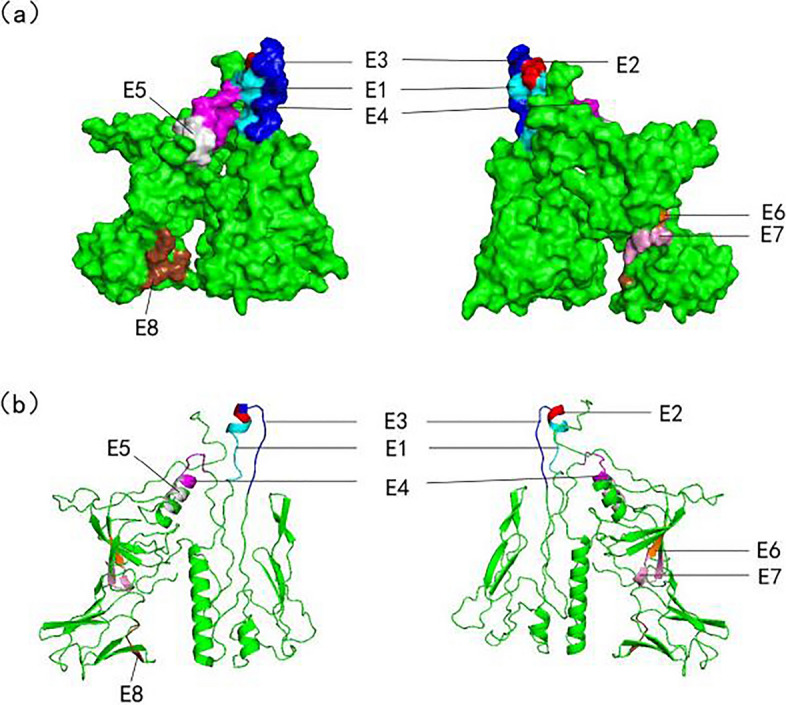
Results: The results showed that P8, P9, P24, P25, P28, P29, and P39 had antigenicity. Subsequently, the seven positive 16-peptide sequences with antigenicity were truncated to form 8-peptide sequences with an overlap of seven amino acids. After analysis with the same method, eight fine antigenic epitopes E1 (58VINSTLDH65), E2 (65HVGSWGMP72), E3 (68SWGMPVTT75), E4 (187IRNQPFKS194), E5 (195FNVEVQ200), E6 (226AVVEHH231), E7 (228VEHHGNKA235), and E8 (310RGGRR314) were identified, all of which were located on the three-dimensional surface of glycoprotein Gn and were highly conserved in different TAMV strains.
Conclusions: Eight precise epitopes were identified, and an indirect ELISA method based on fusion multiepitope peptide (r-Gn-MEPX2) was developed and implemented, featuring high sensitivity, accuracy, and specificity.
期刊介绍:
Parasites & Vectors is an open access, peer-reviewed online journal dealing with the biology of parasites, parasitic diseases, intermediate hosts, vectors and vector-borne pathogens. Manuscripts published in this journal will be available to all worldwide, with no barriers to access, immediately following acceptance. However, authors retain the copyright of their material and may use it, or distribute it, as they wish.
Manuscripts on all aspects of the basic and applied biology of parasites, intermediate hosts, vectors and vector-borne pathogens will be considered. In addition to the traditional and well-established areas of science in these fields, we also aim to provide a vehicle for publication of the rapidly developing resources and technology in parasite, intermediate host and vector genomics and their impacts on biological research. We are able to publish large datasets and extensive results, frequently associated with genomic and post-genomic technologies, which are not readily accommodated in traditional journals. Manuscripts addressing broader issues, for example economics, social sciences and global climate change in relation to parasites, vectors and disease control, are also welcomed.





 京公网安备 11010802042870号
京ICP备2023020795号-1
京公网安备 11010802042870号
京ICP备2023020795号-1

 分享
分享
 求助内容:
求助内容: 应助结果提醒方式:
 扫码关注我们
