Thijs Kuipers, Carlijn Mussies, Aaltje Lei, Gwen M C Masclee, Marc A Benninga, Paul Fockens, Barbara A J Bastiaansen, Albert J Bredenoord, Michiel P van Wijk
{"title":"Peroral Endoscopic myotomy (POEM) in pediatric achalasia: a retrospective cohort on institutional experience and quality of life.","authors":"Thijs Kuipers, Carlijn Mussies, Aaltje Lei, Gwen M C Masclee, Marc A Benninga, Paul Fockens, Barbara A J Bastiaansen, Albert J Bredenoord, Michiel P van Wijk","doi":"10.1186/s13023-025-03565-y","DOIUrl":null,"url":null,"abstract":"<p><strong>Background: </strong>Achalasia is a rare esophageal motility disorder with an estimated annual incidence of 1-5/100.000 and a mean age at diagnosis > 50 years of age. Only a fraction of the patients has an onset during childhood (estimated incidence of 0.1-0.18/ 100.000 children per year). No curative treatment is currently available. Peroral Endoscopic Myotomy (POEM) is a widely accepted treatment option to improve symptoms in adults. Studies evaluating safety and efficacy of POEM in children are scarce and no data exist regarding the quality of life in patients after POEM.</p><p><strong>Methods: </strong>We evaluated the effectiveness and safety of POEM in a cohort of children that was treated for achalasia and we prospectively evaluated their quality of life. We compared the results to a previous cohort evaluating Pneumatic Dilation (PD) and Laparoscopic Heller's Myotomy (LHM) in children with achalasia.</p><p><strong>Results: </strong>Thirty-three achalasia patients (age at time of POEM 14.1(± 2.5) years, 54.5% female) were included. Twenty-nine (87.8%) percent had received previous treatment (PD (n = 20); LHM (n = 1); PD + LHM (n = 7); PD + Botox (n = 1). POEM was technically successful in all patients and no major complications occurred. Mean follow-up duration was 33 (± 25) months. Twenty three (70%) patients did not need retreatment after POEM during the follow up period. Quality of life after POEM did not differ from the population norms. Patients with an Eckardt score > 3 had a significantly worse general (Kidscreen-52: physical score 44.7 vs. 52.4; p = 0.011; mental score: 42.5 vs. 51.3; p = 0.038) and disease specific (35 vs. 16; p = 0.017) quality of life compared to those with an Eckardt ≤ 3. The SF-36 mental health component score was significantly lower (44.2 vs. 53.1; p = 0.036) in patients treated with POEM compared to those treated with PD and LHM. These lower scores could be related to a selection bias, as more severe patients received POEM, and other influences such as the Corona pandemic. However, the overall, quality of life after POEM was not significantly different to PD and LHM.</p><p><strong>Conclusion: </strong>POEM is an effective and safe treatment for achalasia in children. Quality of life after POEM is comparable to the results obtained after PD and Heller.</p>","PeriodicalId":19651,"journal":{"name":"Orphanet Journal of Rare Diseases","volume":"20 1","pages":"39"},"PeriodicalIF":3.5000,"publicationDate":"2025-01-25","publicationTypes":"Journal Article","fieldsOfStudy":null,"isOpenAccess":false,"openAccessPdf":"https://www.ncbi.nlm.nih.gov/pmc/articles/PMC11765891/pdf/","citationCount":"0","resultStr":null,"platform":"Semanticscholar","paperid":null,"PeriodicalName":"Orphanet Journal of Rare Diseases","FirstCategoryId":"3","ListUrlMain":"https://doi.org/10.1186/s13023-025-03565-y","RegionNum":2,"RegionCategory":"医学","ArticlePicture":[],"TitleCN":null,"AbstractTextCN":null,"PMCID":null,"EPubDate":"","PubModel":"","JCR":"Q2","JCRName":"GENETICS & HEREDITY","Score":null,"Total":0}
引用次数: 0
Abstract
Background: Achalasia is a rare esophageal motility disorder with an estimated annual incidence of 1-5/100.000 and a mean age at diagnosis > 50 years of age. Only a fraction of the patients has an onset during childhood (estimated incidence of 0.1-0.18/ 100.000 children per year). No curative treatment is currently available. Peroral Endoscopic Myotomy (POEM) is a widely accepted treatment option to improve symptoms in adults. Studies evaluating safety and efficacy of POEM in children are scarce and no data exist regarding the quality of life in patients after POEM.
Methods: We evaluated the effectiveness and safety of POEM in a cohort of children that was treated for achalasia and we prospectively evaluated their quality of life. We compared the results to a previous cohort evaluating Pneumatic Dilation (PD) and Laparoscopic Heller's Myotomy (LHM) in children with achalasia.
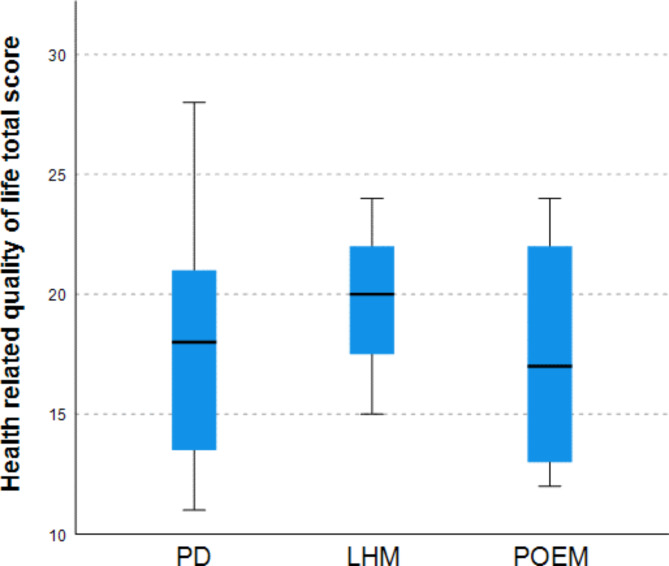
Results: Thirty-three achalasia patients (age at time of POEM 14.1(± 2.5) years, 54.5% female) were included. Twenty-nine (87.8%) percent had received previous treatment (PD (n = 20); LHM (n = 1); PD + LHM (n = 7); PD + Botox (n = 1). POEM was technically successful in all patients and no major complications occurred. Mean follow-up duration was 33 (± 25) months. Twenty three (70%) patients did not need retreatment after POEM during the follow up period. Quality of life after POEM did not differ from the population norms. Patients with an Eckardt score > 3 had a significantly worse general (Kidscreen-52: physical score 44.7 vs. 52.4; p = 0.011; mental score: 42.5 vs. 51.3; p = 0.038) and disease specific (35 vs. 16; p = 0.017) quality of life compared to those with an Eckardt ≤ 3. The SF-36 mental health component score was significantly lower (44.2 vs. 53.1; p = 0.036) in patients treated with POEM compared to those treated with PD and LHM. These lower scores could be related to a selection bias, as more severe patients received POEM, and other influences such as the Corona pandemic. However, the overall, quality of life after POEM was not significantly different to PD and LHM.
Conclusion: POEM is an effective and safe treatment for achalasia in children. Quality of life after POEM is comparable to the results obtained after PD and Heller.
期刊介绍:
Orphanet Journal of Rare Diseases is an open access, peer-reviewed journal that encompasses all aspects of rare diseases and orphan drugs. The journal publishes high-quality reviews on specific rare diseases. In addition, the journal may consider articles on clinical trial outcome reports, either positive or negative, and articles on public health issues in the field of rare diseases and orphan drugs. The journal does not accept case reports.





 京公网安备 11010802042870号
京ICP备2023020795号-1
京公网安备 11010802042870号
京ICP备2023020795号-1

 分享
分享
 求助内容:
求助内容: 应助结果提醒方式:
 扫码关注我们
