Tao Wang, Michael G Leeming, Nicholas A Williamson, Tiffany Bouchery, Rory Doolan, Graham Le Gros, Gavin E Reid, Nicola L Harris, Robin B Gasser
{"title":"The developmental lipidome of Nippostrongylus brasiliensis.","authors":"Tao Wang, Michael G Leeming, Nicholas A Williamson, Tiffany Bouchery, Rory Doolan, Graham Le Gros, Gavin E Reid, Nicola L Harris, Robin B Gasser","doi":"10.1186/s13071-024-06654-2","DOIUrl":null,"url":null,"abstract":"<p><strong>Background: </strong>Nippostrongylus brasiliensis-a nematode of rodents-is commonly used as a model to study the immunobiology of parasitic nematodes. It is a member of the Strongylida-a large order of socioeconomically important parasitic nematodes of animals. Lipids are known to play essential roles in nematode biology, influencing cellular membranes, energy storage and/or signalling.</p><p><strong>Methods: </strong>The present investigation provides a comprehensive, untargeted lipidomic analysis of four developmental stages/sexes (i.e. egg, L3, adult female and adult male stages) of N. brasiliensis utilising liquid chromatography coupled to mass spectrometry.</p><p><strong>Results: </strong>We identified 464 lipid species representing 18 lipid classes and revealed distinct stage-specific changes in lipid composition throughout nematode development. Triacylglycerols (TGs) dominated the lipid profile in the egg stage, suggesting a key role for them in energy storage at this early developmental stage. As N. brasiliensis develops, there was a conspicuous transition toward membrane-associated lipids, including glycerophospholipids (e.g. PE and PC) and ether-linked lipids, particularly in adult stages, indicating a shift toward host adaptation and membrane stabilisation.</p><p><strong>Conclusions: </strong>We provide a comprehensive insight into the lipid composition and abundance of key free-living and parasitic stages of N. brasiliensis. This study provides lipidomic resources to underpin the detailed exploration of lipid biology in this model parasitic nematode.</p>","PeriodicalId":19793,"journal":{"name":"Parasites & Vectors","volume":"18 1","pages":"27"},"PeriodicalIF":3.5000,"publicationDate":"2025-01-25","publicationTypes":"Journal Article","fieldsOfStudy":null,"isOpenAccess":false,"openAccessPdf":"https://www.ncbi.nlm.nih.gov/pmc/articles/PMC11762861/pdf/","citationCount":"0","resultStr":null,"platform":"Semanticscholar","paperid":null,"PeriodicalName":"Parasites & Vectors","FirstCategoryId":"3","ListUrlMain":"https://doi.org/10.1186/s13071-024-06654-2","RegionNum":2,"RegionCategory":"医学","ArticlePicture":[],"TitleCN":null,"AbstractTextCN":null,"PMCID":null,"EPubDate":"","PubModel":"","JCR":"Q1","JCRName":"PARASITOLOGY","Score":null,"Total":0}
引用次数: 0
Abstract
Background: Nippostrongylus brasiliensis-a nematode of rodents-is commonly used as a model to study the immunobiology of parasitic nematodes. It is a member of the Strongylida-a large order of socioeconomically important parasitic nematodes of animals. Lipids are known to play essential roles in nematode biology, influencing cellular membranes, energy storage and/or signalling.
Methods: The present investigation provides a comprehensive, untargeted lipidomic analysis of four developmental stages/sexes (i.e. egg, L3, adult female and adult male stages) of N. brasiliensis utilising liquid chromatography coupled to mass spectrometry.
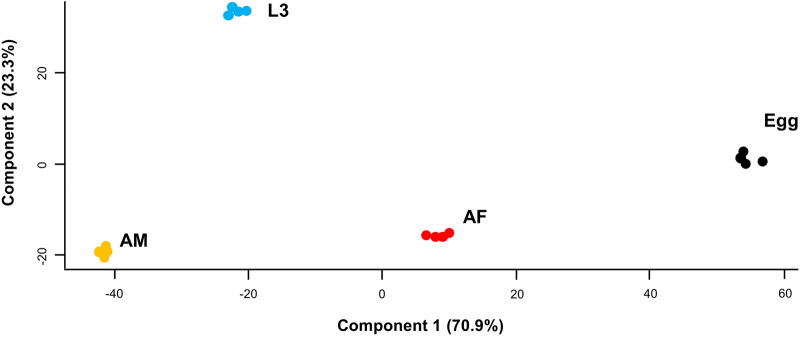
Results: We identified 464 lipid species representing 18 lipid classes and revealed distinct stage-specific changes in lipid composition throughout nematode development. Triacylglycerols (TGs) dominated the lipid profile in the egg stage, suggesting a key role for them in energy storage at this early developmental stage. As N. brasiliensis develops, there was a conspicuous transition toward membrane-associated lipids, including glycerophospholipids (e.g. PE and PC) and ether-linked lipids, particularly in adult stages, indicating a shift toward host adaptation and membrane stabilisation.
Conclusions: We provide a comprehensive insight into the lipid composition and abundance of key free-living and parasitic stages of N. brasiliensis. This study provides lipidomic resources to underpin the detailed exploration of lipid biology in this model parasitic nematode.
期刊介绍:
Parasites & Vectors is an open access, peer-reviewed online journal dealing with the biology of parasites, parasitic diseases, intermediate hosts, vectors and vector-borne pathogens. Manuscripts published in this journal will be available to all worldwide, with no barriers to access, immediately following acceptance. However, authors retain the copyright of their material and may use it, or distribute it, as they wish.
Manuscripts on all aspects of the basic and applied biology of parasites, intermediate hosts, vectors and vector-borne pathogens will be considered. In addition to the traditional and well-established areas of science in these fields, we also aim to provide a vehicle for publication of the rapidly developing resources and technology in parasite, intermediate host and vector genomics and their impacts on biological research. We are able to publish large datasets and extensive results, frequently associated with genomic and post-genomic technologies, which are not readily accommodated in traditional journals. Manuscripts addressing broader issues, for example economics, social sciences and global climate change in relation to parasites, vectors and disease control, are also welcomed.





 京公网安备 11010802042870号
京ICP备2023020795号-1
京公网安备 11010802042870号
京ICP备2023020795号-1

 分享
分享
 求助内容:
求助内容: 应助结果提醒方式:
 扫码关注我们
