Ruolan Chen, Zufa Sabeel, Lu Ying, Youfeng Liang, Rui Guo, Mingxuan Hao, Xiaoyang Chen, Wenjing Zhang, Jian Dong, Yan Liu, Changyuan Yu, Zhao Yang
{"title":"Rhoifolin Suppresses Cell Proliferation and Induces Apoptosis in Hepatocellular Carcinoma Cells In Vitro and In Vivo.","authors":"Ruolan Chen, Zufa Sabeel, Lu Ying, Youfeng Liang, Rui Guo, Mingxuan Hao, Xiaoyang Chen, Wenjing Zhang, Jian Dong, Yan Liu, Changyuan Yu, Zhao Yang","doi":"10.3390/ph18010079","DOIUrl":null,"url":null,"abstract":"<p><p><b>Background:</b> Hepatocellular carcinoma (HCC) is the most prevalent malignant tumor, ranking fifth in terms of fatality with poor prognosis and a low survival rate. Rhoifolin (ROF), a flavonoid constituent, has previously been shown to suppress the proliferation of breast and pancreatic cancer cells. However, its inhibitory effect on HCC has remained unexplored. <b>Objectives:</b> Exploring the potent inhibitory activities and underlying mechanisms of ROF on HCC cells. <b>Methods:</b> The suppressive effect of ROF on HCC cells were assessed via CCK8 assay, apoptosis assay, cell cycle analysis and xenograft tumor mouse model. Furthermore, quantitative real-time PCR and western blot were applied to analyze the underlying mechanisms of ROF on HCC cells. <b>Results:</b> Firstly, the IC<sub>50</sub> values of ROF in HepG2 and HuH7 cells were 373.9 and 288.7 µg/mL at 24 h and 208.9 and 218.0 µg/mL at 48 h, respectively. Moreover, the apoptosis rates of HepG2 and HuH7 cells increased from 6.63% and 6.59% to 17.61% and 21.83% at 24 h and increased from 6.63% and 6.59% to 30.04% and 37.90% at 48 h, respectively. Additionally, ROF induced cell cycle arrest at the S phase in HCC cells. Furthermore, ROF suppressed the tumor growth of HCC cells in vivo without obvious toxicity. Mechanically, ROF facilitated apoptosis by upregulating the expression of PIDD1, CASP8, CASP9, BID, BAX, BIM, and BAK1 in HCC cells. <b>Conclusions:</b> ROF significantly restrains the growth of HCC cells in vitro and in vivo, which could be an effective supplement for HCC therapy.</p>","PeriodicalId":20198,"journal":{"name":"Pharmaceuticals","volume":"18 1","pages":""},"PeriodicalIF":4.8000,"publicationDate":"2025-01-10","publicationTypes":"Journal Article","fieldsOfStudy":null,"isOpenAccess":false,"openAccessPdf":"https://www.ncbi.nlm.nih.gov/pmc/articles/PMC11768873/pdf/","citationCount":"0","resultStr":null,"platform":"Semanticscholar","paperid":null,"PeriodicalName":"Pharmaceuticals","FirstCategoryId":"3","ListUrlMain":"https://doi.org/10.3390/ph18010079","RegionNum":3,"RegionCategory":"医学","ArticlePicture":[],"TitleCN":null,"AbstractTextCN":null,"PMCID":null,"EPubDate":"","PubModel":"","JCR":"Q2","JCRName":"CHEMISTRY, MEDICINAL","Score":null,"Total":0}
引用次数: 0
Abstract
Background: Hepatocellular carcinoma (HCC) is the most prevalent malignant tumor, ranking fifth in terms of fatality with poor prognosis and a low survival rate. Rhoifolin (ROF), a flavonoid constituent, has previously been shown to suppress the proliferation of breast and pancreatic cancer cells. However, its inhibitory effect on HCC has remained unexplored. Objectives: Exploring the potent inhibitory activities and underlying mechanisms of ROF on HCC cells. Methods: The suppressive effect of ROF on HCC cells were assessed via CCK8 assay, apoptosis assay, cell cycle analysis and xenograft tumor mouse model. Furthermore, quantitative real-time PCR and western blot were applied to analyze the underlying mechanisms of ROF on HCC cells. Results: Firstly, the IC50 values of ROF in HepG2 and HuH7 cells were 373.9 and 288.7 µg/mL at 24 h and 208.9 and 218.0 µg/mL at 48 h, respectively. Moreover, the apoptosis rates of HepG2 and HuH7 cells increased from 6.63% and 6.59% to 17.61% and 21.83% at 24 h and increased from 6.63% and 6.59% to 30.04% and 37.90% at 48 h, respectively. Additionally, ROF induced cell cycle arrest at the S phase in HCC cells. Furthermore, ROF suppressed the tumor growth of HCC cells in vivo without obvious toxicity. Mechanically, ROF facilitated apoptosis by upregulating the expression of PIDD1, CASP8, CASP9, BID, BAX, BIM, and BAK1 in HCC cells. Conclusions: ROF significantly restrains the growth of HCC cells in vitro and in vivo, which could be an effective supplement for HCC therapy.
PharmaceuticalsPharmacology, Toxicology and Pharmaceutics-Pharmaceutical Science
CiteScore
6.10
自引率
4.30%
发文量
1332
审稿时长
6 weeks
期刊介绍:
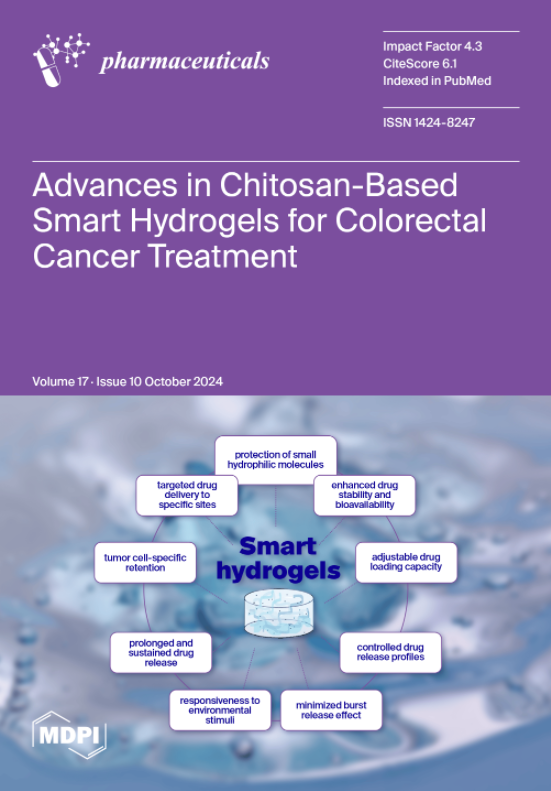
Pharmaceuticals (ISSN 1424-8247) is an international scientific journal of medicinal chemistry and related drug sciences.Our aim is to publish updated reviews as well as research articles with comprehensive theoretical and experimental details. Short communications are also accepted; therefore, there is no restriction on the maximum length of the papers.






 京公网安备 11010802042870号
京ICP备2023020795号-1
京公网安备 11010802042870号
京ICP备2023020795号-1

 分享
分享
 求助内容:
求助内容: 应助结果提醒方式:
 扫码关注我们
