Associations of early-onset coronary heart disease and genetic susceptibility with incident dementia and white matter hyperintensity: A prospective cohort study.
Jie Liang, Yanyu Zhang, Wenya Zhang, Yang Pan, Darui Gao, Jingya Ma, Yuling Liu, Yiwen Dai, Mengmeng Ji, Wuxiang Xie, Fanfan Zheng
{"title":"Associations of early-onset coronary heart disease and genetic susceptibility with incident dementia and white matter hyperintensity: A prospective cohort study.","authors":"Jie Liang, Yanyu Zhang, Wenya Zhang, Yang Pan, Darui Gao, Jingya Ma, Yuling Liu, Yiwen Dai, Mengmeng Ji, Wuxiang Xie, Fanfan Zheng","doi":"10.1016/j.tjpad.2024.100041","DOIUrl":null,"url":null,"abstract":"<p><strong>Background: </strong>The associations of early-onset coronary heart disease (CHD) and genetic susceptibility with incident dementia and brain white matter hyperintensity (WMH) remain unclear. Elucidation of this problem could promote understanding of the neurocognitive impact of early-onset CHD and provide suggestions for the prevention of dementia.</p><p><strong>Objectives: </strong>This study aimed to investigate whether observed and genetically predicted early-onset CHD were related to subsequent dementia and WMH volume.</p><p><strong>Design: </strong>Prospective cohort study.</p><p><strong>Setting: </strong>UK Biobank.</p><p><strong>Participants: </strong>500 671 individuals without dementia at baseline.</p><p><strong>Measurements: </strong>Early-onset CHD (male ≤55 years; female ≤65 years) was ascertained using hospital inpatient records. Incident dementia including all-cause dementia, Alzheimer's disease, and vascular dementia was ascertained using hospital inpatient records, mortality register data, and self-reported data. WMH volume was measured through brain magnetic resonance imaging (MRI). Cox proportional hazards models and linear regression models were used to analyze the associations of early-onset CHD with incident dementia and WMH. Subsequently, a polygenetic risk score (PRS) analysis was conducted to investigate the associations of genetically predicted early-onset CHD with outcomes.</p><p><strong>Results: </strong>Among 500 671 individuals (female: 272 669, 54.5%; mean age: 57.0 ± 8.1 years), 9 294 dementia occurred during a median follow-up of 13.8 years. Compared with the non-CHD group, both early-onset (n = 16 133) and late-onset CHD (n = 43 944) groups had higher risks of developing dementia (hazard ratio [HR]: 1.99, 95% confidence interval [CI]: 1.81 to 2.19 for early-onset group; HR: 1.20, 95% CI: 1.14 to 1.27 for late-onset group). Among CHD participants, early-onset CHD was associated with a significantly higher risk of incident dementia, compared with late-onset CHD (HR: 1.56, 95% CI: 1.39 to 1.75). In a subset of 40 290 individuals who completed brain MRI scans during a median follow-up of 9.3 years, participants with early-onset CHD exhibited the largest WMH volume among the three groups (early-onset CHD, late-onset CHD, and non-CHD, P<sub>trend</sub><0.001). The PRS analysis supported the associations of early-onset CHD with dementia (odds ratio [OR] for the highest quartile: 1.37, 95% CI: 1.28 to 1.46, P<sub>trend</sub><0.001) and WMH volume (β for the highest quartile: 0.042, 95% CI: 0.017 to 0.068, P<sub>trend</sub>=0.002).</p><p><strong>Conclusions: </strong>Early-onset CHD and genetic susceptibility are associated with a higher risk of incident dementia and a larger WMH volume. Additional attention should be paid to the neurocognitive status of individuals with early-onset CHD.</p>","PeriodicalId":22711,"journal":{"name":"The Journal of Prevention of Alzheimer's Disease","volume":"12 2","pages":"100041"},"PeriodicalIF":7.8000,"publicationDate":"2025-02-01","publicationTypes":"Journal Article","fieldsOfStudy":null,"isOpenAccess":false,"openAccessPdf":"https://www.ncbi.nlm.nih.gov/pmc/articles/PMC12184021/pdf/","citationCount":"0","resultStr":null,"platform":"Semanticscholar","paperid":null,"PeriodicalName":"The Journal of Prevention of Alzheimer's Disease","FirstCategoryId":"1085","ListUrlMain":"https://doi.org/10.1016/j.tjpad.2024.100041","RegionNum":0,"RegionCategory":null,"ArticlePicture":[],"TitleCN":null,"AbstractTextCN":null,"PMCID":null,"EPubDate":"2025/1/1 0:00:00","PubModel":"Epub","JCR":"Q2","JCRName":"BUSINESS","Score":null,"Total":0}
引用次数: 0
Abstract
Background: The associations of early-onset coronary heart disease (CHD) and genetic susceptibility with incident dementia and brain white matter hyperintensity (WMH) remain unclear. Elucidation of this problem could promote understanding of the neurocognitive impact of early-onset CHD and provide suggestions for the prevention of dementia.
Objectives: This study aimed to investigate whether observed and genetically predicted early-onset CHD were related to subsequent dementia and WMH volume.
Design: Prospective cohort study.
Setting: UK Biobank.
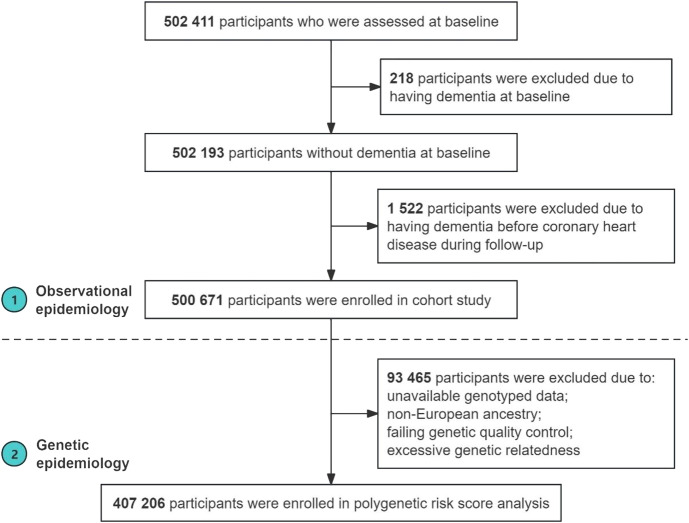
Participants: 500 671 individuals without dementia at baseline.
Measurements: Early-onset CHD (male ≤55 years; female ≤65 years) was ascertained using hospital inpatient records. Incident dementia including all-cause dementia, Alzheimer's disease, and vascular dementia was ascertained using hospital inpatient records, mortality register data, and self-reported data. WMH volume was measured through brain magnetic resonance imaging (MRI). Cox proportional hazards models and linear regression models were used to analyze the associations of early-onset CHD with incident dementia and WMH. Subsequently, a polygenetic risk score (PRS) analysis was conducted to investigate the associations of genetically predicted early-onset CHD with outcomes.
Results: Among 500 671 individuals (female: 272 669, 54.5%; mean age: 57.0 ± 8.1 years), 9 294 dementia occurred during a median follow-up of 13.8 years. Compared with the non-CHD group, both early-onset (n = 16 133) and late-onset CHD (n = 43 944) groups had higher risks of developing dementia (hazard ratio [HR]: 1.99, 95% confidence interval [CI]: 1.81 to 2.19 for early-onset group; HR: 1.20, 95% CI: 1.14 to 1.27 for late-onset group). Among CHD participants, early-onset CHD was associated with a significantly higher risk of incident dementia, compared with late-onset CHD (HR: 1.56, 95% CI: 1.39 to 1.75). In a subset of 40 290 individuals who completed brain MRI scans during a median follow-up of 9.3 years, participants with early-onset CHD exhibited the largest WMH volume among the three groups (early-onset CHD, late-onset CHD, and non-CHD, Ptrend<0.001). The PRS analysis supported the associations of early-onset CHD with dementia (odds ratio [OR] for the highest quartile: 1.37, 95% CI: 1.28 to 1.46, Ptrend<0.001) and WMH volume (β for the highest quartile: 0.042, 95% CI: 0.017 to 0.068, Ptrend=0.002).
Conclusions: Early-onset CHD and genetic susceptibility are associated with a higher risk of incident dementia and a larger WMH volume. Additional attention should be paid to the neurocognitive status of individuals with early-onset CHD.
期刊介绍:
The JPAD Journal of Prevention of Alzheimer’Disease will publish reviews, original research articles and short reports to improve our knowledge in the field of Alzheimer prevention including: neurosciences, biomarkers, imaging, epidemiology, public health, physical cognitive exercise, nutrition, risk and protective factors, drug development, trials design, and heath economic outcomes.JPAD will publish also the meeting abstracts from Clinical Trial on Alzheimer Disease (CTAD) and will be distributed both in paper and online version worldwide.We hope that JPAD with your contribution will play a role in the development of Alzheimer prevention.




 京公网安备 11010802042870号
京ICP备2023020795号-1
京公网安备 11010802042870号
京ICP备2023020795号-1

 分享
分享
 求助内容:
求助内容: 应助结果提醒方式:
 扫码关注我们
