Yanfei Ding, Lingbing Wang, Jun Liu, Yulei Deng, Yang Jiao, Aonan Zhao
{"title":"Distinct CSF α-synuclein aggregation profiles associated with Alzheimer's disease phenotypes and MCI-to-AD conversion.","authors":"Yanfei Ding, Lingbing Wang, Jun Liu, Yulei Deng, Yang Jiao, Aonan Zhao","doi":"10.1016/j.tjpad.2024.100040","DOIUrl":null,"url":null,"abstract":"<p><strong>Background: </strong>α-Synuclein (α-Syn) pathology is present in 30-50 % of Alzheimer's disease (AD) patients, and its interactions with tau proteins may further exacerbate pathological changes in AD. However, the specific role of different aggregation forms of α-Syn in the progression of AD remains unclear.</p><p><strong>Objectives: </strong>To explore the relationship between various aggregation types of CSF α-Syn and Alzheimer's disease progression.</p><p><strong>Design: </strong>We conducted a retrospective analysis of data from the Alzheimer's Disease Neuroimaging Initiative (ADNI) to examine the association between different α-Syn aggregation forms-Syn0 (no detectable α-Syn aggregates) and Syn1 (α-Syn aggregates detected, resembling those found in Parkinson's disease)-with the pathological and clinical features of AD. Additionally, we evaluated their potential as predictors of conversion from mild cognitive impairment (MCI) to AD.</p><p><strong>Setting: </strong>The ADNI database.</p><p><strong>Participants: </strong>A total of 250 participants, including 70 cognitively normal controls, 119 patients diagnosed with MCI, and 61 patients diagnosed with AD.</p><p><strong>Measurements: </strong>Pearson correlation was employed to assess the relationship between α-Syn levels and cerebrospinal fluid (CSF) biomarkers, including total tau (T-tau), phosphorylated tau (p-tau), and amyloid-β<sub>42</sub> (Aβ<sub>42</sub>). Multivariate Cox proportional hazards models were applied, adjusting for APOE4 status, age, and sex, to determine the association between α-Syn forms and AD-related pathological and clinical outcomes. Kaplan-Meier curves were used to evaluate the prognostic value of different α-Syn aggregation states in predicting the conversion from MCI to AD.</p><p><strong>Results: </strong>Compared with controls, overall MCI and AD patients had elevated α-Syn levels. Notably, in the α-Syn0 group, α-Syn levels were increased in the MCI patients and further increased in AD patients, whereas in the α-Syn1 group, α-Syn levels did not significantly differ across diagnostic groups. Both in the α-Syn0 and α-Syn1 groups, α-Syn levels were found to correlate more strongly with CSF tau levels than with Aβ<sub>42</sub>, indicating a possible role for α-Syn in tau-related pathology in AD. Importantly, α-Syn0-AD patients exhibited more rapid cognitive decline and greater hippocampal atrophy than α-Syn1-AD patients. However, MCI patients with CSF α-Syn1 aggregation status had an increased risk of conversion to AD.</p><p><strong>Conclusions: </strong>CSF α-Syn is associated with tau pathology and neurodegeneration in Alzheimer's disease. The distinct aggregation profiles of α-Syn serve as valuable biomarkers, offering insights into differing prognoses in AD and aiding in the prediction of early disease progression.</p>","PeriodicalId":22711,"journal":{"name":"The Journal of Prevention of Alzheimer's Disease","volume":"12 2","pages":"100040"},"PeriodicalIF":7.8000,"publicationDate":"2025-02-01","publicationTypes":"Journal Article","fieldsOfStudy":null,"isOpenAccess":false,"openAccessPdf":"https://www.ncbi.nlm.nih.gov/pmc/articles/PMC12184058/pdf/","citationCount":"0","resultStr":null,"platform":"Semanticscholar","paperid":null,"PeriodicalName":"The Journal of Prevention of Alzheimer's Disease","FirstCategoryId":"1085","ListUrlMain":"https://doi.org/10.1016/j.tjpad.2024.100040","RegionNum":0,"RegionCategory":null,"ArticlePicture":[],"TitleCN":null,"AbstractTextCN":null,"PMCID":null,"EPubDate":"2025/1/3 0:00:00","PubModel":"Epub","JCR":"Q2","JCRName":"BUSINESS","Score":null,"Total":0}
引用次数: 0
Abstract
Background: α-Synuclein (α-Syn) pathology is present in 30-50 % of Alzheimer's disease (AD) patients, and its interactions with tau proteins may further exacerbate pathological changes in AD. However, the specific role of different aggregation forms of α-Syn in the progression of AD remains unclear.
Objectives: To explore the relationship between various aggregation types of CSF α-Syn and Alzheimer's disease progression.
Design: We conducted a retrospective analysis of data from the Alzheimer's Disease Neuroimaging Initiative (ADNI) to examine the association between different α-Syn aggregation forms-Syn0 (no detectable α-Syn aggregates) and Syn1 (α-Syn aggregates detected, resembling those found in Parkinson's disease)-with the pathological and clinical features of AD. Additionally, we evaluated their potential as predictors of conversion from mild cognitive impairment (MCI) to AD.
Setting: The ADNI database.
Participants: A total of 250 participants, including 70 cognitively normal controls, 119 patients diagnosed with MCI, and 61 patients diagnosed with AD.
Measurements: Pearson correlation was employed to assess the relationship between α-Syn levels and cerebrospinal fluid (CSF) biomarkers, including total tau (T-tau), phosphorylated tau (p-tau), and amyloid-β42 (Aβ42). Multivariate Cox proportional hazards models were applied, adjusting for APOE4 status, age, and sex, to determine the association between α-Syn forms and AD-related pathological and clinical outcomes. Kaplan-Meier curves were used to evaluate the prognostic value of different α-Syn aggregation states in predicting the conversion from MCI to AD.
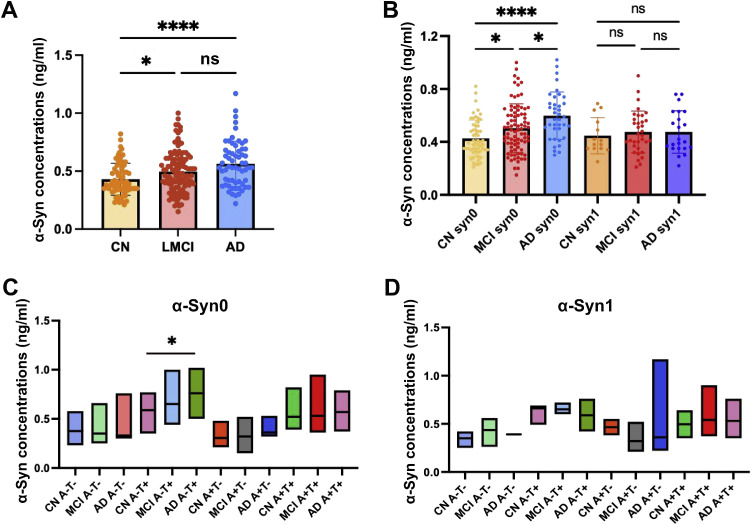
Results: Compared with controls, overall MCI and AD patients had elevated α-Syn levels. Notably, in the α-Syn0 group, α-Syn levels were increased in the MCI patients and further increased in AD patients, whereas in the α-Syn1 group, α-Syn levels did not significantly differ across diagnostic groups. Both in the α-Syn0 and α-Syn1 groups, α-Syn levels were found to correlate more strongly with CSF tau levels than with Aβ42, indicating a possible role for α-Syn in tau-related pathology in AD. Importantly, α-Syn0-AD patients exhibited more rapid cognitive decline and greater hippocampal atrophy than α-Syn1-AD patients. However, MCI patients with CSF α-Syn1 aggregation status had an increased risk of conversion to AD.
Conclusions: CSF α-Syn is associated with tau pathology and neurodegeneration in Alzheimer's disease. The distinct aggregation profiles of α-Syn serve as valuable biomarkers, offering insights into differing prognoses in AD and aiding in the prediction of early disease progression.
期刊介绍:
The JPAD Journal of Prevention of Alzheimer’Disease will publish reviews, original research articles and short reports to improve our knowledge in the field of Alzheimer prevention including: neurosciences, biomarkers, imaging, epidemiology, public health, physical cognitive exercise, nutrition, risk and protective factors, drug development, trials design, and heath economic outcomes.JPAD will publish also the meeting abstracts from Clinical Trial on Alzheimer Disease (CTAD) and will be distributed both in paper and online version worldwide.We hope that JPAD with your contribution will play a role in the development of Alzheimer prevention.





 京公网安备 11010802042870号
京ICP备2023020795号-1
京公网安备 11010802042870号
京ICP备2023020795号-1

 分享
分享
 求助内容:
求助内容: 应助结果提醒方式:
 扫码关注我们
