Long Xie, Sandhitsu R. Das, Yue Li, Laura E. M. Wisse, Emily McGrew, Xueying Lyu, Michael DiCalogero, Ujashi Shah, Ademola Ilesanmi, Amanda E. Denning, Chris A. Brown, Jesse Cohen, Lasya Sreepada, Mengjin Dong, Niyousha Sadeghpour, Pulkit Khandelwal, Ranjit Ittyerah, Sadhana Ravikumar, Shokufeh Sadaghiani, Stanislau Hrybouski, Robin de Flores, Eli Gibson, Paul A. Yushkevich, David A. Wolk, for the Alzheimer's Disease Neuroimaging Initiative
{"title":"A multi-cohort study of longitudinal and cross-sectional Alzheimer's disease biomarkers in cognitively unimpaired older adults","authors":"Long Xie, Sandhitsu R. Das, Yue Li, Laura E. M. Wisse, Emily McGrew, Xueying Lyu, Michael DiCalogero, Ujashi Shah, Ademola Ilesanmi, Amanda E. Denning, Chris A. Brown, Jesse Cohen, Lasya Sreepada, Mengjin Dong, Niyousha Sadeghpour, Pulkit Khandelwal, Ranjit Ittyerah, Sadhana Ravikumar, Shokufeh Sadaghiani, Stanislau Hrybouski, Robin de Flores, Eli Gibson, Paul A. Yushkevich, David A. Wolk, for the Alzheimer's Disease Neuroimaging Initiative","doi":"10.1002/alz.14492","DOIUrl":null,"url":null,"abstract":"<div>\n \n \n <section>\n \n <h3> INTRODUCTION</h3>\n \n <p>The generalizability of neuroimaging and cognitive biomarkers in their sensitivity to detect preclinical Alzheimer's disease (AD) and power to predict progression in large, multisite cohorts remains unclear.</p>\n </section>\n \n <section>\n \n <h3> METHOD</h3>\n \n <p>Longitudinal demographics, T1-weighted magnetic resonance imaging (MRI), and cognitive scores of 3036 cognitively unimpaired (CU) older adults (amyloid beta [Aβ]-negative/positive [A–/A+]: 1270/1558) were included. Cross-sectional and longitudinal cognition and medial temporal lobe (MTL) structural measures were extracted. Cross-sectional MTL tau burden (T) was computed from tau positron emission tomography (<i>N</i> = 1095).</p>\n </section>\n \n <section>\n \n <h3> RESULTS</h3>\n \n <p>We found cross-sectional tau and longitudinal structural biomarkers best separated A+ CU from A– CU. A–T+ CU had significantly faster neurodegeneration rate compared to A–T– CU. MTL tau was significantly correlated with MRI and cognitive biomarkers regardless of Aβ status. MTL tau, MRI, and cognition provided complementary information about disease progression.</p>\n </section>\n \n <section>\n \n <h3> DISCUSSION</h3>\n \n <p>This large multisite study replicates prior findings in CU older adults, supporting the utility of neuroimaging and cognitive biomarkers in preclinical AD clinical trials and normal aging studies.</p>\n </section>\n \n <section>\n \n <h3> Highlights</h3>\n \n <div>\n <ul>\n \n <li>We investigated neuroimaging and cognitive biomarkers in 3036 cognitively unimpaired (CU) participants.</li>\n \n <li>Medial temporal lobe (MTL) tau and longitudinal MTL atrophy best separate amyloid beta positive (A+) CU from amyloid beta negative (A–) CU.</li>\n \n <li>A– tau positive (T+) CU had a significantly faster neurodegeneration rate compared to A–T– CU.</li>\n \n <li>MTL tau correlated with structural magnetic resonance imaging (MRI) and cognition regardless of amyloid beta status.</li>\n \n <li>Combined baseline MTL tau, MRI, and cognition best predict Alzheimer's disease progression.</li>\n </ul>\n </div>\n </section>\n </div>","PeriodicalId":7471,"journal":{"name":"Alzheimer's & Dementia","volume":"21 2","pages":""},"PeriodicalIF":11.1000,"publicationDate":"2025-01-27","publicationTypes":"Journal Article","fieldsOfStudy":null,"isOpenAccess":false,"openAccessPdf":"https://onlinelibrary.wiley.com/doi/epdf/10.1002/alz.14492","citationCount":"0","resultStr":null,"platform":"Semanticscholar","paperid":null,"PeriodicalName":"Alzheimer's & Dementia","FirstCategoryId":"3","ListUrlMain":"https://alz-journals.onlinelibrary.wiley.com/doi/10.1002/alz.14492","RegionNum":1,"RegionCategory":"医学","ArticlePicture":[],"TitleCN":null,"AbstractTextCN":null,"PMCID":null,"EPubDate":"","PubModel":"","JCR":"Q1","JCRName":"CLINICAL NEUROLOGY","Score":null,"Total":0}
引用次数: 0
Abstract
INTRODUCTION
The generalizability of neuroimaging and cognitive biomarkers in their sensitivity to detect preclinical Alzheimer's disease (AD) and power to predict progression in large, multisite cohorts remains unclear.
METHOD
Longitudinal demographics, T1-weighted magnetic resonance imaging (MRI), and cognitive scores of 3036 cognitively unimpaired (CU) older adults (amyloid beta [Aβ]-negative/positive [A–/A+]: 1270/1558) were included. Cross-sectional and longitudinal cognition and medial temporal lobe (MTL) structural measures were extracted. Cross-sectional MTL tau burden (T) was computed from tau positron emission tomography (N = 1095).
RESULTS
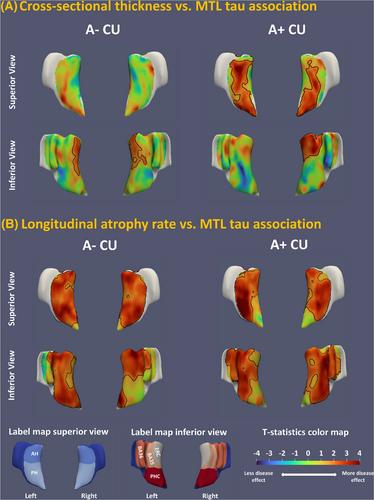
We found cross-sectional tau and longitudinal structural biomarkers best separated A+ CU from A– CU. A–T+ CU had significantly faster neurodegeneration rate compared to A–T– CU. MTL tau was significantly correlated with MRI and cognitive biomarkers regardless of Aβ status. MTL tau, MRI, and cognition provided complementary information about disease progression.
DISCUSSION
This large multisite study replicates prior findings in CU older adults, supporting the utility of neuroimaging and cognitive biomarkers in preclinical AD clinical trials and normal aging studies.
Highlights
We investigated neuroimaging and cognitive biomarkers in 3036 cognitively unimpaired (CU) participants.
Medial temporal lobe (MTL) tau and longitudinal MTL atrophy best separate amyloid beta positive (A+) CU from amyloid beta negative (A–) CU.
A– tau positive (T+) CU had a significantly faster neurodegeneration rate compared to A–T– CU.
MTL tau correlated with structural magnetic resonance imaging (MRI) and cognition regardless of amyloid beta status.
Combined baseline MTL tau, MRI, and cognition best predict Alzheimer's disease progression.
期刊介绍:
Alzheimer's & Dementia is a peer-reviewed journal that aims to bridge knowledge gaps in dementia research by covering the entire spectrum, from basic science to clinical trials to social and behavioral investigations. It provides a platform for rapid communication of new findings and ideas, optimal translation of research into practical applications, increasing knowledge across diverse disciplines for early detection, diagnosis, and intervention, and identifying promising new research directions. In July 2008, Alzheimer's & Dementia was accepted for indexing by MEDLINE, recognizing its scientific merit and contribution to Alzheimer's research.





 京公网安备 11010802042870号
京ICP备2023020795号-1
京公网安备 11010802042870号
京ICP备2023020795号-1

 分享
分享
 求助内容:
求助内容: 应助结果提醒方式:
 扫码关注我们
