Jr-Jiun Liou, Jerry Lou, Lisi Flores-Aguilar, Jamie Nakagiri, William Yong, Christy L. Hom, Eric W. Doran, Minodora O. Totoiu, Ira Lott, Mark Mapstone, David B. Keator, Adam M. Brickman, Sierra T. Wright, Brittany Nelson, Florence Lai, Laura Xicota, Lam-Ha T. Dang, Jinghang Li, Tales Santini, Joseph M. Mettenburg, Milos D. Ikonomovic, Julia Kofler, Tamer Ibrahim, Elizabeth Head, for the Alzheimer Biomarker Consortium - Down Syndrome
{"title":"A neuropathology case report of a woman with Down syndrome who remained cognitively stable: Implications for resilience to neuropathology","authors":"Jr-Jiun Liou, Jerry Lou, Lisi Flores-Aguilar, Jamie Nakagiri, William Yong, Christy L. Hom, Eric W. Doran, Minodora O. Totoiu, Ira Lott, Mark Mapstone, David B. Keator, Adam M. Brickman, Sierra T. Wright, Brittany Nelson, Florence Lai, Laura Xicota, Lam-Ha T. Dang, Jinghang Li, Tales Santini, Joseph M. Mettenburg, Milos D. Ikonomovic, Julia Kofler, Tamer Ibrahim, Elizabeth Head, for the Alzheimer Biomarker Consortium - Down Syndrome","doi":"10.1002/alz.14479","DOIUrl":null,"url":null,"abstract":"<div>\n \n \n <section>\n \n <h3> INTRODUCTION</h3>\n \n <p>Aging adults with Down syndrome (DS) accumulate Alzheimer's disease (AD) neuropathology, including amyloid beta plaques and neurofibrillary tangles, by age 40.</p>\n </section>\n \n <section>\n \n <h3> METHODS</h3>\n \n <p>We present findings from an individual with DS who remained cognitively stable despite AD neuropathology. Clinical assessments, fluid biomarkers, neuroimaging, and neuropathological examinations were conducted to characterize her condition.</p>\n </section>\n \n <section>\n \n <h3> RESULTS</h3>\n \n <p>Her apolipoprotein E was ε2/ε3 and genome-wide association study data indicated mosaicism. Neuroimaging revealed stable yet elevated amyloid and moderately elevated tau levels, while neuropathology indicated intermediate AD neuropathologic change with Lewy body and cerebrovascular pathologies. The participant demonstrated stable cognitive functioning in her 60s, potentially attributed to genetic variations, cognitive resilience, and environmental enrichment.</p>\n </section>\n \n <section>\n \n <h3> DISCUSSION</h3>\n \n <p>These findings emphasize the complexity of AD progression in DS. Further investigation into factors influencing cognitive resilience in individuals with DS is warranted. Understanding the mechanisms underlying cognitive stability in DS could offer insights into resilience to AD neuropathology in people with DS and inform future interventions.</p>\n </section>\n \n <section>\n \n <h3> Highlights</h3>\n \n <div>\n <ul>\n \n <li>Findings from clinical assessments, fluid biomarkers, genotyping, neuroimaging, and neuropathological examinations of an individual with Down syndrome (DS) who remained cognitively stable despite Alzheimer's disease (AD) neuropathology are presented.</li>\n \n <li>Neuroimaging revealed stable yet elevated amyloid profiles and moderately elevated tau levels, while neuropathology indicated intermediate AD neuropathologic change with Lewy body and cerebrovascular pathologies.</li>\n \n <li>Despite the presence of AD pathology, the participant demonstrated intact cognitive functioning, potentially attributed to genetic variations, cognitive resilience, and environmental enrichment, emphasizing the complexity of AD progression in DS.</li>\n </ul>\n </div>\n </section>\n </div>","PeriodicalId":7471,"journal":{"name":"Alzheimer's & Dementia","volume":"21 2","pages":""},"PeriodicalIF":11.1000,"publicationDate":"2025-01-27","publicationTypes":"Journal Article","fieldsOfStudy":null,"isOpenAccess":false,"openAccessPdf":"https://onlinelibrary.wiley.com/doi/epdf/10.1002/alz.14479","citationCount":"0","resultStr":null,"platform":"Semanticscholar","paperid":null,"PeriodicalName":"Alzheimer's & Dementia","FirstCategoryId":"3","ListUrlMain":"https://alz-journals.onlinelibrary.wiley.com/doi/10.1002/alz.14479","RegionNum":1,"RegionCategory":"医学","ArticlePicture":[],"TitleCN":null,"AbstractTextCN":null,"PMCID":null,"EPubDate":"","PubModel":"","JCR":"Q1","JCRName":"CLINICAL NEUROLOGY","Score":null,"Total":0}
引用次数: 0
Abstract
INTRODUCTION
Aging adults with Down syndrome (DS) accumulate Alzheimer's disease (AD) neuropathology, including amyloid beta plaques and neurofibrillary tangles, by age 40.
METHODS
We present findings from an individual with DS who remained cognitively stable despite AD neuropathology. Clinical assessments, fluid biomarkers, neuroimaging, and neuropathological examinations were conducted to characterize her condition.
RESULTS
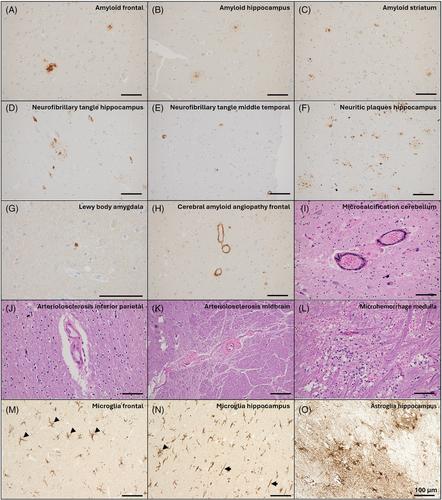
Her apolipoprotein E was ε2/ε3 and genome-wide association study data indicated mosaicism. Neuroimaging revealed stable yet elevated amyloid and moderately elevated tau levels, while neuropathology indicated intermediate AD neuropathologic change with Lewy body and cerebrovascular pathologies. The participant demonstrated stable cognitive functioning in her 60s, potentially attributed to genetic variations, cognitive resilience, and environmental enrichment.
DISCUSSION
These findings emphasize the complexity of AD progression in DS. Further investigation into factors influencing cognitive resilience in individuals with DS is warranted. Understanding the mechanisms underlying cognitive stability in DS could offer insights into resilience to AD neuropathology in people with DS and inform future interventions.
Highlights
Findings from clinical assessments, fluid biomarkers, genotyping, neuroimaging, and neuropathological examinations of an individual with Down syndrome (DS) who remained cognitively stable despite Alzheimer's disease (AD) neuropathology are presented.
Neuroimaging revealed stable yet elevated amyloid profiles and moderately elevated tau levels, while neuropathology indicated intermediate AD neuropathologic change with Lewy body and cerebrovascular pathologies.
Despite the presence of AD pathology, the participant demonstrated intact cognitive functioning, potentially attributed to genetic variations, cognitive resilience, and environmental enrichment, emphasizing the complexity of AD progression in DS.
期刊介绍:
Alzheimer's & Dementia is a peer-reviewed journal that aims to bridge knowledge gaps in dementia research by covering the entire spectrum, from basic science to clinical trials to social and behavioral investigations. It provides a platform for rapid communication of new findings and ideas, optimal translation of research into practical applications, increasing knowledge across diverse disciplines for early detection, diagnosis, and intervention, and identifying promising new research directions. In July 2008, Alzheimer's & Dementia was accepted for indexing by MEDLINE, recognizing its scientific merit and contribution to Alzheimer's research.





 京公网安备 11010802042870号
京ICP备2023020795号-1
京公网安备 11010802042870号
京ICP备2023020795号-1

 分享
分享
 求助内容:
求助内容: 应助结果提醒方式:
 扫码关注我们
