Wenchen Pu, Xianyan Shen, Xin Fan, Yuanyuan Zheng, Xuesha Liu, Jiao Li, Jian-Kang Zhou, Juan He, Rong Wei, Yanqiu Gong, Qingquan Zheng, Yao Luo, Yingli Guo, Min Ai, Yue Ming, Zixia Ye, Yun Zhao, Chun Wang, Yong Peng
{"title":"Structure-Guided Optimization and Preclinical Evaluation of 6-O-Benzylguanine-Based Pin1 Inhibitor for Hepatocellular Carcinoma Treatment","authors":"Wenchen Pu, Xianyan Shen, Xin Fan, Yuanyuan Zheng, Xuesha Liu, Jiao Li, Jian-Kang Zhou, Juan He, Rong Wei, Yanqiu Gong, Qingquan Zheng, Yao Luo, Yingli Guo, Min Ai, Yue Ming, Zixia Ye, Yun Zhao, Chun Wang, Yong Peng","doi":"10.1021/acs.jmedchem.4c02144","DOIUrl":null,"url":null,"abstract":"Hepatocellular carcinoma (HCC) is a major cause of cancer-related deaths globally, and the need for effective systemic therapies for HCC is urgent. Our previous work reveals that Pin1 is a potential anti-HCC target, which regulates miRNA biogenesis and identifies <b>API-1</b> as a novel Pin1 inhibitor to suppresses HCC. However, a great demand in HCC therapy as well as the limited chemical stability and pharmacokinetic feature of <b>API-1</b> motivated us to find improved Pin1 inhibitors. Herein, we designed and synthesized diverse 6-<i>O</i>-benzylguanine derivatives and discovered <b>API-32</b> as a novel Pin1 inhibitor with better stability and pharmacokinetic property over <b>API-1</b>. <b>API-32</b> directly interacted with the Pin1 PPIase domain to inhibit Pin1 activity. <b>API-32</b> significantly suppressed the cell proliferation and migration of HCC cells by blocking Pin1’s downstream signal. Moreover, <b>API-32</b> exhibited an enhanced inhibitory function against the HCC tumor in mice models without obvious toxicity, making it a promising drug candidate for HCC treatment.","PeriodicalId":46,"journal":{"name":"Journal of Medicinal Chemistry","volume":"119 1","pages":""},"PeriodicalIF":7.3000,"publicationDate":"2025-01-27","publicationTypes":"Journal Article","fieldsOfStudy":null,"isOpenAccess":false,"openAccessPdf":"","citationCount":"0","resultStr":null,"platform":"Semanticscholar","paperid":null,"PeriodicalName":"Journal of Medicinal Chemistry","FirstCategoryId":"3","ListUrlMain":"https://doi.org/10.1021/acs.jmedchem.4c02144","RegionNum":1,"RegionCategory":"医学","ArticlePicture":[],"TitleCN":null,"AbstractTextCN":null,"PMCID":null,"EPubDate":"","PubModel":"","JCR":"Q1","JCRName":"CHEMISTRY, MEDICINAL","Score":null,"Total":0}
引用次数: 0
Abstract
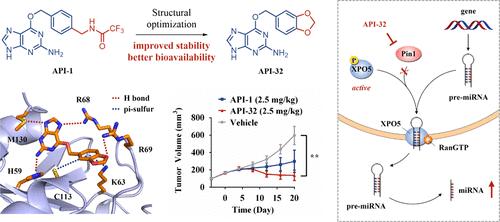
Hepatocellular carcinoma (HCC) is a major cause of cancer-related deaths globally, and the need for effective systemic therapies for HCC is urgent. Our previous work reveals that Pin1 is a potential anti-HCC target, which regulates miRNA biogenesis and identifies API-1 as a novel Pin1 inhibitor to suppresses HCC. However, a great demand in HCC therapy as well as the limited chemical stability and pharmacokinetic feature of API-1 motivated us to find improved Pin1 inhibitors. Herein, we designed and synthesized diverse 6-O-benzylguanine derivatives and discovered API-32 as a novel Pin1 inhibitor with better stability and pharmacokinetic property over API-1. API-32 directly interacted with the Pin1 PPIase domain to inhibit Pin1 activity. API-32 significantly suppressed the cell proliferation and migration of HCC cells by blocking Pin1’s downstream signal. Moreover, API-32 exhibited an enhanced inhibitory function against the HCC tumor in mice models without obvious toxicity, making it a promising drug candidate for HCC treatment.
肝细胞癌(HCC)是全球癌症相关死亡的主要原因,迫切需要对HCC进行有效的全身治疗。我们之前的工作表明,Pin1是一个潜在的抗HCC靶点,它调节miRNA的生物发生,并鉴定API-1是一种新的Pin1抑制剂来抑制HCC。然而,HCC治疗的巨大需求以及API-1有限的化学稳定性和药代动力学特征促使我们寻找改进的Pin1抑制剂。本文设计并合成了多种6- o -苄基鸟嘌呤衍生物,并发现API-32是一种新型的Pin1抑制剂,其稳定性和药动学性能优于API-1。API-32直接与Pin1 PPIase结构域相互作用,抑制Pin1活性。API-32通过阻断Pin1的下游信号,显著抑制HCC细胞的增殖和迁移。此外,API-32在小鼠模型中对肝癌肿瘤表现出增强的抑制功能,且无明显毒性,是一种有前景的肝癌治疗候选药物。
期刊介绍:
The Journal of Medicinal Chemistry is a prestigious biweekly peer-reviewed publication that focuses on the multifaceted field of medicinal chemistry. Since its inception in 1959 as the Journal of Medicinal and Pharmaceutical Chemistry, it has evolved to become a cornerstone in the dissemination of research findings related to the design, synthesis, and development of therapeutic agents.
The Journal of Medicinal Chemistry is recognized for its significant impact in the scientific community, as evidenced by its 2022 impact factor of 7.3. This metric reflects the journal's influence and the importance of its content in shaping the future of drug discovery and development. The journal serves as a vital resource for chemists, pharmacologists, and other researchers interested in the molecular mechanisms of drug action and the optimization of therapeutic compounds.




 京公网安备 11010802042870号
京ICP备2023020795号-1
京公网安备 11010802042870号
京ICP备2023020795号-1

 分享
分享
 求助内容:
求助内容: 应助结果提醒方式:
 扫码关注我们
