Julien Rosselgong , Ali Dhaini , Manon Rochedy , Lourdes Mónica Bravo-Anaya , Jean-François Carpentier , Sophie M. Guillaume
{"title":"Poly(β-hydroxyalkanoate)/polymethacrylate self-assembled architectures by ring-opening polymerization (ROP)/reversible addition–fragmentation chain-transfer (RAFT) polymerization and polymerization-induced self-assembly (PISA)†","authors":"Julien Rosselgong , Ali Dhaini , Manon Rochedy , Lourdes Mónica Bravo-Anaya , Jean-François Carpentier , Sophie M. Guillaume","doi":"10.1039/d4py01447b","DOIUrl":null,"url":null,"abstract":"<div><div>Self-assembled poly(β-hydroxyalkanoate) (PHA)-based block copolymers are attractive materials for biomedical applications due to the biocompatibility and (bio)degradability of the PHA segment. Herein, we report the synthesis and formation of self-assemblies based on PHAs: namely, poly(3-hydroxybutyrate) (PHB) was prepared by ring-opening polymerization (ROP) of racemic β-butyrolactone (<em>rac</em>-β-BL) using a discrete yttrium-based catalyst in the presence of a hydroxy-terminated trithiocarbonate (TTC-OH) as initiator. The resulting TTC end-capped PHB prepolymer next promoted the controlled reversible addition–fragmentation chain-transfer (RAFT) polymerization of 2-hydroxy ethyl methacrylate (HEMA). When performed in THF, in which the initial solvophilic PHB-TTC segment and HEMA monomer are both fully soluble, this second step resulted in a polymerization-induced self-assembly (PISA) leading to the formation of nanoparticles, as the solvophobic PHEMA precipitated in the dispersed medium. The effective extension of the PHB block by a PHEMA segment, as evidenced by SEC and NMR analyses, highlighted the efficiency of the PHB-TTC macro-RAFT agent. This ROP/RAFT/PISA strategy revealed successful at various polyester (DP = 45–90) and polymethacrylate (DP = 200–500) block lengths. The size, polydispersity index (PDI) and morphology of the resulting self-assembled PHB<sub><em>x</em></sub>-<em>b</em>-PHEMA<sub><em>y</em></sub> particles were assessed by dynamic light scattering (DLS) measurements, transmission electron microscopy (TEM) and small-angle X-ray scattering (SAXS). Depending on both segments chain-lengths, DLS enabled identifying particles in suspension having hydrodynamic diameters (<em>D</em><sub>H</sub>) varying from 56 to 194 nm, with narrow polydispersity index, <em>i.e.</em> PDI < 0.140. SAXS measurements and TEM observations revealed vesicles morphology for specific PHB<sub><em>x</em></sub>-<em>b</em>-PHEMA<sub><em>y</em></sub> samples presenting apparent diameters ranging from 134 to 316 nm. These morphologies support the successful copolymerization through a PISA process, first reported herein for the elaboration of PHA-based objects that may be valuable nano-vehicles of active ingredients for biomedical applications.</div></div>","PeriodicalId":100,"journal":{"name":"Polymer Chemistry","volume":"16 10","pages":"Pages 1162-1175"},"PeriodicalIF":3.9000,"publicationDate":"2025-02-21","publicationTypes":"Journal Article","fieldsOfStudy":null,"isOpenAccess":false,"openAccessPdf":"https://pubs.rsc.org/en/content/articlepdf/2025/py/d4py01447b?page=search","citationCount":"0","resultStr":null,"platform":"Semanticscholar","paperid":null,"PeriodicalName":"Polymer Chemistry","FirstCategoryId":"92","ListUrlMain":"https://www.sciencedirect.com/org/science/article/pii/S1759995425000476","RegionNum":2,"RegionCategory":"化学","ArticlePicture":[],"TitleCN":null,"AbstractTextCN":null,"PMCID":null,"EPubDate":"2025/1/27 0:00:00","PubModel":"Epub","JCR":"Q2","JCRName":"POLYMER SCIENCE","Score":null,"Total":0}
引用次数: 0
Abstract
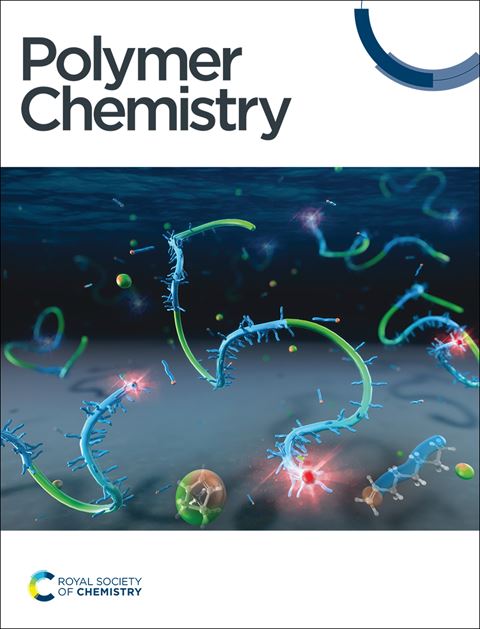
Self-assembled poly(β-hydroxyalkanoate) (PHA)-based block copolymers are attractive materials for biomedical applications due to the biocompatibility and (bio)degradability of the PHA segment. Herein, we report the synthesis and formation of self-assemblies based on PHAs: namely, poly(3-hydroxybutyrate) (PHB) was prepared by ring-opening polymerization (ROP) of racemic β-butyrolactone (rac-β-BL) using a discrete yttrium-based catalyst in the presence of a hydroxy-terminated trithiocarbonate (TTC-OH) as initiator. The resulting TTC end-capped PHB prepolymer next promoted the controlled reversible addition–fragmentation chain-transfer (RAFT) polymerization of 2-hydroxy ethyl methacrylate (HEMA). When performed in THF, in which the initial solvophilic PHB-TTC segment and HEMA monomer are both fully soluble, this second step resulted in a polymerization-induced self-assembly (PISA) leading to the formation of nanoparticles, as the solvophobic PHEMA precipitated in the dispersed medium. The effective extension of the PHB block by a PHEMA segment, as evidenced by SEC and NMR analyses, highlighted the efficiency of the PHB-TTC macro-RAFT agent. This ROP/RAFT/PISA strategy revealed successful at various polyester (DP = 45–90) and polymethacrylate (DP = 200–500) block lengths. The size, polydispersity index (PDI) and morphology of the resulting self-assembled PHBx-b-PHEMAy particles were assessed by dynamic light scattering (DLS) measurements, transmission electron microscopy (TEM) and small-angle X-ray scattering (SAXS). Depending on both segments chain-lengths, DLS enabled identifying particles in suspension having hydrodynamic diameters (DH) varying from 56 to 194 nm, with narrow polydispersity index, i.e. PDI < 0.140. SAXS measurements and TEM observations revealed vesicles morphology for specific PHBx-b-PHEMAy samples presenting apparent diameters ranging from 134 to 316 nm. These morphologies support the successful copolymerization through a PISA process, first reported herein for the elaboration of PHA-based objects that may be valuable nano-vehicles of active ingredients for biomedical applications.
期刊介绍:
Polymer Chemistry welcomes submissions in all areas of polymer science that have a strong focus on macromolecular chemistry. Manuscripts may cover a broad range of fields, yet no direct application focus is required.




 京公网安备 11010802042870号
京ICP备2023020795号-1
京公网安备 11010802042870号
京ICP备2023020795号-1

 分享
分享
 求助内容:
求助内容: 应助结果提醒方式:
 扫码关注我们
