{"title":"Multifunctional DNA-Collagen Biomaterials: Developmental Advances and Biomedical Applications.","authors":"Nikolaos Pipis, Bryan D James, Josephine B Allen","doi":"10.1021/acsbiomaterials.4c01475","DOIUrl":null,"url":null,"abstract":"<p><p>The complexation of nucleic acids and collagen forms a platform biomaterial greater than the sum of its parts. This union of biomacromolecules merges the extracellular matrix functionality of collagen with the designable bioactivity of nucleic acids, enabling advances in regenerative medicine, tissue engineering, gene delivery, and targeted therapy. This review traces the historical foundations and critical applications of DNA-collagen complexes and highlights their capabilities, demonstrating them as biocompatible, bioactive, and tunable platform materials. These complexes form structures across length scales, including nanoparticles, microfibers, and hydrogels, a process controlled by the relative amount of each component and the type of nucleic acid and collagen. The broad distribution of different types of collagen within the body contributes to the extensive biological relevance of DNA-collagen complexes. Functional nucleic acids can form these complexes, such as siRNA, antisense oligonucleotides, DNA origami nanostructures, and, in particular, single-stranded DNA aptamers, often distinguished by their rapid self-assembly at room temperature and formation without external stimuli and modifications. The simple and seamless integration of nucleic acids within collagenous matrices enhances biomimicry and targeted bioactivity, and provides stability against enzymatic degradation, positioning DNA-collagen complexes as an advanced biomaterial system for many applications including angiogenesis, bone tissue regeneration, wound healing, and more.</p>","PeriodicalId":8,"journal":{"name":"ACS Biomaterials Science & Engineering","volume":" ","pages":"1253-1268"},"PeriodicalIF":5.5000,"publicationDate":"2025-03-10","publicationTypes":"Journal Article","fieldsOfStudy":null,"isOpenAccess":false,"openAccessPdf":"https://www.ncbi.nlm.nih.gov/pmc/articles/PMC11897955/pdf/","citationCount":"0","resultStr":null,"platform":"Semanticscholar","paperid":null,"PeriodicalName":"ACS Biomaterials Science & Engineering","FirstCategoryId":"5","ListUrlMain":"https://doi.org/10.1021/acsbiomaterials.4c01475","RegionNum":2,"RegionCategory":"医学","ArticlePicture":[],"TitleCN":null,"AbstractTextCN":null,"PMCID":null,"EPubDate":"2025/1/27 0:00:00","PubModel":"Epub","JCR":"Q2","JCRName":"MATERIALS SCIENCE, BIOMATERIALS","Score":null,"Total":0}
引用次数: 0
Abstract
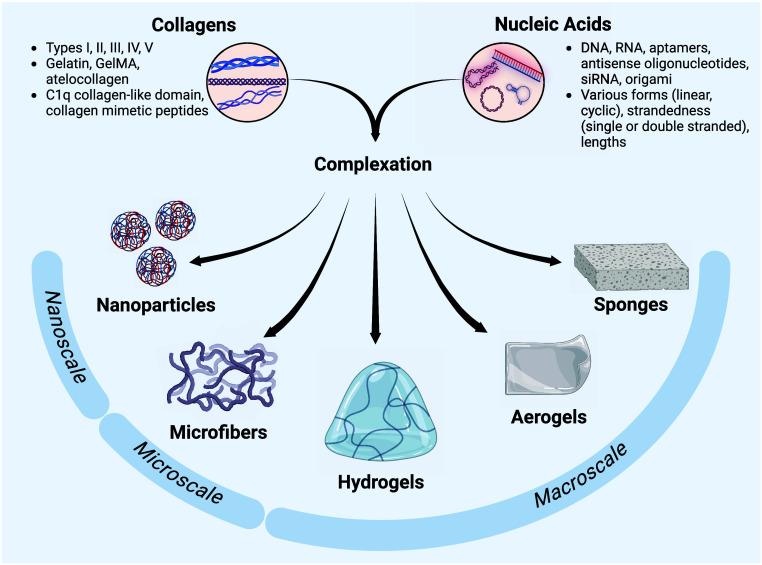
The complexation of nucleic acids and collagen forms a platform biomaterial greater than the sum of its parts. This union of biomacromolecules merges the extracellular matrix functionality of collagen with the designable bioactivity of nucleic acids, enabling advances in regenerative medicine, tissue engineering, gene delivery, and targeted therapy. This review traces the historical foundations and critical applications of DNA-collagen complexes and highlights their capabilities, demonstrating them as biocompatible, bioactive, and tunable platform materials. These complexes form structures across length scales, including nanoparticles, microfibers, and hydrogels, a process controlled by the relative amount of each component and the type of nucleic acid and collagen. The broad distribution of different types of collagen within the body contributes to the extensive biological relevance of DNA-collagen complexes. Functional nucleic acids can form these complexes, such as siRNA, antisense oligonucleotides, DNA origami nanostructures, and, in particular, single-stranded DNA aptamers, often distinguished by their rapid self-assembly at room temperature and formation without external stimuli and modifications. The simple and seamless integration of nucleic acids within collagenous matrices enhances biomimicry and targeted bioactivity, and provides stability against enzymatic degradation, positioning DNA-collagen complexes as an advanced biomaterial system for many applications including angiogenesis, bone tissue regeneration, wound healing, and more.
期刊介绍:
ACS Biomaterials Science & Engineering is the leading journal in the field of biomaterials, serving as an international forum for publishing cutting-edge research and innovative ideas on a broad range of topics:
Applications and Health – implantable tissues and devices, prosthesis, health risks, toxicology
Bio-interactions and Bio-compatibility – material-biology interactions, chemical/morphological/structural communication, mechanobiology, signaling and biological responses, immuno-engineering, calcification, coatings, corrosion and degradation of biomaterials and devices, biophysical regulation of cell functions
Characterization, Synthesis, and Modification – new biomaterials, bioinspired and biomimetic approaches to biomaterials, exploiting structural hierarchy and architectural control, combinatorial strategies for biomaterials discovery, genetic biomaterials design, synthetic biology, new composite systems, bionics, polymer synthesis
Controlled Release and Delivery Systems – biomaterial-based drug and gene delivery, bio-responsive delivery of regulatory molecules, pharmaceutical engineering
Healthcare Advances – clinical translation, regulatory issues, patient safety, emerging trends
Imaging and Diagnostics – imaging agents and probes, theranostics, biosensors, monitoring
Manufacturing and Technology – 3D printing, inks, organ-on-a-chip, bioreactor/perfusion systems, microdevices, BioMEMS, optics and electronics interfaces with biomaterials, systems integration
Modeling and Informatics Tools – scaling methods to guide biomaterial design, predictive algorithms for structure-function, biomechanics, integrating bioinformatics with biomaterials discovery, metabolomics in the context of biomaterials
Tissue Engineering and Regenerative Medicine – basic and applied studies, cell therapies, scaffolds, vascularization, bioartificial organs, transplantation and functionality, cellular agriculture




 京公网安备 11010802042870号
京ICP备2023020795号-1
京公网安备 11010802042870号
京ICP备2023020795号-1

 分享
分享
 求助内容:
求助内容: 应助结果提醒方式:
 扫码关注我们
