{"title":"Assessment of stigma among patients living with Parkinson’s disease: an exploratory study","authors":"Yue Huang, Qing Fu, De-feng Liu","doi":"10.1007/s13760-025-02728-9","DOIUrl":null,"url":null,"abstract":"<div><h3>Objective</h3><p>This cross-sectional study aims to assess the levels of stigma among patients with Parkinson’s disease (PD) and identify the demographic and clinical factors influencing both internal and external stigma.</p><h3>Materials and methods</h3><p>A total of 200 patients diagnosed with PD were recruited from Beijing Tiantan Hospital between June 2023 and June 2024 using convenience sampling. Data were collected through face-to-face interviews, including demographic information, disease severity assessed via the Movement Disorder Society-Unified Parkinson’s Disease Rating Scale (MDS-UPDRS), and stigma levels measured using the 24-item Stigma Scale for Chronic Illness (SSCI). Statistical analyses included t-tests, ANOVA, correlation analysis, and multivariate linear regression.</p><h3>Results</h3><p>The average SSCI score among PD patients was 58.74 ± 13.73, with significant variation based on age, gender, educational level, marital status, disease duration, and motor subtype. Patients aged under 60, male, with lower educational attainment, divorced or widowed, and with longer disease duration had higher SSCI scores. MDS-UPDRS Part I-III scores were positively correlated with both internal and external stigma (<i>r</i> = 0.4, 0.5, and 0.5, respectively, <i>p</i> < 0.001). Multivariate linear regression analysis identified MDS-UPDRS scores, age, self-care ability, marital status, disease duration, and motor subtype as independent predictors of stigma.</p><h3>Conclusion</h3><p>Stigma in PD is influenced by a combination of demographic and disease-related factors, particularly disease severity. Targeted interventions focusing on reducing motor and non-motor symptoms, as well as addressing social determinants, may help alleviate the stigma experienced by PD patients. These findings underscore the need for comprehensive management strategies that incorporate both clinical treatment and psychosocial support.</p></div>","PeriodicalId":7042,"journal":{"name":"Acta neurologica Belgica","volume":"125 2","pages":"489 - 499"},"PeriodicalIF":2.1000,"publicationDate":"2025-01-27","publicationTypes":"Journal Article","fieldsOfStudy":null,"isOpenAccess":false,"openAccessPdf":"","citationCount":"0","resultStr":null,"platform":"Semanticscholar","paperid":null,"PeriodicalName":"Acta neurologica Belgica","FirstCategoryId":"3","ListUrlMain":"https://link.springer.com/article/10.1007/s13760-025-02728-9","RegionNum":4,"RegionCategory":"医学","ArticlePicture":[],"TitleCN":null,"AbstractTextCN":null,"PMCID":null,"EPubDate":"","PubModel":"","JCR":"Q3","JCRName":"CLINICAL NEUROLOGY","Score":null,"Total":0}
引用次数: 0
Abstract
Objective
This cross-sectional study aims to assess the levels of stigma among patients with Parkinson’s disease (PD) and identify the demographic and clinical factors influencing both internal and external stigma.
Materials and methods
A total of 200 patients diagnosed with PD were recruited from Beijing Tiantan Hospital between June 2023 and June 2024 using convenience sampling. Data were collected through face-to-face interviews, including demographic information, disease severity assessed via the Movement Disorder Society-Unified Parkinson’s Disease Rating Scale (MDS-UPDRS), and stigma levels measured using the 24-item Stigma Scale for Chronic Illness (SSCI). Statistical analyses included t-tests, ANOVA, correlation analysis, and multivariate linear regression.
Results
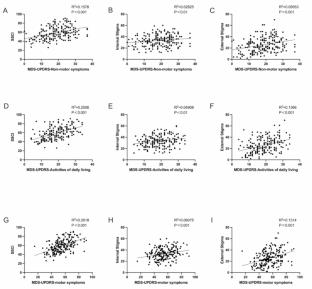
The average SSCI score among PD patients was 58.74 ± 13.73, with significant variation based on age, gender, educational level, marital status, disease duration, and motor subtype. Patients aged under 60, male, with lower educational attainment, divorced or widowed, and with longer disease duration had higher SSCI scores. MDS-UPDRS Part I-III scores were positively correlated with both internal and external stigma (r = 0.4, 0.5, and 0.5, respectively, p < 0.001). Multivariate linear regression analysis identified MDS-UPDRS scores, age, self-care ability, marital status, disease duration, and motor subtype as independent predictors of stigma.
Conclusion
Stigma in PD is influenced by a combination of demographic and disease-related factors, particularly disease severity. Targeted interventions focusing on reducing motor and non-motor symptoms, as well as addressing social determinants, may help alleviate the stigma experienced by PD patients. These findings underscore the need for comprehensive management strategies that incorporate both clinical treatment and psychosocial support.
期刊介绍:
Peer-reviewed and published quarterly, Acta Neurologica Belgicapresents original articles in the clinical and basic neurosciences, and also reports the proceedings and the abstracts of the scientific meetings of the different partner societies. The contents include commentaries, editorials, review articles, case reports, neuro-images of interest, book reviews and letters to the editor.
Acta Neurologica Belgica is the official journal of the following national societies:
Belgian Neurological Society
Belgian Society for Neuroscience
Belgian Society of Clinical Neurophysiology
Belgian Pediatric Neurology Society
Belgian Study Group of Multiple Sclerosis
Belgian Stroke Council
Belgian Headache Society
Belgian Study Group of Neuropathology



 京公网安备 11010802042870号
京ICP备2023020795号-1
京公网安备 11010802042870号
京ICP备2023020795号-1

 分享
分享
 求助内容:
求助内容: 应助结果提醒方式:
 扫码关注我们
