Pei Han Yu , Ze Yan Zhang , Yuan Yuan Kang , Ping Huang , Chang Yang , Hua Naranmandura
{"title":"Acute myeloid leukemia with t(8;21) translocation: Molecular pathogenesis, potential therapeutics and future directions","authors":"Pei Han Yu , Ze Yan Zhang , Yuan Yuan Kang , Ping Huang , Chang Yang , Hua Naranmandura","doi":"10.1016/j.bcp.2025.116774","DOIUrl":null,"url":null,"abstract":"<div><div>Acute myeloid leukemia (AML) is a highly heterogeneous and aggressive blood cancer. Genetic abnormalities, such as the t(8;21) rearrangement, play a significant role in AML onset. This rearrangement leads to the formation of the RUNX1/RUNX1T1 fusion protein, disrupting gene regulation and genomic stability, ultimately causing full-blown leukemia. Despite a generally favorable prognosis, t(8;21) patients face relapse and chemotherapy resistance, particularly when harboring cooperating mutations. While advances in cellular genetics and molecular biology have improved AML treatment, there are currently no specific targeted therapies against RUNX1/RUNX1T1. Therefore, investigating targeted therapies for this AML subtype holds promise for patients. This review explores the complex landscape of t(8;21) AML, unravels the molecular mechanisms of RUNX1/RUNX1T1-driven leukemogenesis, and discusses recent advancements in target therapies including small molecule drugs and PROTAC. Our goal is to develop more effective and less toxic strategies for managing t(8;21) AML patients.</div></div>","PeriodicalId":8806,"journal":{"name":"Biochemical pharmacology","volume":"233 ","pages":"Article 116774"},"PeriodicalIF":5.6000,"publicationDate":"2025-01-27","publicationTypes":"Journal Article","fieldsOfStudy":null,"isOpenAccess":false,"openAccessPdf":"","citationCount":"0","resultStr":null,"platform":"Semanticscholar","paperid":null,"PeriodicalName":"Biochemical pharmacology","FirstCategoryId":"3","ListUrlMain":"https://www.sciencedirect.com/science/article/pii/S000629522500036X","RegionNum":2,"RegionCategory":"医学","ArticlePicture":[],"TitleCN":null,"AbstractTextCN":null,"PMCID":null,"EPubDate":"","PubModel":"","JCR":"Q1","JCRName":"PHARMACOLOGY & PHARMACY","Score":null,"Total":0}
引用次数: 0
Abstract
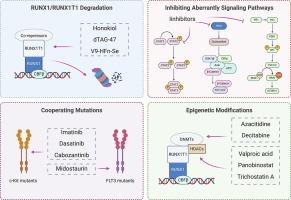
Acute myeloid leukemia (AML) is a highly heterogeneous and aggressive blood cancer. Genetic abnormalities, such as the t(8;21) rearrangement, play a significant role in AML onset. This rearrangement leads to the formation of the RUNX1/RUNX1T1 fusion protein, disrupting gene regulation and genomic stability, ultimately causing full-blown leukemia. Despite a generally favorable prognosis, t(8;21) patients face relapse and chemotherapy resistance, particularly when harboring cooperating mutations. While advances in cellular genetics and molecular biology have improved AML treatment, there are currently no specific targeted therapies against RUNX1/RUNX1T1. Therefore, investigating targeted therapies for this AML subtype holds promise for patients. This review explores the complex landscape of t(8;21) AML, unravels the molecular mechanisms of RUNX1/RUNX1T1-driven leukemogenesis, and discusses recent advancements in target therapies including small molecule drugs and PROTAC. Our goal is to develop more effective and less toxic strategies for managing t(8;21) AML patients.
期刊介绍:
Biochemical Pharmacology publishes original research findings, Commentaries and review articles related to the elucidation of cellular and tissue function(s) at the biochemical and molecular levels, the modification of cellular phenotype(s) by genetic, transcriptional/translational or drug/compound-induced modifications, as well as the pharmacodynamics and pharmacokinetics of xenobiotics and drugs, the latter including both small molecules and biologics.
The journal''s target audience includes scientists engaged in the identification and study of the mechanisms of action of xenobiotics, biologics and drugs and in the drug discovery and development process.
All areas of cellular biology and cellular, tissue/organ and whole animal pharmacology fall within the scope of the journal. Drug classes covered include anti-infectives, anti-inflammatory agents, chemotherapeutics, cardiovascular, endocrinological, immunological, metabolic, neurological and psychiatric drugs, as well as research on drug metabolism and kinetics. While medicinal chemistry is a topic of complimentary interest, manuscripts in this area must contain sufficient biological data to characterize pharmacologically the compounds reported. Submissions describing work focused predominately on chemical synthesis and molecular modeling will not be considered for review.
While particular emphasis is placed on reporting the results of molecular and biochemical studies, research involving the use of tissue and animal models of human pathophysiology and toxicology is of interest to the extent that it helps define drug mechanisms of action, safety and efficacy.



 京公网安备 11010802042870号
京ICP备2023020795号-1
京公网安备 11010802042870号
京ICP备2023020795号-1

 分享
分享
 求助内容:
求助内容: 应助结果提醒方式:
 扫码关注我们
