Nikolaos Nagkoulis , Christos Adam , Ioannis Mamoutos , Stelios Katsanevakis , Antonios D. Mazaris
{"title":"An ecological connectivity dataset for Black Sea obtained from sea currents","authors":"Nikolaos Nagkoulis , Christos Adam , Ioannis Mamoutos , Stelios Katsanevakis , Antonios D. Mazaris","doi":"10.1016/j.dib.2024.111268","DOIUrl":null,"url":null,"abstract":"<div><div>Incorporating ecological connectivity into spatial conservation planning is increasingly recognized as a key strategy to facilitate species movements, especially under changing environmental conditions. However, obtaining connectivity data is challenging, especially in the marine realm. Sea currents are essential for exploring marine structural connectivity, but transforming sea current data into spatial connectivity matrices involves complex and resource-intensive processing steps to ensure accuracy and usability. Here, an applied a graph-based methodology has been developed to transform current data into formats suitable for delineating ecological corridors and applied to Black Sea. The dataset produced can be integrated to spatial conservation prioritization tools to incorporate connectivity in the analysis. This approach involved converting current centroids into points and projecting current directions and magnitudes onto a nearest-neighbour graph connecting these points. Using open-source data from the Copernicus Black Sea Physics Reanalysis dataset from 1993 to 2023, a high-resolution dataset of graph objects (edge lists) and shapefiles (points and edges) for the Black Sea has been created. Analyses were conducted in R, and the algorithm developed to produce the data is accessible on Zenodo. The resulting datasets are compatible with multiple software platforms (e.g., R, Python, and QGIS). A total of 17 datasets are provided from 1993 to 2023: twelve for monthly, four for seasonal, and one for yearly aggregation, supporting diverse spatial and temporal analysis needs. Overall, the datasets can be used to analyse connectivity patterns across the entire Black Sea or focus on specific regions, particularly useful for ecological modelling, and environmental protection purposes.</div></div>","PeriodicalId":10973,"journal":{"name":"Data in Brief","volume":"58 ","pages":"Article 111268"},"PeriodicalIF":1.4000,"publicationDate":"2025-02-01","publicationTypes":"Journal Article","fieldsOfStudy":null,"isOpenAccess":false,"openAccessPdf":"https://www.ncbi.nlm.nih.gov/pmc/articles/PMC11763243/pdf/","citationCount":"0","resultStr":null,"platform":"Semanticscholar","paperid":null,"PeriodicalName":"Data in Brief","FirstCategoryId":"1085","ListUrlMain":"https://www.sciencedirect.com/science/article/pii/S2352340924012307","RegionNum":0,"RegionCategory":null,"ArticlePicture":[],"TitleCN":null,"AbstractTextCN":null,"PMCID":null,"EPubDate":"","PubModel":"","JCR":"Q3","JCRName":"MULTIDISCIPLINARY SCIENCES","Score":null,"Total":0}
引用次数: 0
Abstract
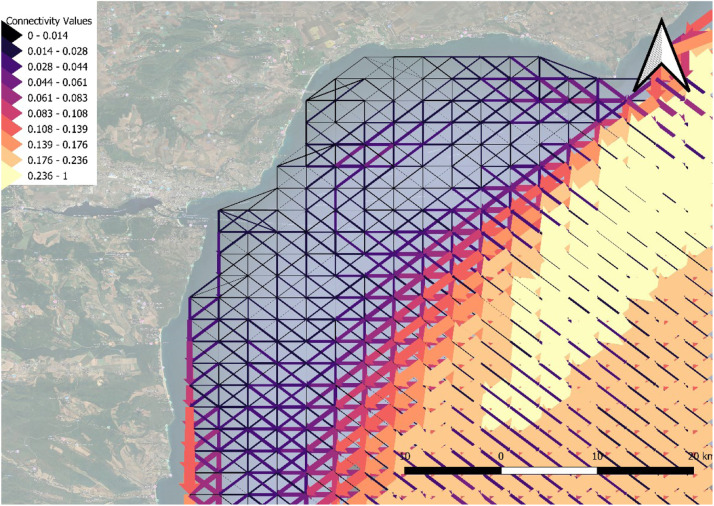
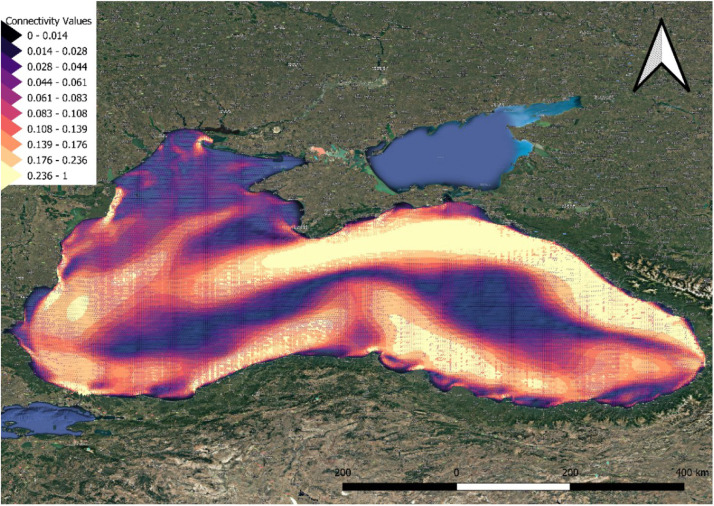
Incorporating ecological connectivity into spatial conservation planning is increasingly recognized as a key strategy to facilitate species movements, especially under changing environmental conditions. However, obtaining connectivity data is challenging, especially in the marine realm. Sea currents are essential for exploring marine structural connectivity, but transforming sea current data into spatial connectivity matrices involves complex and resource-intensive processing steps to ensure accuracy and usability. Here, an applied a graph-based methodology has been developed to transform current data into formats suitable for delineating ecological corridors and applied to Black Sea. The dataset produced can be integrated to spatial conservation prioritization tools to incorporate connectivity in the analysis. This approach involved converting current centroids into points and projecting current directions and magnitudes onto a nearest-neighbour graph connecting these points. Using open-source data from the Copernicus Black Sea Physics Reanalysis dataset from 1993 to 2023, a high-resolution dataset of graph objects (edge lists) and shapefiles (points and edges) for the Black Sea has been created. Analyses were conducted in R, and the algorithm developed to produce the data is accessible on Zenodo. The resulting datasets are compatible with multiple software platforms (e.g., R, Python, and QGIS). A total of 17 datasets are provided from 1993 to 2023: twelve for monthly, four for seasonal, and one for yearly aggregation, supporting diverse spatial and temporal analysis needs. Overall, the datasets can be used to analyse connectivity patterns across the entire Black Sea or focus on specific regions, particularly useful for ecological modelling, and environmental protection purposes.
期刊介绍:
Data in Brief provides a way for researchers to easily share and reuse each other''s datasets by publishing data articles that: -Thoroughly describe your data, facilitating reproducibility. -Make your data, which is often buried in supplementary material, easier to find. -Increase traffic towards associated research articles and data, leading to more citations. -Open up doors for new collaborations. Because you never know what data will be useful to someone else, Data in Brief welcomes submissions that describe data from all research areas.





 京公网安备 11010802042870号
京ICP备2023020795号-1
京公网安备 11010802042870号
京ICP备2023020795号-1

 分享
分享
 求助内容:
求助内容: 应助结果提醒方式:
 扫码关注我们
