{"title":"Study of the impact on emissions and engine performance of diesel fuel additives made from cotton and castor blended seed oils.","authors":"Hailegebrel Zewdie Woldetensy, Dinku Seyoum Zeleke, Getachew Shunki Tibba","doi":"10.1016/j.heliyon.2025.e41659","DOIUrl":null,"url":null,"abstract":"<p><p>Many approaches have been implemented in order to reduce the emissions of particular pollutants without compromising engine performance. Cotton and castor mixed seed oil was chosen for the current study due to their distinct fatty acid composition and potential as a feedstock for bio-additives. Three fuel samples-99 % diesel and 1 % blended fuel (cottonseed oil + castor seed oil), 99.50 % diesel and 0.50 % (cottonseed oil + castor seed oil) blended fuel, and 100 % diesel fuel-are examined. Gas chromatography was used to assess the fatty acid makeup of the substances under investigation. A TBMC8 test bench was used to measure the performance and exhaust emissions characteristics of the diesel fuel containing additives of cotton and castor seed oil. Brake-specific fuel consumption (BSFC), brake thermal efficiency (BTE), engine torque, and emission characteristics of the diesel with additives are measured by adjusting an engine load at 0 %, 20 %, 40 %, 60 %, and 80 %. For D99 (cottonseed oil + castor seed oil) 1, BSFC, BTE, and engine torque at 20 % engine load are 0.757 kg/kWh, 32.98 %, and increased by 1.1 %, respectively. When engine load increased, BSFC slightly increased by 1.1 %. Unlikely, as an engine load increases, there is a modest drop in both BTE and engine torque. Due to the increased oxygen content of bio-additives, which aids in CO oxidization during combustion, carbon monoxide (CO) emissions have dropped by 1.5 % for engine loads ranging from 0 % to 80 %. The higher oxygen content of biodiesel significantly reduced CO emissions, however higher oxygen percentages in blends of biodiesel led to a rise in CO2 emissions. Because cotton and castor blended additives ignited more quickly, NOx increased. Nevertheless, all fall within the allowed range of the ASTM standard.</p>","PeriodicalId":12894,"journal":{"name":"Heliyon","volume":"11 1","pages":"e41659"},"PeriodicalIF":3.6000,"publicationDate":"2025-01-02","publicationTypes":"Journal Article","fieldsOfStudy":null,"isOpenAccess":false,"openAccessPdf":"https://www.ncbi.nlm.nih.gov/pmc/articles/PMC11757774/pdf/","citationCount":"0","resultStr":null,"platform":"Semanticscholar","paperid":null,"PeriodicalName":"Heliyon","FirstCategoryId":"103","ListUrlMain":"https://doi.org/10.1016/j.heliyon.2025.e41659","RegionNum":3,"RegionCategory":"综合性期刊","ArticlePicture":[],"TitleCN":null,"AbstractTextCN":null,"PMCID":null,"EPubDate":"2025/1/15 0:00:00","PubModel":"eCollection","JCR":"Q1","JCRName":"MULTIDISCIPLINARY SCIENCES","Score":null,"Total":0}
引用次数: 0
Abstract
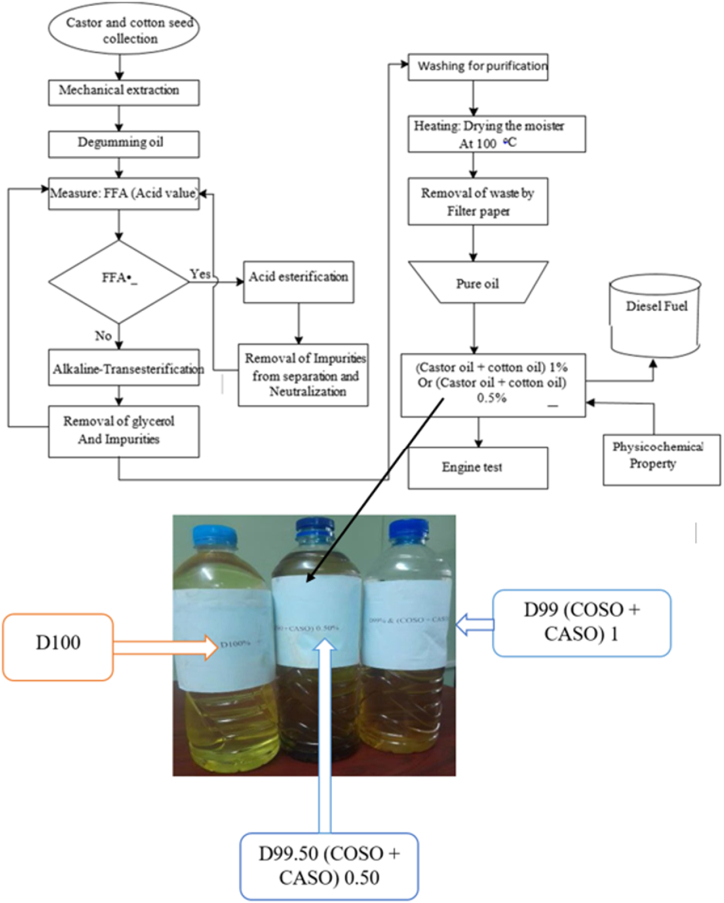
Many approaches have been implemented in order to reduce the emissions of particular pollutants without compromising engine performance. Cotton and castor mixed seed oil was chosen for the current study due to their distinct fatty acid composition and potential as a feedstock for bio-additives. Three fuel samples-99 % diesel and 1 % blended fuel (cottonseed oil + castor seed oil), 99.50 % diesel and 0.50 % (cottonseed oil + castor seed oil) blended fuel, and 100 % diesel fuel-are examined. Gas chromatography was used to assess the fatty acid makeup of the substances under investigation. A TBMC8 test bench was used to measure the performance and exhaust emissions characteristics of the diesel fuel containing additives of cotton and castor seed oil. Brake-specific fuel consumption (BSFC), brake thermal efficiency (BTE), engine torque, and emission characteristics of the diesel with additives are measured by adjusting an engine load at 0 %, 20 %, 40 %, 60 %, and 80 %. For D99 (cottonseed oil + castor seed oil) 1, BSFC, BTE, and engine torque at 20 % engine load are 0.757 kg/kWh, 32.98 %, and increased by 1.1 %, respectively. When engine load increased, BSFC slightly increased by 1.1 %. Unlikely, as an engine load increases, there is a modest drop in both BTE and engine torque. Due to the increased oxygen content of bio-additives, which aids in CO oxidization during combustion, carbon monoxide (CO) emissions have dropped by 1.5 % for engine loads ranging from 0 % to 80 %. The higher oxygen content of biodiesel significantly reduced CO emissions, however higher oxygen percentages in blends of biodiesel led to a rise in CO2 emissions. Because cotton and castor blended additives ignited more quickly, NOx increased. Nevertheless, all fall within the allowed range of the ASTM standard.
期刊介绍:
Heliyon is an all-science, open access journal that is part of the Cell Press family. Any paper reporting scientifically accurate and valuable research, which adheres to accepted ethical and scientific publishing standards, will be considered for publication. Our growing team of dedicated section editors, along with our in-house team, handle your paper and manage the publication process end-to-end, giving your research the editorial support it deserves.






 京公网安备 11010802042870号
京ICP备2023020795号-1
京公网安备 11010802042870号
京ICP备2023020795号-1

 分享
分享
 求助内容:
求助内容: 应助结果提醒方式:
 扫码关注我们
