Molecular characterization and genome sequencing of selected highly resistant clinical isolates of Pseudomonas aeruginosa and its association with the clustered regularly interspaced palindromic repeat/Cas system.
{"title":"Molecular characterization and genome sequencing of selected highly resistant clinical isolates of <i>Pseudomonas aeruginosa</i> and its association with the clustered regularly interspaced palindromic repeat/Cas system.","authors":"Hekmat A Owaid, Mushtak T S Al-Ouqaili","doi":"10.1016/j.heliyon.2025.e41670","DOIUrl":null,"url":null,"abstract":"<p><p>The presence of the clustered regularly interspaced short palindromic repeats (CRISPR)/Cas system in the superbug <i>Pseudomonas (P) aeruginosa</i> presents a unique opportunity to precisely target and edit bacterial genomes to modify their drug resistance. The objective was to detect the prevalence of CRISPR in extensively and pan-drug-resistant <i>Pseudomonas aeruginosa</i> and to determine the utility of whole-genome sequencing (WGS) for the analysis of the entire genome for such strains. The antimicrobial susceptibilities of one hundred isolates were assessed using the antibiotic susceptibility test (AST) card of the VITEK system. The presence of the CRISPR/Cas system was determined via specific primers using conventional polymerase chain reaction (PCR). Further, WGS was conducted using a DNA nanoball sequencing platform via BGI-Tech for the isolates of interest. Out of 54 resistant <i>Pseudomonas aeruginosa</i> isolates<i>,</i> 33 (33.0 %) were metallo-β-lactamase producers. Cas1, Cas3, CRISPR1, and CRISPR2 were positive in 6.0 % of isolates, while incomplete CRISPR1-Cas systems alone were found in 15.0 %. Also, CRISPR2-type was found intact in 26 % of isolates. The prevalence of resistance to antimicrobials in <i>P. aeruginosa</i> isolates was significantly greater in the CRISPR/Cas-negative group compared to the CRISPR/Cas-positive. Significant relationships for variables were examined using Fisher's exact tests using Chi-squared and a P-value of <0.05 as a statistical threshold. Further, on examination of CRs as a collective entity, encompassing both extensive drug resistance (XDR) and pan-drug resistance (PDR), it becomes evident that the vast majority of these strains (n = 29; 87.8 %) lacked CRISPR/Cas systems. In phylogenic analysis, PDR-<i>P. aeruginosa</i> revealed a very close evolutionary relationship with those originating from Kazakhstan, while XDR was globally unique. Further, the entire genome showed the presence of unique virulence and resistant pseudomonal genes. The CRISPR/Cas system and drug resistance are antagonistic to one another. XDR and PDR <i>P. aeruginosa</i> represent a potential threat to public health and contribute to the seriousness of associated illnesses by leading to resistant infections. Further, WGS for the two strains revealed resistance to multiple antibiotics. It is important to examine specific antimicrobial resistance (AMR) pathways, which suggests that a significant number of resistant genes in these isolates indicate a loss of CRISPR genes in the two strains. Furthermore, the WGS approach can lead to a better understanding of the genomic mechanism of pseudomonal resistance to antibiotics.</p>","PeriodicalId":12894,"journal":{"name":"Heliyon","volume":"11 1","pages":"e41670"},"PeriodicalIF":3.6000,"publicationDate":"2025-01-06","publicationTypes":"Journal Article","fieldsOfStudy":null,"isOpenAccess":false,"openAccessPdf":"https://www.ncbi.nlm.nih.gov/pmc/articles/PMC11761341/pdf/","citationCount":"0","resultStr":null,"platform":"Semanticscholar","paperid":null,"PeriodicalName":"Heliyon","FirstCategoryId":"103","ListUrlMain":"https://doi.org/10.1016/j.heliyon.2025.e41670","RegionNum":3,"RegionCategory":"综合性期刊","ArticlePicture":[],"TitleCN":null,"AbstractTextCN":null,"PMCID":null,"EPubDate":"2025/1/15 0:00:00","PubModel":"eCollection","JCR":"Q1","JCRName":"MULTIDISCIPLINARY SCIENCES","Score":null,"Total":0}
引用次数: 0
Abstract
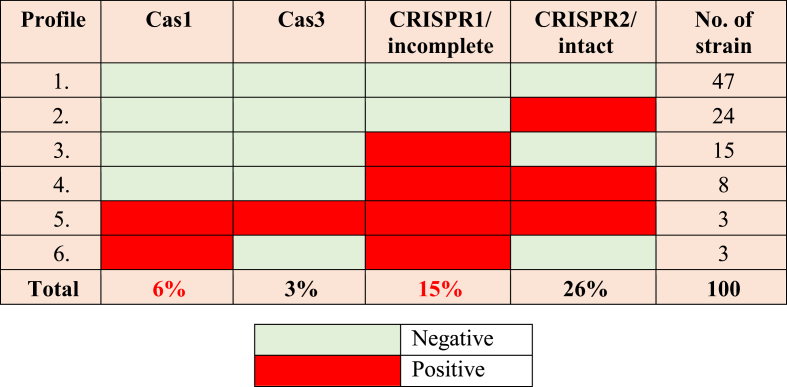
The presence of the clustered regularly interspaced short palindromic repeats (CRISPR)/Cas system in the superbug Pseudomonas (P) aeruginosa presents a unique opportunity to precisely target and edit bacterial genomes to modify their drug resistance. The objective was to detect the prevalence of CRISPR in extensively and pan-drug-resistant Pseudomonas aeruginosa and to determine the utility of whole-genome sequencing (WGS) for the analysis of the entire genome for such strains. The antimicrobial susceptibilities of one hundred isolates were assessed using the antibiotic susceptibility test (AST) card of the VITEK system. The presence of the CRISPR/Cas system was determined via specific primers using conventional polymerase chain reaction (PCR). Further, WGS was conducted using a DNA nanoball sequencing platform via BGI-Tech for the isolates of interest. Out of 54 resistant Pseudomonas aeruginosa isolates, 33 (33.0 %) were metallo-β-lactamase producers. Cas1, Cas3, CRISPR1, and CRISPR2 were positive in 6.0 % of isolates, while incomplete CRISPR1-Cas systems alone were found in 15.0 %. Also, CRISPR2-type was found intact in 26 % of isolates. The prevalence of resistance to antimicrobials in P. aeruginosa isolates was significantly greater in the CRISPR/Cas-negative group compared to the CRISPR/Cas-positive. Significant relationships for variables were examined using Fisher's exact tests using Chi-squared and a P-value of <0.05 as a statistical threshold. Further, on examination of CRs as a collective entity, encompassing both extensive drug resistance (XDR) and pan-drug resistance (PDR), it becomes evident that the vast majority of these strains (n = 29; 87.8 %) lacked CRISPR/Cas systems. In phylogenic analysis, PDR-P. aeruginosa revealed a very close evolutionary relationship with those originating from Kazakhstan, while XDR was globally unique. Further, the entire genome showed the presence of unique virulence and resistant pseudomonal genes. The CRISPR/Cas system and drug resistance are antagonistic to one another. XDR and PDR P. aeruginosa represent a potential threat to public health and contribute to the seriousness of associated illnesses by leading to resistant infections. Further, WGS for the two strains revealed resistance to multiple antibiotics. It is important to examine specific antimicrobial resistance (AMR) pathways, which suggests that a significant number of resistant genes in these isolates indicate a loss of CRISPR genes in the two strains. Furthermore, the WGS approach can lead to a better understanding of the genomic mechanism of pseudomonal resistance to antibiotics.
期刊介绍:
Heliyon is an all-science, open access journal that is part of the Cell Press family. Any paper reporting scientifically accurate and valuable research, which adheres to accepted ethical and scientific publishing standards, will be considered for publication. Our growing team of dedicated section editors, along with our in-house team, handle your paper and manage the publication process end-to-end, giving your research the editorial support it deserves.






 京公网安备 11010802042870号
京ICP备2023020795号-1
京公网安备 11010802042870号
京ICP备2023020795号-1

 分享
分享
 求助内容:
求助内容: 应助结果提醒方式:
 扫码关注我们
